Calle Marqués de Larios
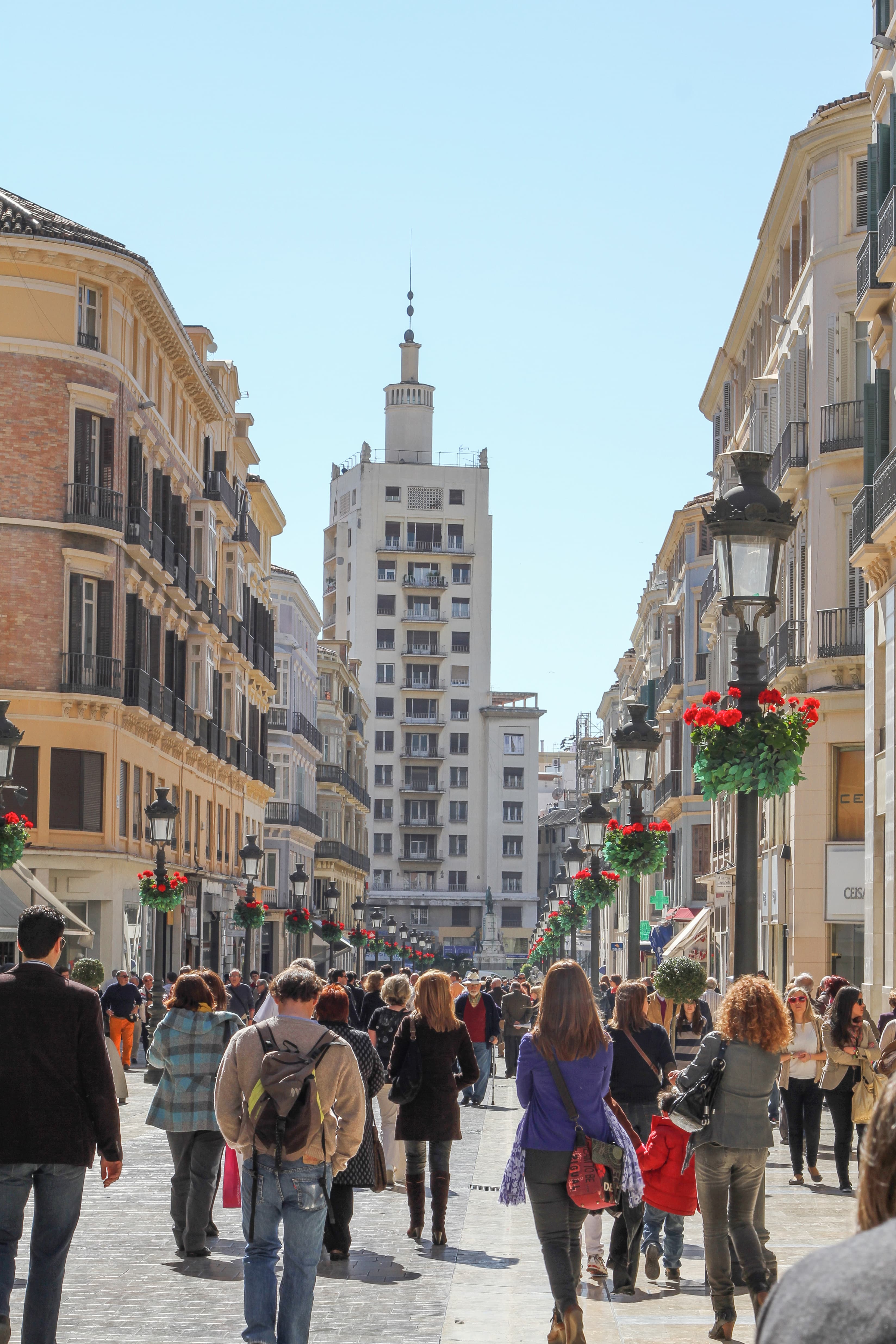
A 300-metre pedestrian artery inaugurated on 27 August 1891 and pedestrianised in 2002, it is the commercial and social heart of Málaga. Its 19th-century limestone buildings frame shops and terraces all the way to Plaza de la Constitución. An essential backdrop for the August Fiestas and Málaga's Holy Week. Free access.
The essentials
- Tickets
- Gratis
A street that is Málaga's living room
Larios is the backbone of central Málaga: 300 straight, pedestrianised metres of ivory marble connecting Plaza de la Constitución with the Alameda Principal. It's not a monument you enter — it's where everyone passes through, which is exactly why it's worth slowing down rather than rushing across. What makes it special is up high: identical façades with rounded corners (curved chamfers), wrought-iron balconies and a metal framework that was pure modernity in 1891. Notice the proportions: the buildings stand about 16 metres tall, almost the same as the street's width, creating that unmistakable symmetrical corridor effect. It opened on 27 August 1891 after more than four years of construction, largely funded by the marquis whose name it bears, built over medieval Arab lanes that were demolished to make way for it. One detail almost nobody knows: until 1907 the surface was wooden decking, laid to muffle the noise of carriages and give the street the feel of a ballroom.
Free, always open — and how to dodge the crowds
There's no ticket, no desk, no booking: it's a public pedestrian space open around the clock, with free and unrestricted access. The shops lining it open Monday to Saturday, roughly 10:00 to 21:00–21:30 (many close Sundays except public holidays), and the terraces stretch past midnight in summer. Allow 1 hour to stroll at leisure, sit at a terrace and take in the architecture; add the Plaza de la Constitución and the side streets and budget 2 hours. The insider tip: go early. Before 10:00–10:30, or on a weekday morning, you'll almost have it to yourself. The hours to avoid are 11:00–14:00 and 17:00–20:00 at weekends and in summer. During the Feria de Málaga (August) and Semana Santa the street is packed at any hour: if you want quiet those days, you'll only find it before 09:30 or after 22:00. And if you're there at Christmas, come back at night — the LED light display puts on a sound-and-light show three times each evening (around 18:30, 20:00 and 22:00).
Getting there and four practical tips
The easiest option is the metro: Line 1 (L1), Atarazanas stop, on the Alameda Principal — from there it's a 5-minute walk along the Alameda to the start of the street. If you're on L2, change at El Perchel to L1. By city bus (EMT) lines 19, 25, 27, 7, M-110 and M-160 serve the area; the Paseo del Parque – Plaza Marina stop is 4 minutes away. On Cercanías Renfe (C-1 and C-2), get off at Málaga-Centro Alameda and walk roughly 10 minutes along the Alameda. If you're already at the Port or Plaza de la Marina it's a 3–5-minute walk; from the Alcazaba, about 10. The street is completely flat, making it ideal for wheelchairs or pushchairs. Two more things: in August and during Semana Santa the centre of the street can be very slow-going, so stick to the sides; and as pavement maintenance works crop up occasionally, it's worth checking the City Council website (ayto-malaga.es) for any closures on the day of your visit.
Frequently asked questions
Do I need to pay or book to visit Calle Larios?
How long do I need to see it?
What's the best time to avoid the crowds?
Some links on this page are affiliate links: if you book through them, Andelaria may earn a commission at no extra cost to you. Transparency & affiliate policy
Book tickets and tours: Calle Marqués de Larios· GratisPlan your trip
Book the essentials for your trip to Málaga.
Other places in Málaga
Alcazaba de Málaga
alcazabaAn 11th-century Arab fortress declared a Historic-Artistic Monument in 1931, with 110 towers and three walled enclosures rising from the Roman theatre up to the Nasrid palace. Built under the Zirid taifa of Badis (1056), its inner gardens and pools rival those of the Alhambra. Entrance: €7 (combined with Gibralfaro: €10); free on Sundays from 2 pm.
Catedral de la Encarnación (La Manquita)
catedralA Renaissance cathedral begun in 1528 on the site of the former main mosque, with Gothic and Baroque touches. Málaga locals call it 'La Manquita' because its south tower was never finished; the north tower reaches 84 metres, the second tallest in Andalusia after the Giralda. Entrance: €6; with rooftop access: €10.
Castillo de Gibralfaro
castilloA 14th-century Muslim fortress perched 130 metres above the sea, connected to the Alcazaba by the 'coracha' wall. From its battlements you command views of the Port, La Malagueta and the whole bay. A museum room on its military history was opened in 2003. Entrance: €7 (combined with the Alcazaba: €10); free on Sundays from 2 pm.
Museo Picasso Málaga
museoInaugurated by the King and Queen of Spain in October 2003, it occupies the 16th-century Palacio Buenavista in the historic centre. It houses 285 works donated by the Picasso family, covering every period of the Málaga-born genius's career, from his academic studies to late Cubism. Entrance: €13 (audio guide included).
Centro de Arte Contemporáneo de Málaga (CAC)
museoMálaga's only museum dedicated entirely to 20th- and 21st-century art, housed in the former Wholesale Market of 1939 (architects Gutiérrez Soto and Jáuregui). It hosts temporary exhibitions by international artists such as Louise Bourgeois and Marc Quinn in a Rationalist building with a triangular floor plan. Free admission.
Semana Santa en Málaga
fiestaMálaga's Holy Week fills the historic centre with floats weighing up to 4,200 kg, carried by hundreds of men and women bearers. It is free and street-based: from Palm Sunday to Easter Sunday (in 2026, 29 March to 5 April). Its distinctive sound — bugles and drums — was born here in 1911.
Feria de Málaga (Feria de Agosto)
fiestaThe Feria de Málaga is actually two free fairs in one: the daytime fair in the city centre (Calle Larios, 12:00–18:00) and the nighttime fair at the Real del Cortijo de Torres, with around 120 casetas (marquees) with free entry. In 2026 it runs from 15 to 22 August, commemorating the entry of the Catholic Monarchs into Málaga in 1487.
Festival de Málaga — Cine en Español
fiestaThe Málaga Festival is Spain's leading Spanish-language film festival after San Sebastián. Its 29th edition ran from 6 to 15 March 2026 and drew around 111,000 attendees. It is a ticketed event: galas and screenings require a paid entry, except for the free summer programme Cine Abierto.
Noche en Blanco de Málaga
fiestaMálaga's Noche en Blanco is a free nocturnal festival that opens museums, monuments and city-centre streets for a single night. Its 2026 edition (the 17th, held on 16 May, from 20:00 to 01:00) brought together around 150 art, music and dance events across nearly a hundred venues, all free to enter.
Similar places in other cities
Plaza de España
SevillaA monumental neo-Renaissance and neo-Moorish semicircle built for the 1929 Ibero-American Exposition in the Parque de María Luisa. Its 48 tiled benches represent every Spanish province. The central canal invites boat rides, and its bridges and north and south towers make for perfect photographs at sunrise.
Puerta del Sol
MadridKilometre zero for all of Spain's radial roads, the Puerta del Sol is the symbolic epicentre of Madrid and of the country. The 18th-century Real Casa de Correos, the bear and the strawberry tree — the city's heraldic emblem — and the twelve New Year's Eve chimes make it an unmissable landmark for any visitor.
Praça do Comércio
LisboaThe grand riverside square of the Baixa, opening onto the Tagus beneath the Arco da Rua Augusta and the equestrian statue of King José I.