Plaza de España
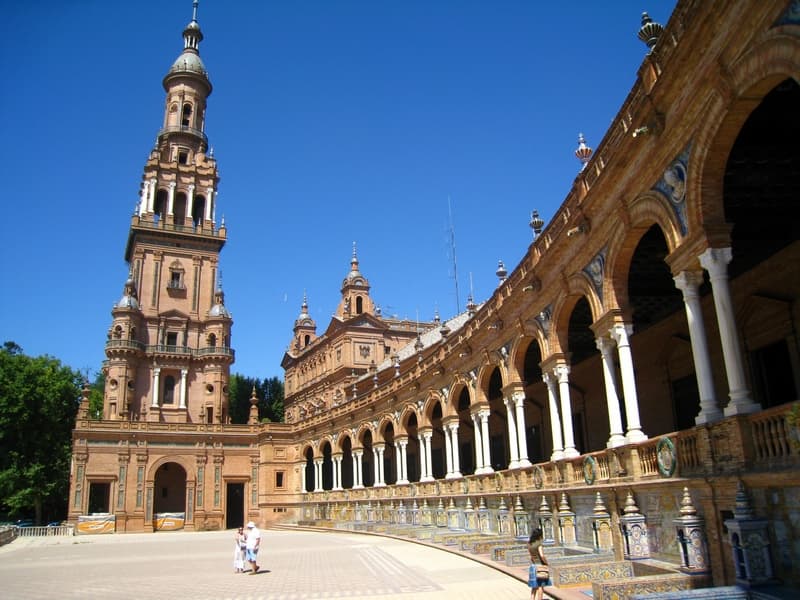
A monumental neo-Renaissance and neo-Moorish semicircle built for the 1929 Ibero-American Exposition in the Parque de María Luisa. Its 48 tiled benches represent every Spanish province. The central canal invites boat rides, and its bridges and north and south towers make for perfect photographs at sunrise.
The essentials
- Tickets
- Gratis
What it is and why it's genuinely worth your time
Seville's Plaza de España, set within Parque de María Luisa, is no ordinary square: it's a grand 200-metre semicircle designed by local architect Aníbal González for the 1929 Ibero-American Exposition. Construction began in 1914 and took 15 years. What makes it special are the details you only notice up close: 48 tiled benches, one for each Spanish province of the time, each featuring a hand-painted map and a historical scene. You can play your own "provinces trail" hunting for your region. The 515-metre canal is crossed by four bridges representing the ancient kingdoms of Castile, León, Aragon and Navarre, while two 74-metre towers frame the whole ensemble. If it looks familiar, that's because it has starred on screen: Lawrence of Arabia (1962) and Star Wars Episode II (2002), where it stood in for the planet Naboo. It has been a listed Cultural Heritage Site since 2023.
Tickets, opening hours and how to beat the crowds
The outer precinct — which is what most visitors come for (bridges, canal, tiled benches) — is free to enter and requires no booking. Since 2024 there has been ongoing discussion about introducing a small tourist charge, but as of today it has not been implemented; it is worth checking Seville's official tourism website before you travel in case anything changes. Opening hours: low season (November–March) 8:00–22:00, high season (April–October) 8:00–24:00. If you want to row on the canal, boat hire costs around €6 for 35 minutes or €10 for 70 minutes (max. 4 people); rentals run 10:00–20:00 in winter and until 22:00 in summer — call 626 19 75 23 to book. The trick to enjoying it without the crush is to arrive early: between 7:30 and 9:30 you get golden light and almost no tour groups. Avoid 11:00–18:00 in high season, when organised tours descend. Summer sunsets are also excellent for photos with far fewer people than at midday.
How to get there and tips from someone who's been
The easiest option is Metro Line 1 to Prado de San Sebastián: you emerge almost at the park and walk about 5 minutes. The MetroCentro tram (T1) serves the same stop from Plaza Nueva every 7–10 minutes, with a single ticket costing around €1.40. Several urban bus lines also stop here (C2, C3, 3, 6, 34). From the Cathedral it is a pleasant 20–25-minute walk along Paseo de Cristóbal Colón and through the park. There is a continuous cycle lane from the city centre and SEVICI bike-share nearby. Allow 45–60 minutes if you just want to stroll, or 2–3 hours if you add a boat trip, the gallery and unhurried photos. Practical notes: there is no left-luggage facility, the central building only opens for special events, and in July and August midday temperatures exceed 38 °C, making an early-morning or late-afternoon visit almost essential. The entire site is flat and fully accessible for wheelchairs and pushchairs.
Frequently asked questions
How much does it cost to enter the Plaza de España in Seville?
How long do I need to visit it?
What is the best time to avoid the crowds?
Some links on this page are affiliate links: if you book through them, Andelaria may earn a commission at no extra cost to you. Transparency & affiliate policy
Book tickets and tours: Plaza de España· GratisPlan your trip
Book the essentials for your trip to Sevilla.
Other places in Sevilla
Real Alcázar de Sevilla
alcazarThe oldest inhabited royal palace in Europe, a UNESCO World Heritage Site. Its Mudéjar architecture, the tiled Patio de las Doncellas and gardens of fountains and labyrinths make it Seville's essential visit. A filming location for Game of Thrones, it breathes Almohad and Christian history in equal measure.
Catedral de Sevilla y La Giralda
catedralThe largest Gothic cathedral in the world and the third-largest church by floor area, built on the site of the former Almohad mosque. La Giralda, its 97-metre bell tower, is Seville's undisputed symbol. Inside lies the tomb of Christopher Columbus. The ticket includes access to the tower, which has no steps — only ramps.
Barrio de Santa Cruz
barrioThe medieval Jewish quarter of whitewashed alleyways, flower-filled courtyards and squares shaded by orange trees. Nestled beside the Alcázar and the Cathedral, it is the romantic heart of Seville. Wandering streets like Agua or Vida, discovering the Hospital de los Venerables and sitting in the Plaza de Doña Elvira are experiences that capture the very soul of the city.
Torre del Oro
torreA 13th-century Almohad watchtower on the banks of the Guadalquivir, one of Seville's great defensive symbols. Its name comes from the golden tiles that once covered it. It houses the Naval Museum, with historical maps and objects from the American expeditions. The view from Puente de Triana at sunset is breathtaking.
Metropol Parasol (Las Setas)
museoThe largest wooden structure in the world, designed by Jürgen Mayer H. and inaugurated in 2011 in the Plaza de la Encarnación. Its elevated walkways offer the best panoramic views of Seville. At ground level it houses the Antiquarium, with Roman and Arab archaeological remains from the 1st century. Not to be missed at sunset.
Semana Santa de Sevilla
fiestaSeville's Holy Week is free and open to all: you only pay for seats and grandstands along the Official Route. In 2026 it runs from 29 March to 5 April, with the eve celebrations on the 27th. Its peak is La Madrugá, when five major brotherhoods process from 1:00 a.m. until noon.
Feria de Abril de Sevilla
fiestaTwo weeks after Easter, Sevilla sets up its Real in Los Remedios: around 1,059 casetas (up to ~1,250 plots with the expansion), flamenco dresses, horses and sevillanas. Entry is free, but most are private and only accessible with an invitation from a member. Only around 14–16 are open to the public.
Velá de Santiago y Santa Ana
fiestaSeville's oldest festival, with more than 750 years of history, doesn't take place in the city centre — it happens in Triana. The Velá de Santa Ana falls in the last week of July, around the 26th: free casetas along the Guadalquivir, the cucaña grease-pole contest over the river, and not a flamenco dress or equestrian parade in sight.
Cabalgata de Reyes Magos de Sevilla
fiestaEvery January 5th, Seville's Cabalgata de Reyes Magos winds through the city centre with 33 floats and around 100,000 kg of sweets tossed from them. Organised by the Ateneo since 1918, it is one of the oldest in Spain. Entry is free and open to all; the parade lasts about six hours.
Similar places in other cities
Calle Marqués de Larios
MálagaA 300-metre pedestrian artery inaugurated on 27 August 1891 and pedestrianised in 2002, it is the commercial and social heart of Málaga. Its 19th-century limestone buildings frame shops and terraces all the way to Plaza de la Constitución. An essential backdrop for the August Fiestas and Málaga's Holy Week. Free access.
Praça do Comércio
LisboaThe grand riverside square of the Baixa, opening onto the Tagus beneath the Arco da Rua Augusta and the equestrian statue of King José I.
Puerta del Sol
MadridKilometre zero for all of Spain's radial roads, the Puerta del Sol is the symbolic epicentre of Madrid and of the country. The 18th-century Real Casa de Correos, the bear and the strawberry tree — the city's heraldic emblem — and the twelve New Year's Eve chimes make it an unmissable landmark for any visitor.