Semana Santa en Málaga
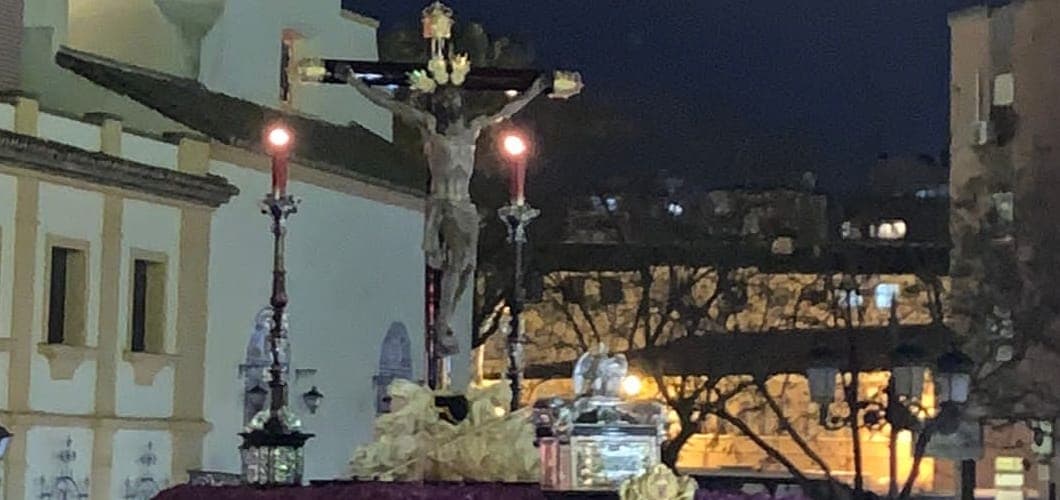
Málaga's Holy Week fills the historic centre with floats weighing up to 4,200 kg, carried by hundreds of men and women bearers. It is free and street-based: from Palm Sunday to Easter Sunday (in 2026, 29 March to 5 April). Its distinctive sound — bugles and drums — was born here in 1911.
What it is and when
Málaga's Semana Santa is a street religious celebration through the historic centre of the city — not a beach party or a fairground event. It follows the moveable rule of the liturgical calendar: it runs from Palm Sunday to Easter Sunday, eight consecutive days. In 2026 it falls on 29 March to 5 April; in 2027 it is expected around 11–18 April. Always check the official website of the Agrupación de Cofradías for the exact daily route and the upcoming edition. It is 100% free and open access: processions pass through public streets and most people watch them standing on the pavement. There are paid grandstands and chairs along the official route (Calle Larios and surroundings), but these are a minority and tend to be expensive. More than 40 brotherhoods take part in processions; the highlights change each day, so it is worth checking the programme before you go.
Tronos and the pulso
Here the floats are not called pasos but tronos, and the difference from Sevilla is radical. The Málaga trono is carried on the outside: the men and women bearers rest their shoulders under the varales — longitudinal poles of up to 12 metres — and walk in full view of the public in several rows. There are no costaleros crouching inside, and no relay system: the same bearers cover the entire route, up to 250 people on the largest tronos. They are enormous: the one bearing the Virgen de Dolores Coronada weighs 4,200 kg and the Esperanza 4,100 kg, among the heaviest in Spain. The highlight unique to Málaga is the pulso: the bearers raise the trono with their arms fully extended above their heads and hold it suspended for several seconds, to the sound of the national anthem. Practical tip: the pulso usually happens at the end of the route, after hours of carrying; if you want to see it, find out where the final stretch is, not the starting point.
Bugles, drums and escorts
The sound of Málaga's Holy Week is bugles and drums: sharp and piercing, very different from the brass bands of Sevilla. And it is a local invention. The Banda del Real Cuerpo de Bomberos was founded here in 1911 (its first processional outing was in 1920) and is considered the mother and master of the genre: from Málaga this style spread to Sevilla and the rest of Spain. Here the bands accompany both the Christ tronos and the Virgin tronos indistinctly, not only the Virgin's. Another sight that surprises visitors: the military escort. The Legión arrives by ship at the port on Holy Thursday and carries on their shoulders the Cristo de la Buena Muerte (the Cristo de Mena), their Holy Patron since 1928; the Parachute Brigade escorts the Cristo de Ánimas de Ciegos on Holy Wednesday. And keep an eye on the balconies: saetas ring out live, without a microphone. Tip: areas with military escorts get very crowded, so arrive with plenty of time.
Where to watch and how to get there
Avoid Calle Larios and the official route if you want to steer clear of tourists, grandstands and long waits: with around 24,000–25,000 chairs installed, free space shrinks considerably, and in 2026 there is a ban on personal folding chairs in the centre from 29 March to 5 April (the Local Police may remove them and a 3-metre clear passage is required). The local's alternative: La Trinidad and El Perchel, the popular cofradía neighbourhoods where El Cautivo — the Señor de Málaga — was born. There the tronos pass closer and without the crowds of the centre. To get there, the metro extends its hours during Holy Week; do not drive into the historic centre as entire streets are closed for days on end. Park on the outskirts and walk 10–15 minutes. A real gotcha: the first brotherhoods on Palm Sunday set off at 9:45 and many people arrive in the afternoon and miss the midday processions. La Pollinica leaves at 9:50 from San Agustín and is only seen by early risers.
Frequently asked questions
When is Málaga's Holy Week?
Is there an entrance fee?
What is La Pollinica and what time does it leave?
Why are the floats called tronos in Málaga and not pasos?
Some links on this page are affiliate links: if you book through them, Andelaria may earn a commission at no extra cost to you. Transparency & affiliate policy
Book tickets and tours: Semana Santa en MálagaPlan your trip
Book the essentials for your trip to Málaga.
Other places in Málaga
Alcazaba de Málaga
alcazabaAn 11th-century Arab fortress declared a Historic-Artistic Monument in 1931, with 110 towers and three walled enclosures rising from the Roman theatre up to the Nasrid palace. Built under the Zirid taifa of Badis (1056), its inner gardens and pools rival those of the Alhambra. Entrance: €7 (combined with Gibralfaro: €10); free on Sundays from 2 pm.
Catedral de la Encarnación (La Manquita)
catedralA Renaissance cathedral begun in 1528 on the site of the former main mosque, with Gothic and Baroque touches. Málaga locals call it 'La Manquita' because its south tower was never finished; the north tower reaches 84 metres, the second tallest in Andalusia after the Giralda. Entrance: €6; with rooftop access: €10.
Castillo de Gibralfaro
castilloA 14th-century Muslim fortress perched 130 metres above the sea, connected to the Alcazaba by the 'coracha' wall. From its battlements you command views of the Port, La Malagueta and the whole bay. A museum room on its military history was opened in 2003. Entrance: €7 (combined with the Alcazaba: €10); free on Sundays from 2 pm.
Museo Picasso Málaga
museoInaugurated by the King and Queen of Spain in October 2003, it occupies the 16th-century Palacio Buenavista in the historic centre. It houses 285 works donated by the Picasso family, covering every period of the Málaga-born genius's career, from his academic studies to late Cubism. Entrance: €13 (audio guide included).
Centro de Arte Contemporáneo de Málaga (CAC)
museoMálaga's only museum dedicated entirely to 20th- and 21st-century art, housed in the former Wholesale Market of 1939 (architects Gutiérrez Soto and Jáuregui). It hosts temporary exhibitions by international artists such as Louise Bourgeois and Marc Quinn in a Rationalist building with a triangular floor plan. Free admission.
Calle Marqués de Larios
plazaA 300-metre pedestrian artery inaugurated on 27 August 1891 and pedestrianised in 2002, it is the commercial and social heart of Málaga. Its 19th-century limestone buildings frame shops and terraces all the way to Plaza de la Constitución. An essential backdrop for the August Fiestas and Málaga's Holy Week. Free access.
Feria de Málaga (Feria de Agosto)
fiestaThe Feria de Málaga is actually two free fairs in one: the daytime fair in the city centre (Calle Larios, 12:00–18:00) and the nighttime fair at the Real del Cortijo de Torres, with around 120 casetas (marquees) with free entry. In 2026 it runs from 15 to 22 August, commemorating the entry of the Catholic Monarchs into Málaga in 1487.
Festival de Málaga — Cine en Español
fiestaThe Málaga Festival is Spain's leading Spanish-language film festival after San Sebastián. Its 29th edition ran from 6 to 15 March 2026 and drew around 111,000 attendees. It is a ticketed event: galas and screenings require a paid entry, except for the free summer programme Cine Abierto.
Similar places in other cities
Fiestas del Corpus de Granada
GranadaCorpus Christi is Granada's biggest festival: a full week of free fairground festivities centred on a Thursday with a moveable date (60 days after Easter, almost always between late May and early June). The procession of the Custodia, fairground casetas in Almanjáyar, the Tarasca figure and the satirical Carocas panels in Bib-Rambla.
Semana Santa de Granada
GranadaGranada's Semana Santa brings together 32 brotherhoods, 58 floats and more than 2,000 costaleros, and holds the title of Festival of International Tourist Interest. It is free and open to anyone on the street. Its hallmark is quiet devotion: the Silencio de la Madrugá moves through darkness to the beat of a single drum, with the Alhambra as a backdrop.
Festival Internacional de Música y Danza de Granada
GranadaFounded in 1952, the Granada International Festival of Music and Dance is one of the oldest classical music festivals in Europe. Every summer, between June and July, it stages classical music, flamenco, and dance at the Palacio de Carlos V and the Generalife, within the Alhambra. It is a ticketed event: entry must be purchased in advance.