Fiestas del Corpus de Granada
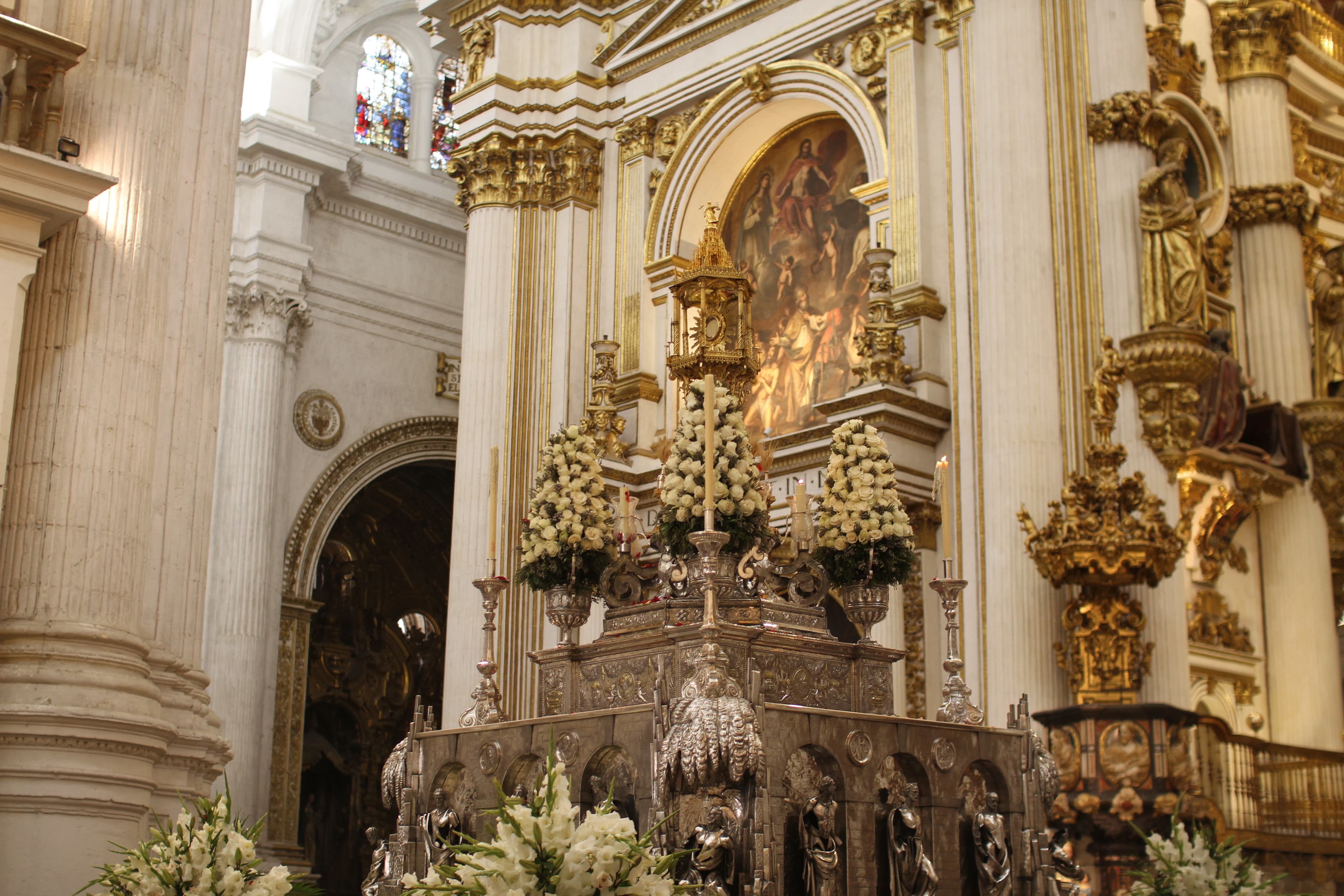
Corpus Christi is Granada's biggest festival: a full week of free fairground festivities centred on a Thursday with a moveable date (60 days after Easter, almost always between late May and early June). The procession of the Custodia, fairground casetas in Almanjáyar, the Tarasca figure and the satirical Carocas panels in Bib-Rambla.
What is Corpus Christi and where does it come from
Corpus Christi is Granada's greatest celebration, and its roots go back to the Christian conquest: the Catholic Monarchs established it after 1492 to christianise a city that had been Islamic for eight centuries, and in 1501 Queen Isabella donated the gilded silver monstrance — the Custodia — that still leads the procession today. The date is moveable: it always falls on a Thursday, 60 days after Easter Sunday, which places it between late May and mid-June. The festival has two souls that coexist: the religious, with the solemn procession of the Custodia through the historic centre, and the festive, with a fair that runs for nearly a week. Its iconic symbols are the Tarasca — a female mannequin mounted on a dragon that parades on the eve of the feast; its dress is kept secret until that moment and traditionally sets the fashion trend of the summer — and the Carocas, satirical canvases hung in Bib-Rambla bearing witty five-line verses that poke fun at the year's current affairs. One thing worth knowing: this is not a beach festival or a bonfire celebration — it is an inland Andalusian fair.
How to experience it: the fair, the procession and the bullfights
Corpus has four distinct faces. The Real de la Feria is held in Almanjáyar, in the northern part of the city: free-entry casetas with sevillanas, flamenco, rebujito, fried fish, Sacromonte omelette and churros in the early hours, plus fairground rides and music until dawn. During the day, the festivities move into the city centre: at midday in Plaza Bib-Rambla there is a Children's Corpus celebration, the Carocas are unveiled, and on the eve of the main Thursday the Tarasca parade — with giants and big-headed figures — sets off from Plaza del Carmen. The big Thursday brings the procession of the Custodia departing from the Cathedral at around 10:15, led by the Tarasca and followed by the religious cortège in strict hierarchical order. There is also a top-tier bullfighting season at the Plaza de Toros, with ticketed events that routinely sell out. Tip: the Real does not really come alive until nightfall; if you are travelling with children, make the most of the city centre in the morning and head to the fairground in the early afternoon.
Moveable dates, a local public holiday and free entry
Bear this in mind before planning your trip: Corpus has no fixed date. It always falls on a Thursday, 60 days after Easter Sunday, so it shifts every year and usually lands between late May and early June (in 2026 it fell on 4 June; in 2027 it will be Thursday 27 May). The fair runs for around a week centred on that Thursday, which is a LOCAL public holiday in the city of Granada only — not across the province or Spain as a whole — along with 2 January (La Toma). Entry to the Real and to the public casetas (traditional and institutional ones) is free; you only pay for what you consume, plus the fairground rides and the bullfights, which are separately ticketed. Some commercial stalls at the fairground are ordinary pay-to-enter venues. Since the dates and the programme change every edition, always check the official schedule at granada.org before booking anything: the full calendar and a map of the fairground are published there.
Getting there, the heat and practical tips
The Real is in Almanjáyar and public transport is your best friend: the metro stop 'Jaén' (Line 1) is about 200 m from the entrance, and the city council runs six special fair bus lines (around €2 per journey; note that multi-journey passes such as Pase cards are not valid, but the Credibus wallet card is). Driving is strongly discouraged: the northern zone gets badly congested at night and getting out after midnight is slow; there are supervised car parks near Joaquina Eguaras/Casería de Aguirre (around €4–5) and a caravan area, but vehicles parked illegally are towed. The biggest threat is the heat: June in Granada is brutal — in 2025 the average daily maximum reached 37.6 °C — and the medical services treat hundreds of heat-related cases. Bring water, a hat and seek shade, and save the fairground for the evening, when it cools down and the party truly begins. The metro may run on altered timetables during the fair; check before relying on it.
Frequently asked questions
When does the Granada Corpus Christi festival take place?
Do you have to pay to get into the fair?
How do I get to the Real de la Feria without a car?
What are the Tarasca and the Carocas?
Some links on this page are affiliate links: if you book through them, Andelaria may earn a commission at no extra cost to you. Transparency & affiliate policy
Book tickets and tours: Fiestas del Corpus de GranadaPlan your trip
Book the essentials for your trip to Granada.
Other places in Granada
La Alhambra
monumentoNasrid palace-fortress of the kingdom of al-Andalus, taken by the Reyes Católicos in 1492 and declared a UNESCO World Heritage Site in 1984.
El Albaicín y el Mirador de San Nicolás
barrioFormer Moorish quarter of steep streets, a World Heritage Site since 1994, whose Mirador de San Nicolás offers the classic view of the Alhambra against Sierra Nevada.
Catedral de Granada y Capilla Real
catedralA Renaissance complex beside the Capilla Real, begun in 1505, which houses the tombs of the Reyes Católicos Isabel and Fernando.
Sacromonte
barrioA Romani quarter of whitewashed cave dwellings hewn into the hillside of the valle de Valparaíso, birthplace of zambra flamenco since the sixteenth century.
Jardines del Generalife
jardinSummer retreat of the Nasrid sultans, built in the early fourteenth century, whose Patio de la Acequia blends water, jets and gardens in perfect harmony.
Semana Santa de Granada
fiestaGranada's Semana Santa brings together 32 brotherhoods, 58 floats and more than 2,000 costaleros, and holds the title of Festival of International Tourist Interest. It is free and open to anyone on the street. Its hallmark is quiet devotion: the Silencio de la Madrugá moves through darkness to the beat of a single drum, with the Alhambra as a backdrop.
Festival Internacional de Música y Danza de Granada
fiestaFounded in 1952, the Granada International Festival of Music and Dance is one of the oldest classical music festivals in Europe. Every summer, between June and July, it stages classical music, flamenco, and dance at the Palacio de Carlos V and the Generalife, within the Alhambra. It is a ticketed event: entry must be purchased in advance.
Similar places in other cities
Semana Santa en Málaga
MálagaMálaga's Holy Week fills the historic centre with floats weighing up to 4,200 kg, carried by hundreds of men and women bearers. It is free and street-based: from Palm Sunday to Easter Sunday (in 2026, 29 March to 5 April). Its distinctive sound — bugles and drums — was born here in 1911.
Feria de Málaga (Feria de Agosto)
MálagaThe Feria de Málaga is actually two free fairs in one: the daytime fair in the city centre (Calle Larios, 12:00–18:00) and the nighttime fair at the Real del Cortijo de Torres, with around 120 casetas (marquees) with free entry. In 2026 it runs from 15 to 22 August, commemorating the entry of the Catholic Monarchs into Málaga in 1487.
Festival de Málaga — Cine en Español
MálagaThe Málaga Festival is Spain's leading Spanish-language film festival after San Sebastián. Its 29th edition ran from 6 to 15 March 2026 and drew around 111,000 attendees. It is a ticketed event: galas and screenings require a paid entry, except for the free summer programme Cine Abierto.