Semana Santa de Córdoba
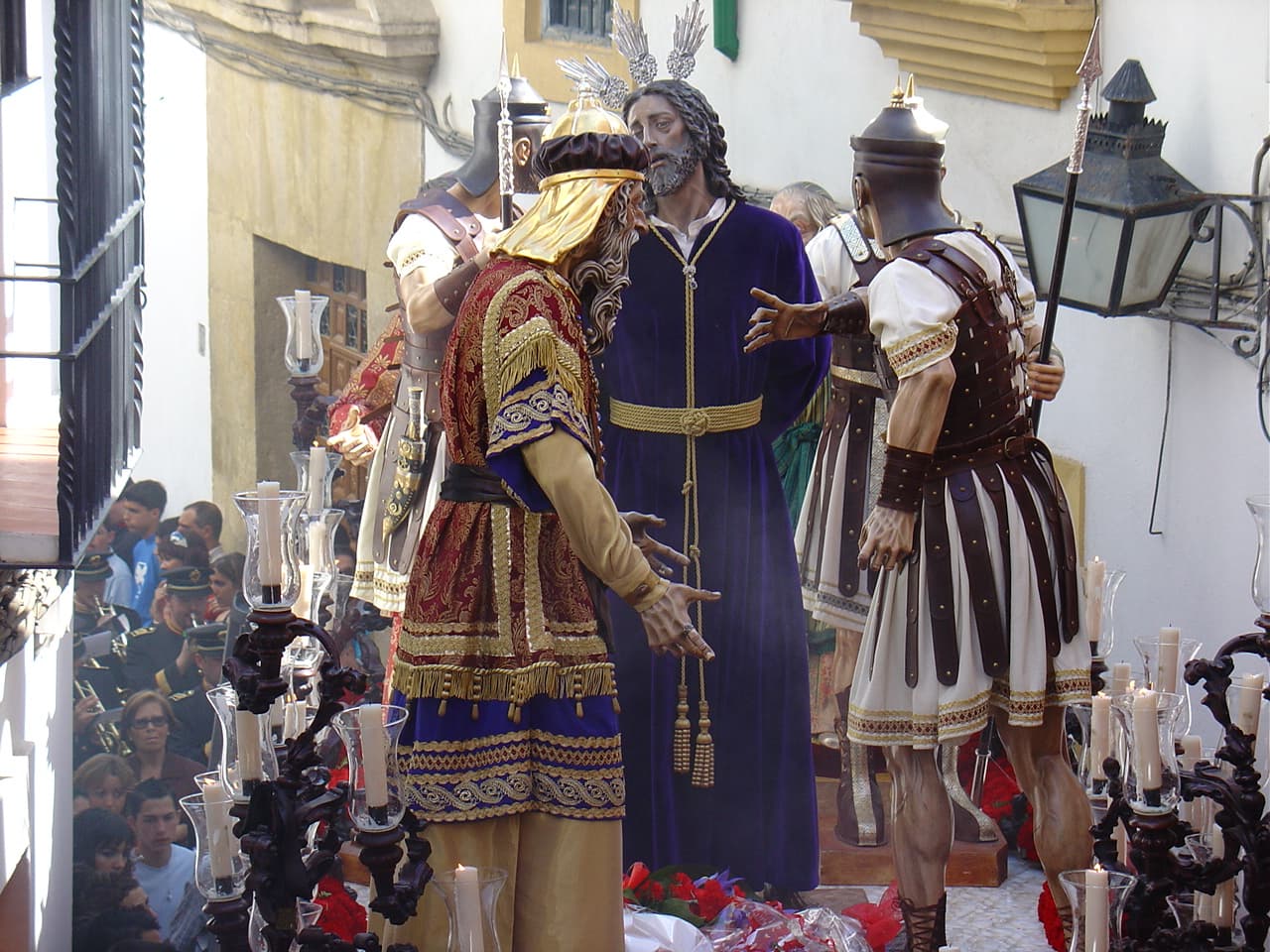
Córdoba's Semana Santa is free and open to all, with processions moving through the medieval Jewish quarter from dawn into the early morning hours. Its defining feature in Spain: since 2017, the Carrera Oficial passes through the interior of the Mezquita-Catedral, a UNESCO World Heritage monument. Thirty-nine of the 42 brotherhoods take part. The festival holds National Tourist Interest status.
What makes it unique: the Carrera Oficial enters the Mezquita
Córdoba's signature distinction is that its Carrera Oficial runs through the interior of the Mezquita-Catedral, declared a UNESCO World Heritage Site in 1984. The route enters through the Puerta del Perdón, crosses the Patio de los Naranjos, passes through the interior of the temple and exits via the Puerta de Santa Catalina — making it one of the few Semana Santa celebrations in Spain whose official route passes inside a UNESCO monument. The practice was revived in 2016–2017 after more than 150 years of absence, following the opening of a second gate in the north wall in 2017; that authorization was annulled by the Supreme Court in 2021 and the case remains in litigation. Key tip: capacity inside is very limited and reserved for brotherhoods and season-ticket holders — do not expect to watch a float pass through the temple from the street. To experience the atmosphere, position yourself on Torrijos or Cardenal Herrero, in the exterior surroundings.
2026 dates and how they are calculated
Semana Santa is a moveable feast: it is set from Easter Sunday, which falls on the first Sunday after the first full moon of spring. In 2026 it runs from 29 March (Palm Sunday) to 5 April (Easter Sunday), with eve brotherhoods already processing on Passion Saturday, 28 March. Córdoba has a distinctive local tradition compared to Sevilla: here the custom is to process at dawn rather than deep into the night. The only brotherhood that marches in the true small hours is the Hermandad de la Buena Muerte, which sets out at midnight on Good Friday in silence and without music, from the Colegiata de San Hipólito. Key tip: in early April summer time (CEST) is already in effect; sunset falls around 20:45–20:55, so the late-afternoon floats coincide with the golden hour. Do not plan around dates or programmes heard second-hand — check the website of the Agrupación de Hermandades y Cofradías de Córdoba each year.
The route, best viewpoints and the Puente Romano
The brotherhoods wind through the narrow lanes of the historic centre before reaching the Carrera Oficial. The best spots are found outside the ticketed section: the Jewish quarter, the plazas surrounding the Mezquita and, above all, the Puente Romano at sunset — the most photographed image of the festival. The south bank, facing the Torre de la Calahorra, offers the classic framing with the bridge's 16 arches in the foreground and the Mezquita bathed in warm western light behind. Key tip: to secure a spot at the railing, arrive 90 minutes early — the bridge is pedestrian-only and gets extremely crowded. Note that not every brotherhood crosses the bridge: the Buena Muerte, for example, does not (it passes along the Ronda de Isasa at around 02:00–02:15 on the night of Good Friday). If you want to see a specific float on the bridge, verify its itinerary in advance — street routes are published and change each year.
Seating, stands, brotherhoods and aesthetic
The festival is free along almost the entire route; only the chairs and stands of the Carrera Oficial require advance tickets (roughly €15–40 per section per day; institutional stands are more expensive and have waiting lists). Planning weeks ahead is essential — tickets are not sold at street booths on the day. If you want to save money, the pavements and plazas along the route are free. Thirty-nine of Córdoba's 42 brotherhoods process. On the aesthetic: Córdoba's penitents wear a pointed conical hood — the capirote — and the penitential colour purple is particularly prevalent here. The sculptural heritage is of the highest order, with works such as the Virgen de las Angustias, a posthumous piece by Juan de Mesa. Key tip: the city is not Sevilla and does not try to be — this is a tradition rebuilt from the mid-19th century after the Trevilla Decree of 1819, with its own local logic. Come without expecting a Sevillian replica.
Frequently asked questions
Do you have to pay to watch the processions?
Is it true that the processions pass through the Mezquita-Catedral?
When is Córdoba's Semana Santa in 2026?
How do I get around if the streets in the Jewish quarter are closed?
Some links on this page are affiliate links: if you book through them, Andelaria may earn a commission at no extra cost to you. Transparency & affiliate policy
Book tickets and tours: Semana Santa de CórdobaPlan your trip
Book the essentials for your trip to Córdoba.
Other places in Córdoba
Mezquita-Catedral de Córdoba
catedralDeclared a UNESCO World Heritage Site, the Mosque-Cathedral is Córdoba's most iconic monument. Built from the year 786 onwards by Abd al-Rahman I on the site of a Visigoth basilica, it was for centuries the second-largest mosque in the world. Its forest of 856 two-tone columns of jasper and marble is an unforgettable sight.
Alcázar de los Reyes Cristianos
alcazarA 14th-century medieval fortress where the Catholic Monarchs established their headquarters during the Reconquista and received Christopher Columbus before his voyage to the Americas. Its terraced gardens with ponds, cypress trees and fountains, along with the Roman mosaics in the interior museum, make it essential visiting. After months of works, the gardens reopened on 16 June 2026 with a reduced summer schedule (8:15–13:00, Tue–Sun) and an admission fee of €7 — check the official website before you go.
Puente Romano
puenteBuilt in the 1st century BC on the orders of Augustus, this 16-arch bridge over the Guadalquivir was for twenty centuries the only southern entrance to the city. It offers the most photogenic view of Córdoba: the Mosque tower silhouetted against the sky at sunrise or sunset. Today it is pedestrian-only.
Medina Azahara (Madinat al-Zahra)
museoA caliphal palace city built in 936 by Abd al-Rahman III, 8 km from Córdoba, declared a UNESCO World Heritage Site in 2018. At its peak it housed up to 25,000 people. The throne room of Abd al-Rahman III, with its restored polychrome marble arches, conveys the splendour of the Córdoba caliphate at the height of its power.
Calleja de las Flores
barrioThe most photographed alley in Córdoba, set within the medieval Judería. Its whitewashed façades covered in pots of geraniums and begonias form a natural frame through which the Mosque's bell tower appears in the distance. Together with the surrounding Judería neighbourhood, it is the finest surviving example of Andalusian urban planning.
Judería de Córdoba
barrioCórdoba's medieval Jewish quarter, declared a World Heritage Site, is one of the best-preserved historic districts in Europe. Its narrow cobbled streets conceal the Synagogue of 1315 — one of only three surviving medieval synagogues in Spain — and the Casa de Sefarad. The maze of lanes between Calle Judíos and Plaza Maimónides is made for getting pleasantly lost.
Festival de los Patios Cordobeses
fiestaEvery first half of May, Córdoba opens around 53 privately owned competition courtyards for free — plus a dozen institutional spaces: geraniums, bougainvillea, and recycled terracotta pots in living, inhabited patios. UNESCO Intangible Heritage since 2012, with an official competition running since 1921. Free entry, no booking required, split daily hours.
Noche Blanca del Flamenco de Córdoba
fiestaOne June night, Córdoba scatters free flamenco across its historic old town. The Noche Blanca del Flamenco falls on the summer solstice (20–21 June) and sets up around ten simultaneous stages, running from 22:30 until 5:00 in the morning. No ticket, no booking: you walk in, listen, and drift from square to square.
Navidad en Córdoba
fiestaFrom 2 December to 5 January, Córdoba lights up with over 400 free activities: the light-and-sound show on Cruz Conde (488,755 LED points), the Municipal Nativity Scene near the Judería, Christmas markets, and the Three Kings Parade on 5 January. All free to enjoy in the historic centre.
Similar places in other cities
Semana Santa de Sevilla
SevillaSeville's Holy Week is free and open to all: you only pay for seats and grandstands along the Official Route. In 2026 it runs from 29 March to 5 April, with the eve celebrations on the 27th. Its peak is La Madrugá, when five major brotherhoods process from 1:00 a.m. until noon.
Feria de Abril de Sevilla
SevillaTwo weeks after Easter, Sevilla sets up its Real in Los Remedios: around 1,059 casetas (up to ~1,250 plots with the expansion), flamenco dresses, horses and sevillanas. Entry is free, but most are private and only accessible with an invitation from a member. Only around 14–16 are open to the public.
Velá de Santiago y Santa Ana
SevillaSeville's oldest festival, with more than 750 years of history, doesn't take place in the city centre — it happens in Triana. The Velá de Santa Ana falls in the last week of July, around the 26th: free casetas along the Guadalquivir, the cucaña grease-pole contest over the river, and not a flamenco dress or equestrian parade in sight.