Mezquita-Catedral de Córdoba
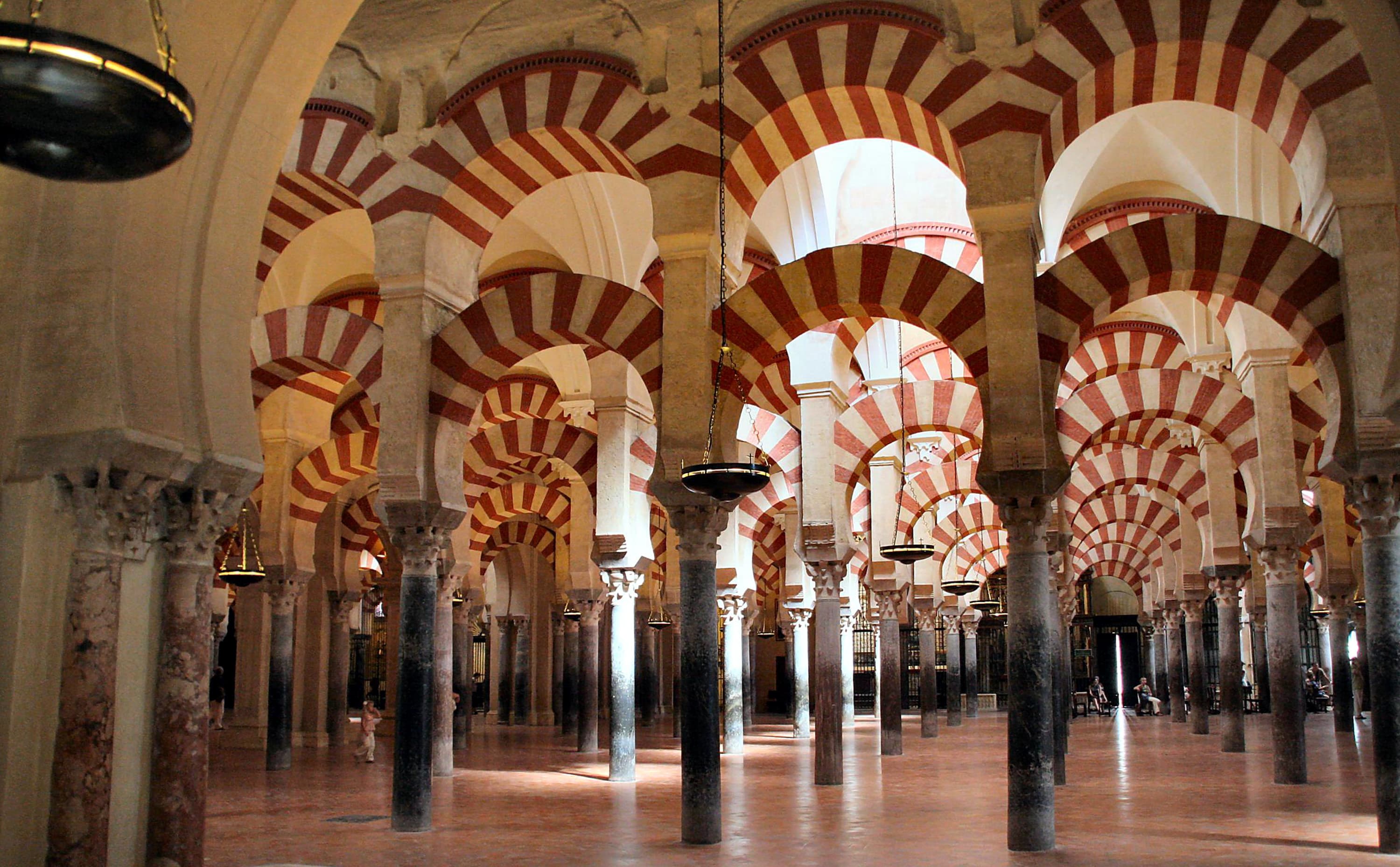
Declared a UNESCO World Heritage Site, the Mosque-Cathedral is Córdoba's most iconic monument. Built from the year 786 onwards by Abd al-Rahman I on the site of a Visigoth basilica, it was for centuries the second-largest mosque in the world. Its forest of 856 two-tone columns of jasper and marble is an unforgettable sight.
The essentials
- Tickets
- 15 €
What it is and why it's genuinely worth it
The Mosque-Cathedral is one of those places you understand better once you've set foot inside. What greets you at the entrance is a forest of 856 marble, jasper and granite columns linked by 365 double horseshoe arches, their voussoirs alternating red (brick) and white (stone) in a pattern that repeats until it dissolves into the distance: the optical effect alone is worth half the visit. It was built in phases over two centuries: Abd al-Rahman I began construction in 785, Al-Hakam II added the mihrab and the muqarnas domes, and Al-Mansur extended it to the size it holds today. A detail almost no one notices: the mihrab does not point towards Mecca but south, following the tradition of Damascus, Abd al-Rahman I's city of origin. And at the centre, wedged inside the Islamic building, stands the Renaissance cathedral erected in the 16th century after the Reconquista; legend has it that Charles I, upon seeing it finished, rebuked the canons for having destroyed something unique in order to build something you can see anywhere. The original 10th-century minaret still stands inside the baroque bell tower, which was built around it without demolishing it. This is not just another monument: it is two temples layered on top of each other, sharing the same ground.
Tickets, prices, opening hours and how to beat the queues
General admission costs 15 € (from April 2026); reduced to 12 € for over-65s, students aged 15–26 and holders of the European Youth Card, and 8 € for children aged 10–14, large families or people with disabilities up to 64 %. Free for under-10s, residents or people born in the diocese of Córdoba, holders of the Andalucía Junta 65 card, and people with a disability above 64 % accompanied by a carer. Climbing the bell tower costs an extra 4 €, and the night tour 'El Alma de Córdoba' costs 25 € (18 € reduced). The trick to getting in free: Monday to Saturday, from 08:30 to 09:30 there is free individual access in strict silence (no groups, and they start clearing the space at 09:20). It is also the least crowded slot. Normal visiting hours are 10:00–19:00 in summer (March–October) and until 18:00 in winter; on Sundays and public holidays it opens in two shifts, 08:30–11:30 and in the afternoon. Last entry 30 minutes before closing. Book at tickets.mezquita-catedraldecordoba.es/en: advance booking is not compulsory on weekdays, but at weekends, on public holidays and during Holy Week tickets can sell out on the day, so it's best to book ahead. Avoid Saturday and Sunday between 11:00 and 17:00.
How to get there and tips from those who've been
Córdoba has no metro or tram, so don't go looking for one: you get there on foot or by urban bus (AUCORSA). From the AVE high-speed train station (Renfe), the Mosque-Cathedral is about a 20-minute walk through the historic centre, or 15–18 minutes on bus line 3, which is the most useful for getting from the station to the centre. Lines 7, 12 and T also serve the area. The nearest stop is Puerta del Puente, about a 3-minute walk away. The monument is in the middle of a pedestrian zone (Calle Cardenal Herrero, 1), so the last 5–10 minutes always involve cobbled streets; car access is very limited and it's best to park on the outskirts of the old town. Allow 1.5 to 2 hours to see it at a comfortable pace (the column hall, the mihrab, the interior cathedral and the courtyards), or 2–2.5 hours with an audio guide or official guide. The exterior Patio de los Naranjos can be visited more quickly. Two reminders: wear comfortable shoes because the floors are marble and cobblestone and the complex is large, and bear in mind that it is still an active place of worship with masses, so covered shoulders and knees are recommended out of courtesy. For enquiries or bookings, the phone number is +34 670 967 272.
Frequently asked questions
How much does admission cost, and do I need to book?
How much time do I need for the visit?
What is the best time to avoid queues?
Some links on this page are affiliate links: if you book through them, Andelaria may earn a commission at no extra cost to you. Transparency & affiliate policy
Book tickets and tours: Mezquita-Catedral de Córdoba· 15 €Plan your trip
Book the essentials for your trip to Córdoba.
Other places in Córdoba
Alcázar de los Reyes Cristianos
alcazarA 14th-century medieval fortress where the Catholic Monarchs established their headquarters during the Reconquista and received Christopher Columbus before his voyage to the Americas. Its terraced gardens with ponds, cypress trees and fountains, along with the Roman mosaics in the interior museum, make it essential visiting. After months of works, the gardens reopened on 16 June 2026 with a reduced summer schedule (8:15–13:00, Tue–Sun) and an admission fee of €7 — check the official website before you go.
Puente Romano
puenteBuilt in the 1st century BC on the orders of Augustus, this 16-arch bridge over the Guadalquivir was for twenty centuries the only southern entrance to the city. It offers the most photogenic view of Córdoba: the Mosque tower silhouetted against the sky at sunrise or sunset. Today it is pedestrian-only.
Medina Azahara (Madinat al-Zahra)
museoA caliphal palace city built in 936 by Abd al-Rahman III, 8 km from Córdoba, declared a UNESCO World Heritage Site in 2018. At its peak it housed up to 25,000 people. The throne room of Abd al-Rahman III, with its restored polychrome marble arches, conveys the splendour of the Córdoba caliphate at the height of its power.
Calleja de las Flores
barrioThe most photographed alley in Córdoba, set within the medieval Judería. Its whitewashed façades covered in pots of geraniums and begonias form a natural frame through which the Mosque's bell tower appears in the distance. Together with the surrounding Judería neighbourhood, it is the finest surviving example of Andalusian urban planning.
Judería de Córdoba
barrioCórdoba's medieval Jewish quarter, declared a World Heritage Site, is one of the best-preserved historic districts in Europe. Its narrow cobbled streets conceal the Synagogue of 1315 — one of only three surviving medieval synagogues in Spain — and the Casa de Sefarad. The maze of lanes between Calle Judíos and Plaza Maimónides is made for getting pleasantly lost.
Festival de los Patios Cordobeses
fiestaEvery first half of May, Córdoba opens around 53 privately owned competition courtyards for free — plus a dozen institutional spaces: geraniums, bougainvillea, and recycled terracotta pots in living, inhabited patios. UNESCO Intangible Heritage since 2012, with an official competition running since 1921. Free entry, no booking required, split daily hours.
Semana Santa de Córdoba
fiestaCórdoba's Semana Santa is free and open to all, with processions moving through the medieval Jewish quarter from dawn into the early morning hours. Its defining feature in Spain: since 2017, the Carrera Oficial passes through the interior of the Mezquita-Catedral, a UNESCO World Heritage monument. Thirty-nine of the 42 brotherhoods take part. The festival holds National Tourist Interest status.
Noche Blanca del Flamenco de Córdoba
fiestaOne June night, Córdoba scatters free flamenco across its historic old town. The Noche Blanca del Flamenco falls on the summer solstice (20–21 June) and sets up around ten simultaneous stages, running from 22:30 until 5:00 in the morning. No ticket, no booking: you walk in, listen, and drift from square to square.
Navidad en Córdoba
fiestaFrom 2 December to 5 January, Córdoba lights up with over 400 free activities: the light-and-sound show on Cruz Conde (488,755 LED points), the Municipal Nativity Scene near the Judería, Christmas markets, and the Three Kings Parade on 5 January. All free to enjoy in the historic centre.
Similar places in other cities
Catedral de Sevilla y La Giralda
SevillaThe largest Gothic cathedral in the world and the third-largest church by floor area, built on the site of the former Almohad mosque. La Giralda, its 97-metre bell tower, is Seville's undisputed symbol. Inside lies the tomb of Christopher Columbus. The ticket includes access to the tower, which has no steps — only ramps.
Catedral de Granada y Capilla Real
GranadaA Renaissance complex beside the Capilla Real, begun in 1505, which houses the tombs of the Reyes Católicos Isabel and Fernando.
Catedral de la Encarnación (La Manquita)
MálagaA Renaissance cathedral begun in 1528 on the site of the former main mosque, with Gothic and Baroque touches. Málaga locals call it 'La Manquita' because its south tower was never finished; the north tower reaches 84 metres, the second tallest in Andalusia after the Giralda. Entrance: €6; with rooftop access: €10.