Puente Romano
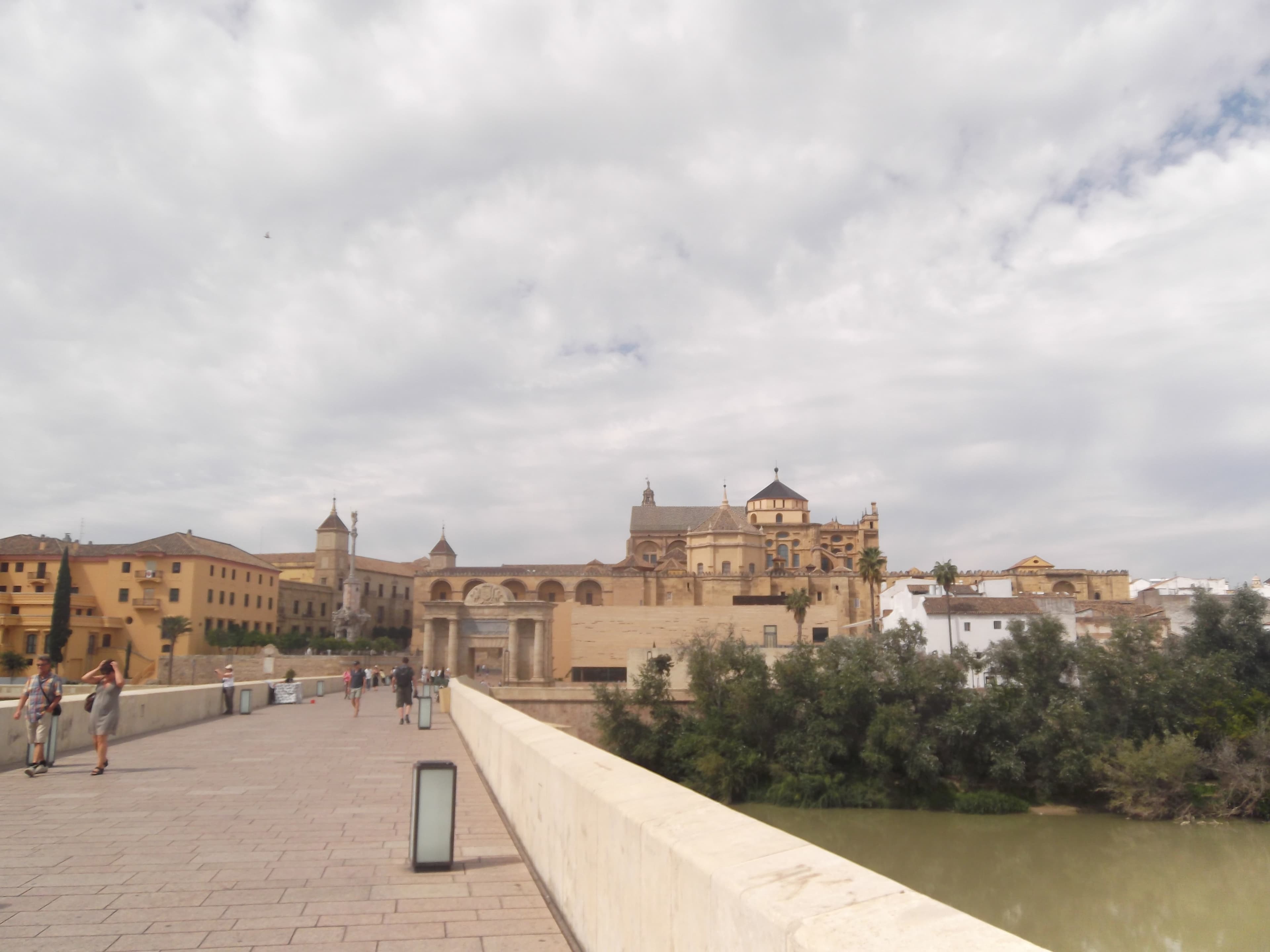
Built in the 1st century BC on the orders of Augustus, this 16-arch bridge over the Guadalquivir was for twenty centuries the only southern entrance to the city. It offers the most photogenic view of Córdoba: the Mosque tower silhouetted against the sky at sunrise or sunset. Today it is pedestrian-only.
The essentials
- Tickets
- gratis
A Roman bridge with only two Roman arches (and a lot more history)
Let's start with an uncomfortable truth: of the 16 arches you cross today, only two — arches 14 and 15, counting from the Puerta del Puente — retain genuinely Roman stonework. The rest are Caliphal, medieval and modern reconstructions, and the last major restoration (2006–2008, €13.6 million under Juan Cuenca Montilla) left the paving and parapets you walk on now. That said, the bridge is absolutely worth it. It dates to the Roman era of Augustus, and for roughly twenty centuries it was the only fixed crossing over the Guadalquivir without a boat: it formed part of the Via Augusta, linking Rome with Cádiz. Three civilisations have patched it up, there's a 17th-century statue of San Rafael at its centre (with a niche for saints Acisclo and Victoria), and if it looks familiar, that's because it played the "Long Bridge of Volantis" in Game of Thrones. It's 331 pedestrian metres with the Mosque-Cathedral tower as a backdrop: the shot you've seen in a thousand photos, and one that holds up perfectly in person.
Free and open 24/7 — no queues, just heat
The bridge is a public pedestrian space, open 24 hours a day all year round, with no ticket booth, no entrance fee and no reservation needed. There is nothing to buy to cross it. The only exception is the Torre de la Calahorra, the museum at the southern end, which does charge admission (around €4.50 for adults); if you want to go in, check opening times and availability on its official website, as advance booking may be required in high season. Since there are no queues, the real "problem" in Córdoba is the heat and the midday crowds: in July and August temperatures frequently exceed 40 °C and the bridge fills up. The best time is dawn (07:00–08:30): spectacular light on the tower, almost no one around and the best photo of the day. Sunset (around 19:00–21:00 in summer, 17:30–19:30 in winter) gives a lovely golden light, with a few more people but nothing like midday. If you can choose your dates, autumn and early spring, outside Semana Santa and the Feria, are the quietest.
Getting there and what to keep in mind
You'll most likely arrive on foot: the bridge is a few minutes' walk from the Mosque-Cathedral, in the same historic quarter, so the natural thing is to pair it with a visit to the Mosque. If you're coming by bus, Córdoba has no metro or tram: you get around using Aucorsa. For the south entrance (direct access from the Puerta del Puente) take lines 3 and 12; for the north entrance, near Avenida de Cádiz / Plaza de Santa Teresa, lines 12 and 14 serve it. From the Renfe station the easiest options are a taxi or bus 3 or 12. Allow 20–30 minutes to cross and return at a leisurely pace with photos, or 1.5–2 hours if you combine it with the Torre de la Calahorra and a stroll along the riverbank. Two tips from someone who has been: it has been fully pedestrianised since 2004, so forget about cars; and in summer bring water and a hat without fail, because the heat and the stone reflecting the sun can make for a rough time. We're not aware of any closures or works currently underway (June 2026), but before your trip it's worth checking the Córdoba Tourism portal in case of any temporary interventions.
Frequently asked questions
Do you need to pay or book to cross the Roman Bridge?
How much time do I need to visit it?
What is the best time to visit without crowds?
Some links on this page are affiliate links: if you book through them, Andelaria may earn a commission at no extra cost to you. Transparency & affiliate policy
Book tickets and tours: Puente Romano· gratisPlan your trip
Book the essentials for your trip to Córdoba.
Other places in Córdoba
Mezquita-Catedral de Córdoba
catedralDeclared a UNESCO World Heritage Site, the Mosque-Cathedral is Córdoba's most iconic monument. Built from the year 786 onwards by Abd al-Rahman I on the site of a Visigoth basilica, it was for centuries the second-largest mosque in the world. Its forest of 856 two-tone columns of jasper and marble is an unforgettable sight.
Alcázar de los Reyes Cristianos
alcazarA 14th-century medieval fortress where the Catholic Monarchs established their headquarters during the Reconquista and received Christopher Columbus before his voyage to the Americas. Its terraced gardens with ponds, cypress trees and fountains, along with the Roman mosaics in the interior museum, make it essential visiting. After months of works, the gardens reopened on 16 June 2026 with a reduced summer schedule (8:15–13:00, Tue–Sun) and an admission fee of €7 — check the official website before you go.
Medina Azahara (Madinat al-Zahra)
museoA caliphal palace city built in 936 by Abd al-Rahman III, 8 km from Córdoba, declared a UNESCO World Heritage Site in 2018. At its peak it housed up to 25,000 people. The throne room of Abd al-Rahman III, with its restored polychrome marble arches, conveys the splendour of the Córdoba caliphate at the height of its power.
Calleja de las Flores
barrioThe most photographed alley in Córdoba, set within the medieval Judería. Its whitewashed façades covered in pots of geraniums and begonias form a natural frame through which the Mosque's bell tower appears in the distance. Together with the surrounding Judería neighbourhood, it is the finest surviving example of Andalusian urban planning.
Judería de Córdoba
barrioCórdoba's medieval Jewish quarter, declared a World Heritage Site, is one of the best-preserved historic districts in Europe. Its narrow cobbled streets conceal the Synagogue of 1315 — one of only three surviving medieval synagogues in Spain — and the Casa de Sefarad. The maze of lanes between Calle Judíos and Plaza Maimónides is made for getting pleasantly lost.
Festival de los Patios Cordobeses
fiestaEvery first half of May, Córdoba opens around 53 privately owned competition courtyards for free — plus a dozen institutional spaces: geraniums, bougainvillea, and recycled terracotta pots in living, inhabited patios. UNESCO Intangible Heritage since 2012, with an official competition running since 1921. Free entry, no booking required, split daily hours.
Semana Santa de Córdoba
fiestaCórdoba's Semana Santa is free and open to all, with processions moving through the medieval Jewish quarter from dawn into the early morning hours. Its defining feature in Spain: since 2017, the Carrera Oficial passes through the interior of the Mezquita-Catedral, a UNESCO World Heritage monument. Thirty-nine of the 42 brotherhoods take part. The festival holds National Tourist Interest status.
Noche Blanca del Flamenco de Córdoba
fiestaOne June night, Córdoba scatters free flamenco across its historic old town. The Noche Blanca del Flamenco falls on the summer solstice (20–21 June) and sets up around ten simultaneous stages, running from 22:30 until 5:00 in the morning. No ticket, no booking: you walk in, listen, and drift from square to square.
Similar places in other cities
Ponte Dom Luís I
PortoDouble-deck iron bridge from 1886 by a disciple of Eiffel; its upper deck is walkable with the city's finest view.
Cases de l'Onyar i Pont de les Peixateries Velles
GironaThe colourful houses over the river and the red iron bridge built by Eiffel's firm in 1877. Girona's definitive postcard view.