Noche Blanca del Flamenco de Córdoba
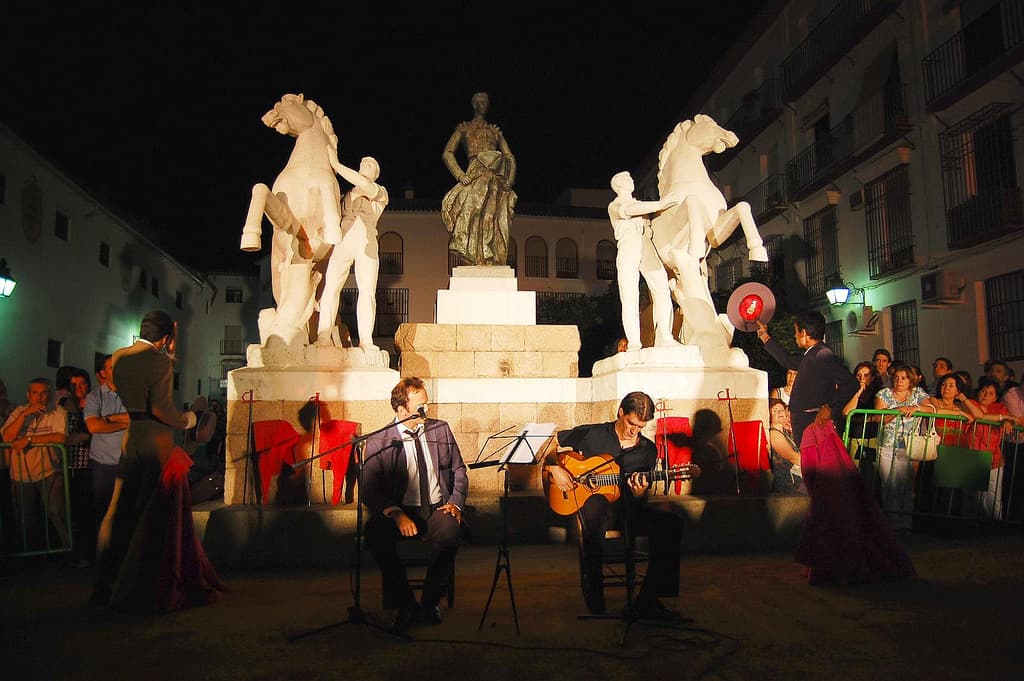
One June night, Córdoba scatters free flamenco across its historic old town. The Noche Blanca del Flamenco falls on the summer solstice (20–21 June) and sets up around ten simultaneous stages, running from 22:30 until 5:00 in the morning. No ticket, no booking: you walk in, listen, and drift from square to square.
What it is and where it comes from
The Noche Blanca del Flamenco is a free, all-night festival that the Ayuntamiento de Córdoba (Delegación de Cultura y Patrimonio Histórico) has organised since 2008. Once a year it turns the historic old town into one continuous flamenco stage that never stops, with artists spread across squares and monuments. The 2026 edition is the 17th, though not seventeen consecutive years — the pandemic wiped out 2020 and 2021. The core idea has never changed: cante, baile and guitar in the open air, free and out on the street, with the city centre taken over by the crowd. The very first edition in 2008 drew more than 200,000 people, and attendance has kept climbing. This is popular flamenco, not a ticketed festival with numbered seats — and that is precisely what makes it special.
When it takes place and who it honours
The date is easy to remember: always the night of the summer solstice, from 20 to 21 June (Saturday into Sunday in 2026). The programme runs from 22:30 to 5:00 in the morning without a break. The 2026 edition is dedicated to the Cordovan cantaor Antonio Fernández Díaz, 'Fosforito', a towering figure of cante jondo who passed away in November 2025. Because this page is evergreen, we do not reproduce any single year's line-up: artists, exact set times per stage and any programme changes are announced each year, weeks in advance, on the official website (nocheblancadelflamenco.cordoba.es). One critical tip: never assume the bill repeats itself. The framework — ten stages, one night, free admission — is stable, but who performs and at what time changes every edition, so check the final programme before planning your route and do not rely on previous years' listings.
The stages: from the Patio to El Potro
There are around ten simultaneous stages spread across the city centre and the Judería: Plaza de las Tendillas (where things kick off at around 22:30), Plaza de San Agustín, the Patio de los Naranjos inside the Mezquita-Catedral, the Torre de la Calahorra, the Cine Fuenseca, the Compás de San Francisco, the Plaza del Conde de Priego, La Corredera, the Plaza del Potro and the Jardines del Alcázar, which usually close out the night at around 5:00. The most iconic is the Patio de los Naranjos: live flamenco inside the courtyard of a 9th-century monument, with 6,500 m² of space but a limited capacity. The atmosphere there and at San Agustín is intimate and focused. La Corredera, El Potro and the Compás de San Francisco, by contrast, attract a younger crowd and a more festive energy. Tip: the Patio fills up fast, so arrive 30–45 minutes before the midnight session to get a good spot.
How to plan your route without a booking
There are no reservations or tickets: entry is free until each stage reaches capacity, so the night is played out on foot. The strategy that works best is to start early at the Patio de los Naranjos (enter through the Mezquita-Catedral precinct as directed by the organisers; check the official website each year for the exact access point), then work your way through the smaller stages, which have thinner crowds and better sightlines, until around 3 or 4 in the morning. Watch out around Tendillas: when a large square hits capacity, the Ayuntamiento activates a special traffic plan and restricts pedestrian access. Walk or use public transport; the city centre is closed to private vehicles. Solstice nights sit at around 24–26 degrees — ideal for walking between stages, which is exactly the spirit of the event. Bars and restaurants close at 5:00, and only special licensed venues with music run until 6:00.
Frequently asked questions
Do you need to buy a ticket or book in advance?
What date does it take place each year?
How do I make sure I get a spot in the Patio de los Naranjos?
How do I get around the city centre that night?
Some links on this page are affiliate links: if you book through them, Andelaria may earn a commission at no extra cost to you. Transparency & affiliate policy
Book tickets and tours: Noche Blanca del Flamenco de CórdobaPlan your trip
Book the essentials for your trip to Córdoba.
Other places in Córdoba
Mezquita-Catedral de Córdoba
catedralDeclared a UNESCO World Heritage Site, the Mosque-Cathedral is Córdoba's most iconic monument. Built from the year 786 onwards by Abd al-Rahman I on the site of a Visigoth basilica, it was for centuries the second-largest mosque in the world. Its forest of 856 two-tone columns of jasper and marble is an unforgettable sight.
Alcázar de los Reyes Cristianos
alcazarA 14th-century medieval fortress where the Catholic Monarchs established their headquarters during the Reconquista and received Christopher Columbus before his voyage to the Americas. Its terraced gardens with ponds, cypress trees and fountains, along with the Roman mosaics in the interior museum, make it essential visiting. After months of works, the gardens reopened on 16 June 2026 with a reduced summer schedule (8:15–13:00, Tue–Sun) and an admission fee of €7 — check the official website before you go.
Puente Romano
puenteBuilt in the 1st century BC on the orders of Augustus, this 16-arch bridge over the Guadalquivir was for twenty centuries the only southern entrance to the city. It offers the most photogenic view of Córdoba: the Mosque tower silhouetted against the sky at sunrise or sunset. Today it is pedestrian-only.
Medina Azahara (Madinat al-Zahra)
museoA caliphal palace city built in 936 by Abd al-Rahman III, 8 km from Córdoba, declared a UNESCO World Heritage Site in 2018. At its peak it housed up to 25,000 people. The throne room of Abd al-Rahman III, with its restored polychrome marble arches, conveys the splendour of the Córdoba caliphate at the height of its power.
Calleja de las Flores
barrioThe most photographed alley in Córdoba, set within the medieval Judería. Its whitewashed façades covered in pots of geraniums and begonias form a natural frame through which the Mosque's bell tower appears in the distance. Together with the surrounding Judería neighbourhood, it is the finest surviving example of Andalusian urban planning.
Judería de Córdoba
barrioCórdoba's medieval Jewish quarter, declared a World Heritage Site, is one of the best-preserved historic districts in Europe. Its narrow cobbled streets conceal the Synagogue of 1315 — one of only three surviving medieval synagogues in Spain — and the Casa de Sefarad. The maze of lanes between Calle Judíos and Plaza Maimónides is made for getting pleasantly lost.
Festival de los Patios Cordobeses
fiestaEvery first half of May, Córdoba opens around 53 privately owned competition courtyards for free — plus a dozen institutional spaces: geraniums, bougainvillea, and recycled terracotta pots in living, inhabited patios. UNESCO Intangible Heritage since 2012, with an official competition running since 1921. Free entry, no booking required, split daily hours.
Semana Santa de Córdoba
fiestaCórdoba's Semana Santa is free and open to all, with processions moving through the medieval Jewish quarter from dawn into the early morning hours. Its defining feature in Spain: since 2017, the Carrera Oficial passes through the interior of the Mezquita-Catedral, a UNESCO World Heritage monument. Thirty-nine of the 42 brotherhoods take part. The festival holds National Tourist Interest status.
Navidad en Córdoba
fiestaFrom 2 December to 5 January, Córdoba lights up with over 400 free activities: the light-and-sound show on Cruz Conde (488,755 LED points), the Municipal Nativity Scene near the Judería, Christmas markets, and the Three Kings Parade on 5 January. All free to enjoy in the historic centre.
Similar places in other cities
Semana Santa de Sevilla
SevillaSeville's Holy Week is free and open to all: you only pay for seats and grandstands along the Official Route. In 2026 it runs from 29 March to 5 April, with the eve celebrations on the 27th. Its peak is La Madrugá, when five major brotherhoods process from 1:00 a.m. until noon.
Feria de Abril de Sevilla
SevillaTwo weeks after Easter, Sevilla sets up its Real in Los Remedios: around 1,059 casetas (up to ~1,250 plots with the expansion), flamenco dresses, horses and sevillanas. Entry is free, but most are private and only accessible with an invitation from a member. Only around 14–16 are open to the public.
Velá de Santiago y Santa Ana
SevillaSeville's oldest festival, with more than 750 years of history, doesn't take place in the city centre — it happens in Triana. The Velá de Santa Ana falls in the last week of July, around the 26th: free casetas along the Guadalquivir, the cucaña grease-pole contest over the river, and not a flamenco dress or equestrian parade in sight.