Passeig Marítim
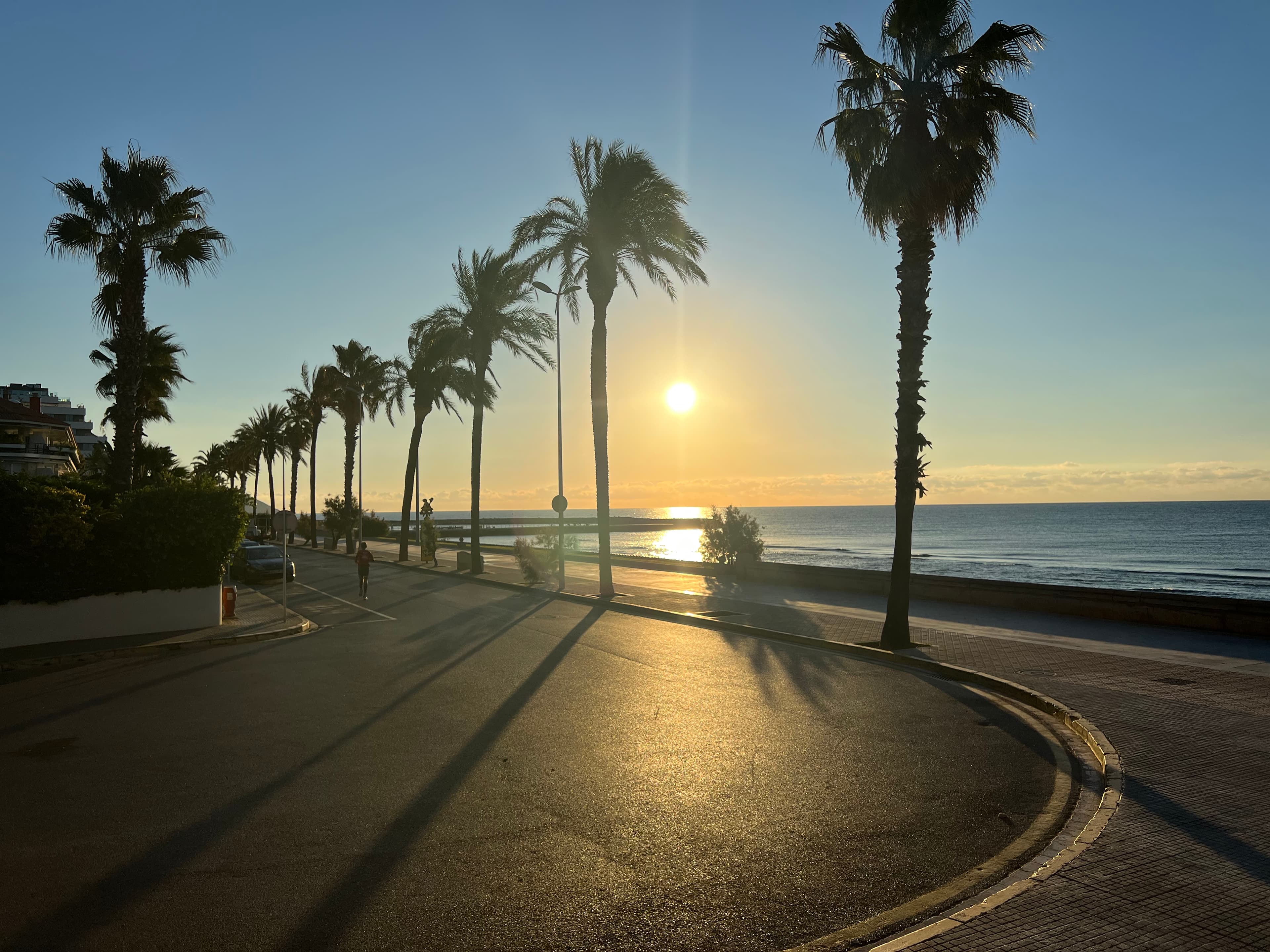
Seafront promenade with palms, terraces and the El Greco statue.
What it is and why it's worth your time
The Passeig Marítim in Sitges is a flat, 2.5 km seafront promenade running from the Passeig de la Ribera, in front of the old town, all the way to the Jardins del Terramar. What sets it apart is not any single superlative — it's the unbroken view of the Mediterranean horizon, framed by palm trees and terrace cafés, with no buildings cutting in. It's listed as a Bé Cultural d'Interès Local, and because the route is completely flat it works equally well for wheelchairs, pushchairs or bikes. Along the way you'll pass the monument to El Greco, which has a story behind it: Santiago Rusiñol championed it in 1896 through a public subscription to claim the painter as a forerunner of Catalan Modernisme and the Cau Ferrat circle. The original piece deteriorated, and since 1972–73 what you see is a replica by Nicolau Ortiz. Another local footnote: tradition holds that the first chiringuito (beach bar) in Spain was founded here in 1913.
Admission, opening hours and how to avoid the crowds
The promenade is free and open 24 hours — no booking, no ticket required. The Jardins del Terramar at the far end are also free: open 10:00–20:00 in summer and until 19:00 in winter. The key to beating the crowds is timing. In July and August, go early (before 10:00) or wait for the evening stroll from 19:00 onwards, when the heat and the people ease off. Summer weekends are busiest between 12:00 and 17:00, so avoid that window. From October to May, any time of day is fine — the promenade returns to its quiet village pace. A useful note for June 2026: roadworks are ongoing at Les Botigues de Sitges (the stretch between Port Ginesta and Castelldefels, scheduled until September 2026), but they do NOT affect the main Sitges promenade, which is fully open as normal.
Getting there and practical tips
The easiest option from Barcelona is the train: Rodalies line R2 Sud (R2S) from Sants or Passeig de Gràcia to Sitges station, around 35–40 minutes, with trains every 20–30 minutes (check timetables at renfe.com). From the station to the start of the promenade is a 10–12 minute walk. By bus, line SL2 connects the Garraf municipalities; the nearest stop is Av. Navarra – Av. J. Carner, about 4 minutes on foot — though the train wins on frequency and price. By car, parking is scarce in peak season: leave the car on the outskirts and walk in. As for time, a there-and-back walk without stops takes 45–60 minutes; with terrace stops, the El Greco monument and the Jardins del Terramar, allow 2–3 hours; combined with the Cau Ferrat or a swim, it's half a day. In summer a petit train runs along the promenade — check availability and price at the tourist office (visitsitges.com).
Frequently asked questions
Is there an entrance fee or booking required for the Passeig Marítim?
How long does it take to walk the Passeig Marítim?
What is the best time to avoid the crowds?
Some links on this page are affiliate links: if you book through them, Andelaria may earn a commission at no extra cost to you. Transparency & affiliate policy
Book tickets and tours: Passeig MarítimPlan your trip
Book the essentials for your trip to Sitges.
Other places in Sitges
Església de Sant Bartomeu i Santa Tecla
monumentoThe church on the rock between two beaches, the symbol of Sitges.
Museu del Cau Ferrat
museoSantiago Rusiñol's house-studio, a Modernist gem with works by El Greco.
Platja de la Ribera
playaThe main town beach, beside the promenade and old quarter.
Platja de Sant Sebastià
playaQuieter beach on the far side of the church, family-friendly.
Palau de Maricel
monumentoSeafront Noucentista palace with decorated halls and Mediterranean views, a venue for concerts and weddings.
Revetlla de Sant Joan
fiestaThe Revetlla de Sant Joan is the free, open-access midsummer fire festival on the night of 23–24 June (the 24th is a public holiday throughout Catalonia). In Sitges it unfolds on the beaches, with the Flama del Canigó, coca de Sant Joan, cava and firecrackers until dawn.
Carnaval de Sitges
fiestaThe Carnaval de Sitges is the town's biggest street party: free, open to all, and drawing over 200,000 visitors (municipal figure). Documented since 1586 and revived in 1976, it is today Catalonia's most internationally recognised carnival, featuring two nocturnal rúas, a drag gala, and an unmistakable LGBTQ+ spirit.
Festival de Cine Fantástico de Sitges
fiestaThe Sitges Film Festival is the world's oldest fantastic film festival (since 1968) and a global benchmark for the genre alongside Fantasia and Fantastic Fest. Ten days in October with over 200 horror, fantasy and science fiction films. Screenings are ticketed: individual tickets and passes available on the official website.
Festa Major de Sitges (Sant Bartomeu)
fiestaThe Festa Major de Sant Bartomeu is the celebration Sitgetans truly call their own — not a tourist event like Carnival. It is the town's most deep-rooted festival, declared a Festivity of National Interest in Catalonia, with the Ball de Diables documented since 1853. Free and street-level: its heart is the 36 hours spanning 23 and 24 August.