Revetlla de Sant Joan
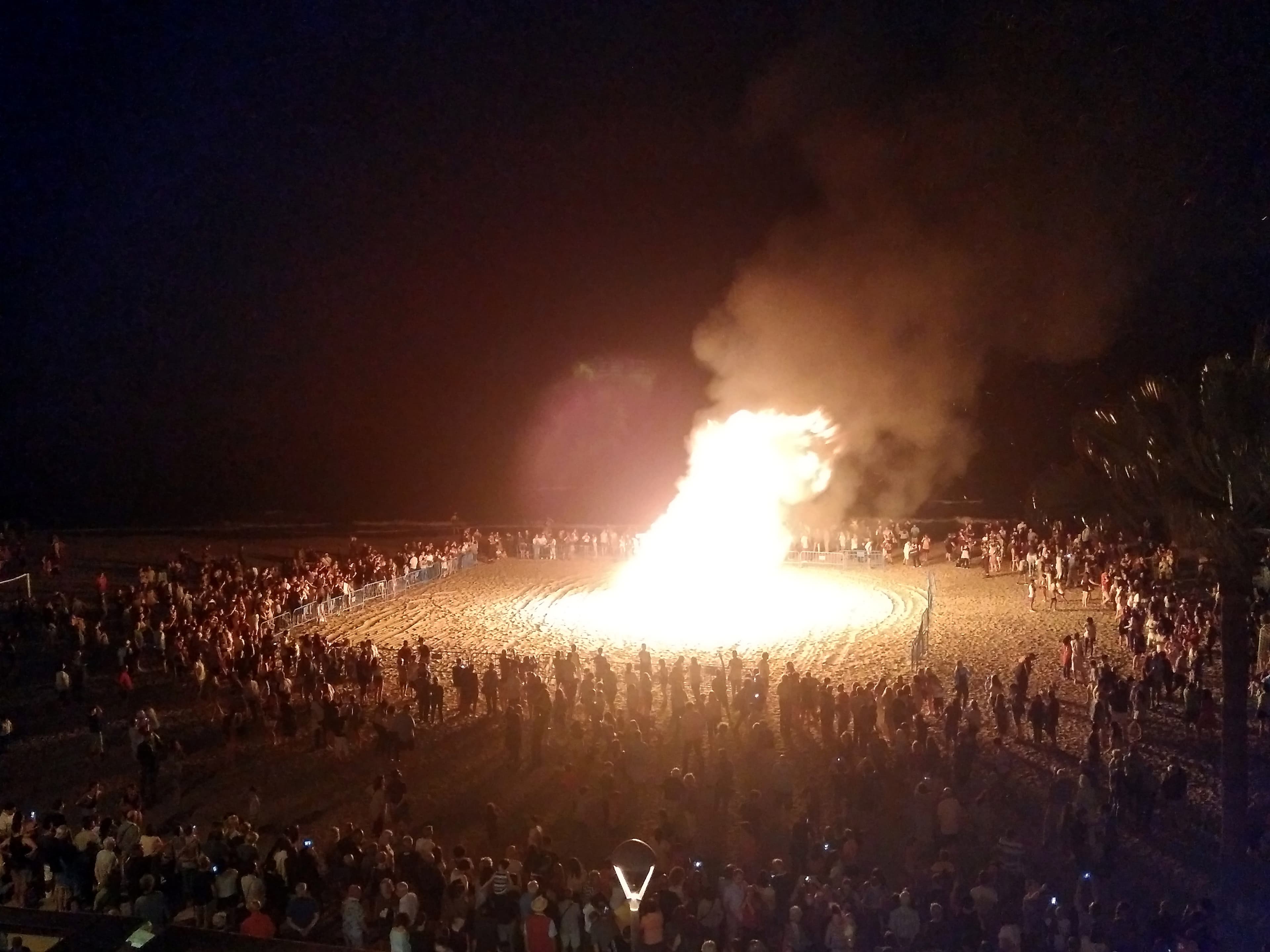
The Revetlla de Sant Joan is the free, open-access midsummer fire festival on the night of 23–24 June (the 24th is a public holiday throughout Catalonia). In Sitges it unfolds on the beaches, with the Flama del Canigó, coca de Sant Joan, cava and firecrackers until dawn.
What is the Nit de Sant Joan
The Nit de Sant Joan is the great midsummer fire celebration in Catalonia and the Catalan Countries, rooted in pagan tradition and later Christianised to coincide with the Nativity of Saint John the Baptist on 24 June. One common misconception worth clearing up: the astronomical solstice of 2026 falls on Sunday 21 June at 09:24 local time (IGN), two days before the revetlla itself. Fire plays a purifying role — people leap over bonfires and perform rituals with herbs. The most distinctive Catalan symbol is the Flama del Canigó, first lit in 1955 and officially institutionalised in 1963: every 22 June, a group of hikers carry fire to the summit of the Canigó (2,784 m, in the Catalunya Nord) and bring it back renewed. That same night, some 3,000 bonfires are lit with this flame across more than 350 towns. The tradition survived Francoism underground as a symbol of the Catalan language.
How it unfolds in Sitges
Compared to the mass crowds of Barcelona, Sitges offers a more intimate coastal-town revetlla. The official focal point is the Poble Sec neighbourhood, centred on Plaça de Catalunya, but the night spills out along the promenade and beaches (Fragata, Ribera, Sant Sebastià). Important note: bonfires on the sand are PROHIBITED by municipal ordinance; those in urban areas require a council permit and must be at least 15 metres from trees, buildings and vehicles. Fireworks are concentrated around the La Fragata area and the jetties, which are cordoned off and supervised. Do not expect an official Sant Joan fireworks display: Sitges' major pyrotechnics show takes place during the Festa Major de Sant Bartomeu in August. The drone show at La Fragata in 2024 was a one-off sponsored event, not a tradition. The authentic experience is coca de Sant Joan with cava, havaneres with cremat, and the verbena in the square.
Dates, public holiday and programme
The Revetlla is always on the night of 23–24 June. The 24th is a regional public holiday in Catalonia (not a national one): most shops close and some supermarkets or tourist businesses open reduced hours, so stock up beforehand. The annual pattern in Sitges is consistent: on the 23rd at 14:00 the 12 morterets are fired in Plaça de Catalunya, the Flama del Canigó arrives at 19:00 (accompanied by the Colla Jove de Castellers and Òmnium Garraf), and the verbena starts after dark and runs until around 05:00. The 24th is reserved for religious services at the church of Sant Joan, the procession of balls de bastons, sardanes and a final traca at midnight. As this is an evergreen guide: do not rely on specific poster dates — always check the definitive programme for each year at sitges.cat (Ajuntament de Sitges), which is usually published with little advance notice.
Practical tips
Transport is the critical point. The R2 Sud train (37–40 min, Barcelona–Sitges) is the most comfortable option but comes with a catch: on that night regular services stop and only a handful of special trains run, with a gap of several hours (departing around 23:36 from Estació de França; return around 05:30 from Sant Vicenç de Calders). The reliable option for getting back in the early hours is the Mon-Bus/BusGarraf night bus line N30, with departures from Sitges at approximately 01:34, 02:34, 03:34 and 04:34 (ticket approx. €3.80). Forget the car: parking nearby is almost impossible (most of the area is paid zona blava). Wear closed shoes because of the firecrackers, bring a blanket for when it cools down after midnight, and carry your own food and drink — the chiringuitos fill up from early on. With firecrackers, observe the legal safety distances and never hold them in your hand or point them at your face.
Frequently asked questions
Is there an entrance fee for the Revetlla de Sant Joan in Sitges?
Are bonfires allowed on the beaches in Sitges?
How do I get back to Barcelona in the early hours after Sant Joan?
Where can I find the official programme each year?
Some links on this page are affiliate links: if you book through them, Andelaria may earn a commission at no extra cost to you. Transparency & affiliate policy
Book tickets and tours: Revetlla de Sant JoanPlan your trip
Book the essentials for your trip to Sitges.
Other places in Sitges
Església de Sant Bartomeu i Santa Tecla
monumentoThe church on the rock between two beaches, the symbol of Sitges.
Museu del Cau Ferrat
museoSantiago Rusiñol's house-studio, a Modernist gem with works by El Greco.
Platja de la Ribera
playaThe main town beach, beside the promenade and old quarter.
Passeig Marítim
paseoSeafront promenade with palms, terraces and the El Greco statue.
Platja de Sant Sebastià
playaQuieter beach on the far side of the church, family-friendly.
Palau de Maricel
monumentoSeafront Noucentista palace with decorated halls and Mediterranean views, a venue for concerts and weddings.
Carnaval de Sitges
fiestaThe Carnaval de Sitges is the town's biggest street party: free, open to all, and drawing over 200,000 visitors (municipal figure). Documented since 1586 and revived in 1976, it is today Catalonia's most internationally recognised carnival, featuring two nocturnal rúas, a drag gala, and an unmistakable LGBTQ+ spirit.
Festival de Cine Fantástico de Sitges
fiestaThe Sitges Film Festival is the world's oldest fantastic film festival (since 1968) and a global benchmark for the genre alongside Fantasia and Fantastic Fest. Ten days in October with over 200 horror, fantasy and science fiction films. Screenings are ticketed: individual tickets and passes available on the official website.
Festa Major de Sitges (Sant Bartomeu)
fiestaThe Festa Major de Sant Bartomeu is the celebration Sitgetans truly call their own — not a tourist event like Carnival. It is the town's most deep-rooted festival, declared a Festivity of National Interest in Catalonia, with the Ball de Diables documented since 1853. Free and street-level: its heart is the 36 hours spanning 23 and 24 August.
Similar places in other cities
Revetlla de Sant Joan
BarcelonaOn the night of June 23rd to 24th, Barcelona catches fire: more than 92,000 people packed the beaches in 2025 (Guàrdia Urbana). Free street parties across all ten districts, coca de Sant Joan, cava, firecrackers and the Flama del Canigó brought down from the Pyrenees. June 24th is a public holiday throughout Catalonia. Here's how to enjoy it without nasty surprises.
Primavera Sound
BarcelonaPrimavera Sound is a paid mega-festival that fills Barcelona's Parc del Fòrum in early June. Founded in 2001, it now draws around 75,000 people a day with an international lineup of indie, electronic, hip hop and pop. It isn't free: you get in with a full pass or a day ticket, and it usually sells out months ahead.
Festa Major de Gràcia
BarcelonaThe Festa Major de Gràcia is Barcelona's most iconic neighbourhood festival — and it's completely free. From 15 to 21 August 2026 (with the pregó on Friday 14), 23 streets in the barrio compete with themed decorations that local residents spend months building from recycled materials. Over 600 free activities: concerts, castells, correfoc and gegants.