Corpus Christi de València (la Festa Grossa)
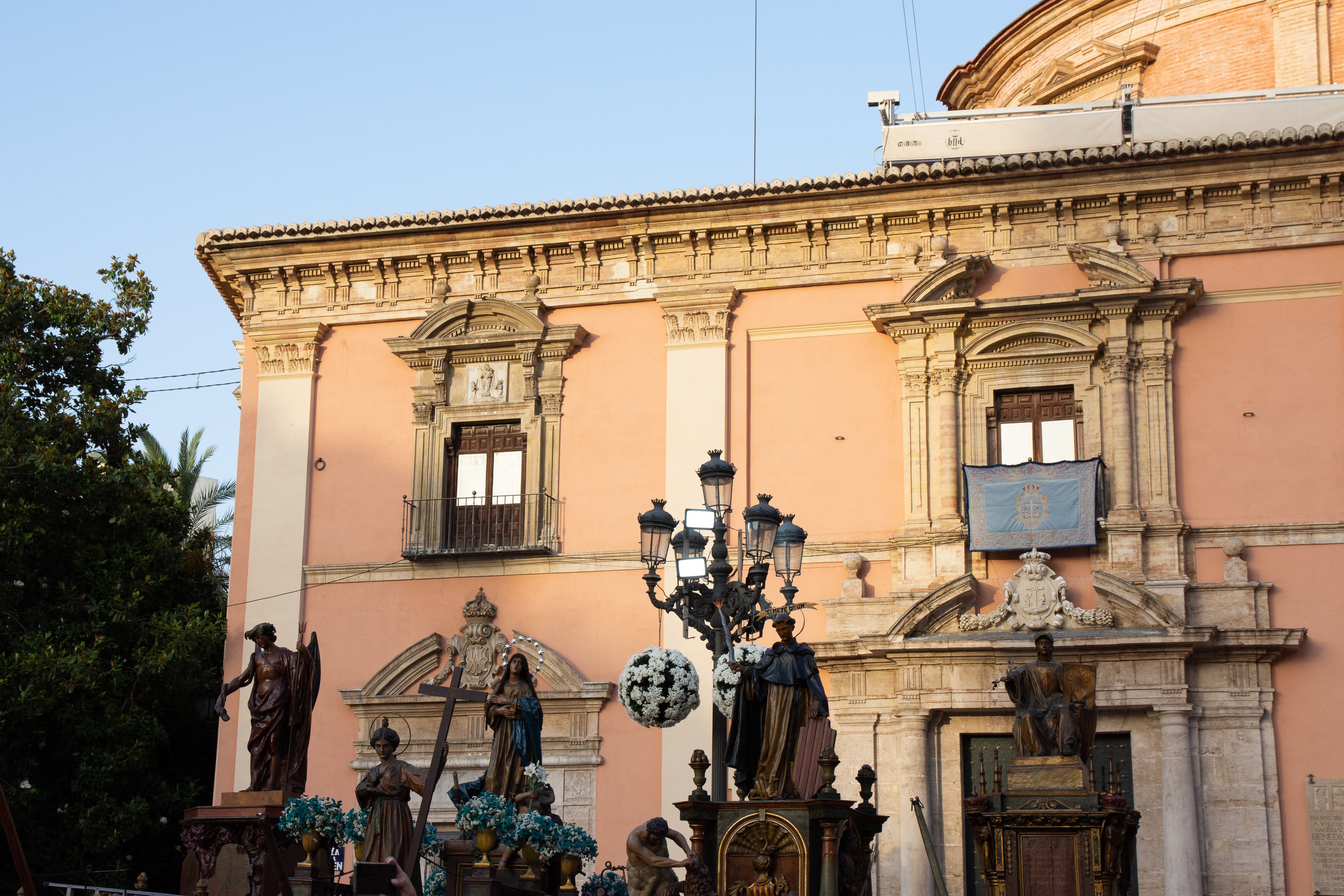
Valencia's Corpus Christi is the city's oldest and most baroque festival: 700 uninterrupted years since its first documentation in 1326. Free and held entirely outdoors, it blends the mascletà, medieval Rocas floats, the Dance of La Moma, and the largest processional monstrance in the world (600 kg of silver). The date shifts each year, always 60 days after Easter.
What it is and why it turns 700
The Corpus Christi is Valencia's oldest and most baroque festival: the first documentary reference dates to 1326 (the Consell de la Ciutat book), and the first general procession to 1355, promoted by Bishop Hugo de Fenollet. In 2026 it celebrated its 700th anniversary — the largest edition in its history — with a candidacy for UNESCO Intangible Cultural Heritage submitted to the city council and Spanish parliament. It has held Bien de Interés Cultural Inmaterial status since 2010. Don't expect the austere solemnity of Toledo or Seville's Corpus: here the show belongs to the medieval Rocas floats, the Dance of La Moma, the theatrical Misteris, and yes, a mascletà. Valencia preserves an exceptional living set of profane elements — not because other Corpus celebrations lack them, but because of the sheer scale. Critical tip: this is a street and gunpowder festival, not a beach holiday; if you're looking for pure devotional recollection, this isn't your Corpus.
When it falls and how to calculate the date
The date is moveable: the Corpus falls liturgically 60 days after Easter Sunday, but Valencia shifts its main day to the following Sunday. In 2026 it ran from 4 to 7 June, with the central Sunday on the 7th; in 2027 it will fall on 30 May. As an evergreen guide, calculate from Easter each year and always confirm the full programme on the official Ajuntament de València website and with Amics del Corpus, as timings are adjusted every edition. Critical tip: June in Valencia already hits hard with heat, and the central Sunday concentrates hours in direct sun between noon and 7 pm. Bring water, a cap, and seek shade; the procession route through Ciutat Vella offers little tree cover and the waits are long. Avoid booking a tight train or flight in the mid-afternoon: the old town locks up solid and getting around is painful.
The central day, hour by hour
The main Sunday follows a packed script. At 10 am, pontifical mass in the Cathedral. At noon, the Cavalcada del Convit sets off — a street parade that announces the festivities. At 2 pm, the mascletà fires from the Plaza del Ayuntamiento (in 2026 by Pirotecnia Alt Palància): five minutes of thunderous gunpowder — all noise, no light. At 4:30 pm the Rocas, the medieval triumphal floats, parade through the streets. And at 7 pm the General Procession departs from the Porta dels Apòstols, featuring the largest processional monstrance in the world (over 4 m tall, 600 kg of silver, 8 kg of gold). Critical tip: the mascletà is extreme noise. If you're with young children, elderly relatives, or anyone with auditory sensitivity, stay well back from the centre of the square and cover your ears — the blast ricochets between the buildings. For the procession, arrive early: by 7 pm the front rows of the public are already taken.
The Rocas, La Moma, and where to eat
The 11 Rocas are wooden ship-shaped floats (built between 1373 and 1392) that come out only for Corpus; La Diablera (1511) is the oldest surviving one. They are kept year-round at the Casa de les Roques (Carrer Roteros 8), a free museum open Tuesday to Saturday 10 am–2 pm and 3–7 pm, Sundays and public holidays 10 am–2 pm, closed Mondays (last admission 30 min before closing). La Moma, a white figure who defeats the seven Momos (the Vices), and the biblical Misteris complete the procession. On the eve — Saturday at 11:30 pm — the Nit d'albaes winds through the centre from the Casa de les Roques. For food: Valencian cherry season is in full swing at market stalls, and horchata with fartons at the Horchatería Santa Catalina — facing the Cathedral, with over two centuries of tradition — is the classic post-procession gathering spot. Critical tip: after the procession, Santa Catalina fills up fast. Go beforehand or accept a standing queue.
Frequently asked questions
When does Valencia's Corpus Christi take place?
Is there an admission charge for the Corpus?
How does it differ from the Corpus in Toledo or Seville?
Where should I stand to watch the procession?
Some links on this page are affiliate links: if you book through them, Andelaria may earn a commission at no extra cost to you. Transparency & affiliate policy
Book tickets and tours: Corpus Christi de València (la Festa Grossa)Plan your trip
Book the essentials for your trip to Valencia.
Other places in Valencia
Ciudad de las Artes y las Ciencias
complejoValencia's defining architectural landmark, designed by Santiago Calatrava over the old Turia riverbed. Its five buildings — the Hemisfèric, the Museu de les Ciències, the Oceanogràfic, the Palau de les Arts and the Umbracle — form Spain's largest cultural complex. The Oceanogràfic is the biggest aquarium in Europe.
Catedral de Valencia
catedralBuilt between the 13th and 15th centuries on the site of a former mosque, the Seu blends Romanesque, Gothic, Renaissance and Baroque styles. It holds the Santo Cáliz, identified by many as the Holy Grail. Its bell tower, the Micalet, rewards the climb of its 207 steps with 360° panoramic views.
La Lonja de la Seda
museoA masterpiece of Valencian civic Gothic, declared a UNESCO World Heritage Site in 1996. Built between 1482 and 1548 as the city's silk-trading exchange, its Sala de Contratació — with 16 helical columns rising 16 metres — still impresses. Free entry on Sundays and public holidays.
Mercado Central
mercadoOne of the largest working food markets in Europe, inaugurated in 1928 inside a magnificent Art Nouveau building with tiled domes and stained glass. More than 300 stalls sell Valencian oranges, fresh fish, garden vegetables and horchata. Entry to the building is free.
Jardines del Turia
parqueNine kilometres of linear urban parkland built over the old Turia riverbed, rerouted after the 1957 floods. Gardens, fountains, football pitches, athletics tracks and the Gulliver Park — complete with slides — form the green lung connecting the historic centre with the Ciudad de las Artes.
Barrio del Carmen
barrioThe medieval heart of Valencia, with streets dating back to Roman and medieval times, Arab towers such as the Torres de Quart and Torres de Serranos, art galleries and tapas bars. It's the epicentre of Valencian street art and the city's liveliest neighbourhood after dark, buzzing from the afternoon right through to dawn.
Las Fallas de València
fiestaLas Fallas de València is fire, gunpowder, and ephemeral art right out in the street. Every March (in 2026, from the 1st to the 19th; main days 15–19) the city burns hundreds of papier-mâché monuments. A free, open-access festival and UNESCO Intangible Cultural Heritage since 2016. Its defining daily ritual: the mascletà at 2:00 PM — 120 dB you don't just hear, you feel.
Gran Fira de València (Feria de Julio)
fiestaThe Gran Fira de València runs throughout July (in 2026, from July 1 to 31): the most festive month of the Valencian year, with over 400 events spread across the city since 1871. Most are free, but the Conciertos de Viveros and the Batalla de Flores grandstands require tickets. Check dates and the programme on the official website.
Similar places in other cities
Revetlla de Sant Joan
TarragonaThe Revetlla de Sant Joan — free and open to all — lights up Tarragona on the night of 23–24 June (the 24th is a public holiday across Catalonia). The Flama del Canigó arrives in the fishermen's quarter of El Serrallo, the bonfire blazes in plaça Corsini, and the beaches fill with fire, firecrackers, coca and cava until dawn.
Festa de Santa Tecla
TarragonaSanta Tecla is Tarragona's main festival, held around 23 September in honour of the city's patron saint since the 12th century. It is free and open to all, featuring the richest seguici popular in Catalonia — bestiari, gegants and castellers in a single procession. It holds a double recognition of national interest at both regional and state level.
Tarraco Viva
TarragonaEvery May, for about two weeks, Tarragona becomes Tárraco again: Tarraco Viva fills the Roman amphitheatre, circus, and forum with gladiators, legionaries, and period markets. It is the most important Roman re-enactment festival in southern Europe, with more than 500 activities and 70% free admission.