Miradouro da Senhora do Monte
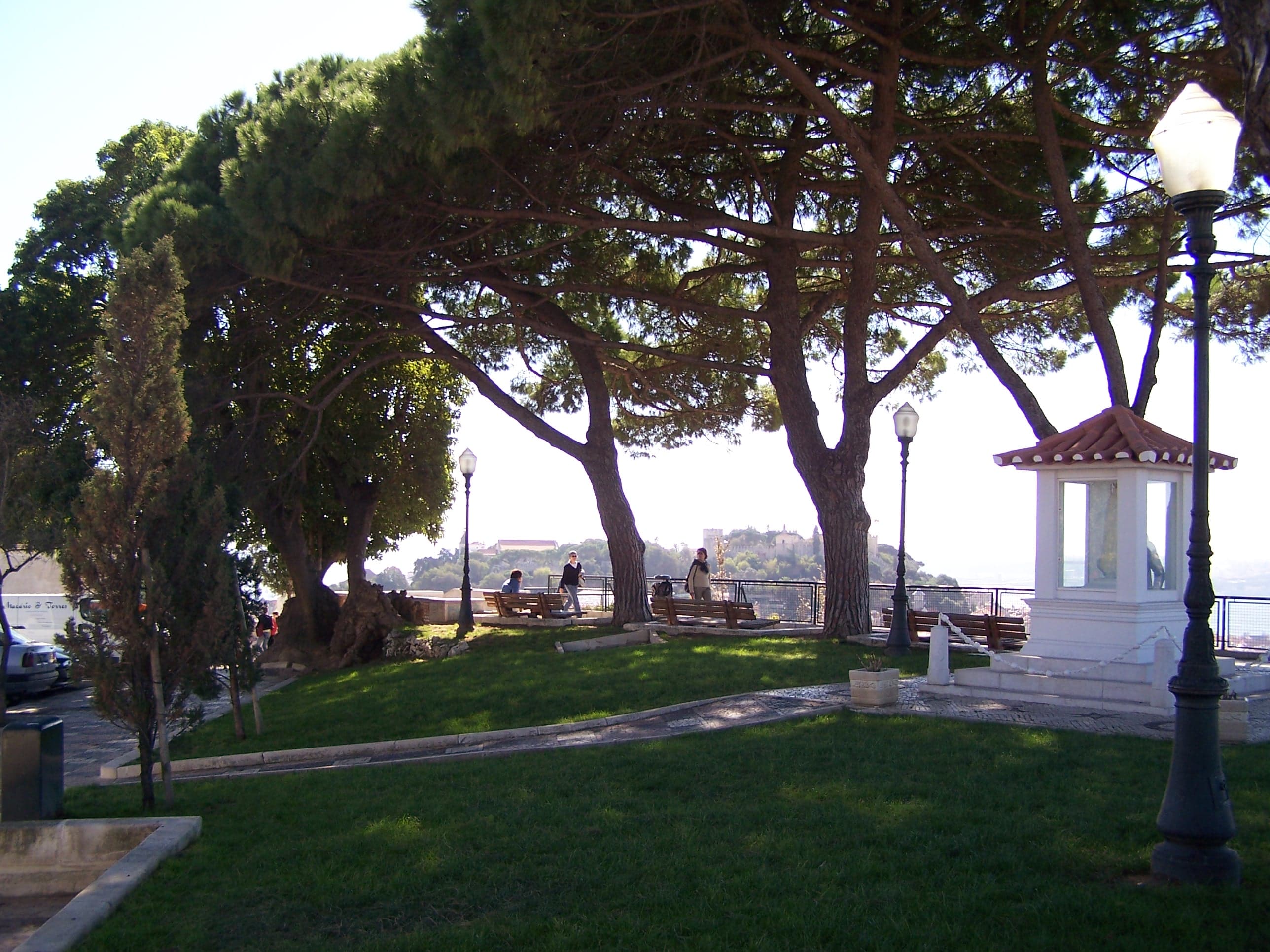
Lisbon's highest viewpoint, in Graça, with a 180º view over the castle, Baixa and Tagus, perfect at sunset.
Lisbon's highest viewpoint — and you feel every metre of it
The Miradouro da Senhora do Monte sits at the top of the Graça hill and is, without question, Lisbon's highest panoramic point. From the low wall you get an almost 180-degree sweep: the Baixa below, Alfama cascading down to the river, the Castelo de São Jorge close enough to touch and the Tagus stretching away in the background. On a clear day you can even make out the Cristo Rei statue on the far bank of the estuary, 5.6 km away. What sets it apart from busier viewpoints is that it still draws plenty of locals: they come for the kiosk, sit on the wall and let the afternoon drift by. Right beside the viewpoint stands a baroque chapel rebuilt in 1796 after the 1755 earthquake; inside, a stone chair attributed to the martyr bishop São Gens survives, along with the long-held belief that pregnant women who sit in it will have an easy birth — a superstition powerful enough that Queen Dona Maria Ana sat there in 1711. The hill is also associated with Afonso Henriques, Portugal's first king, who camped here during the reconquest of Lisbon in 1147.
Free, open 24 hours — and how to have it almost to yourself
Access is completely free: this is a public space with no ticket office or online reservation, open 24 hours a day, seven days a week. With that in mind, the difference between enjoying it and fighting for a spot comes down to timing. Allow 20 to 40 minutes for the views; if you want to look inside the chapel, add another 10–15 minutes. To find it almost deserted, go early, before 10:00. Sunset in summer (around 20:00–21:00) is beautiful but also the busiest moment; if you want a spot on the wall or a table at the kiosk terrace, arrive about an hour ahead. Avoid weekends between 10:00 and 18:00, and peak sunset hour in July and August. One useful note: in summer the sun sets behind the hills of Bairro Alto so you won't see it sink directly; in winter it drops visibly over the Tagus estuary, which makes the cold months better for sunset photography.
Getting there and tips from someone who's been
However you arrive, there will always be a stretch of uphill walking — wear comfortable shoes. The most direct option is the bus: lines 726 and 734 stop closest to the viewpoint, while lines 708, 712 and 735 also serve the area with nearby stops in Graça. The famous Tram 28E drops you at the Rua da Graça stop, from where you walk about 400 m up a steep slope along Rua da Senhora do Monte; bear in mind that in high season the 28E will be packed, so buses 726/734 are usually more comfortable. By metro, the nearest station is Martim Moniz (Green Line), about 9 minutes uphill on foot, with Anjos (also Green Line) as an alternative at around 10 minutes; the metro is not the most restful option given the final climb. Two practical warnings: there are no public toilets at the viewpoint itself — the nearest ones are at the Jardim da Cerca da Graça, about a 5-minute walk away — and the kiosk terrace tables are in high demand at sunset, so expect a wait. As of June 2026 no works or closures have been announced, but if your trip is imminent, do check before heading up.
Frequently asked questions
Do I need to pay or book in advance to visit the Miradouro da Senhora do Monte?
How much time do I need for the visit?
What is the best time to avoid crowds?
Some links on this page are affiliate links: if you book through them, Andelaria may earn a commission at no extra cost to you. Transparency & affiliate policy
Book tickets and tours: Miradouro da Senhora do MontePlan your trip
Book the essentials for your trip to Lisboa.
Other places in Lisboa
Torre de Belém
monumento16th-century Manueline fortified tower on the Tagus, a UNESCO World Heritage site and symbol of the Age of Discoveries.
Mosteiro dos Jerónimos
monumentoManueline-Gothic masterpiece in Belém, a UNESCO site, home to the cloister and the tomb of Vasco da Gama.
Castelo de São Jorge
monumentoMedieval castle atop the Alfama hill, with ramparts, peacocks and the finest panorama over the city and river.
Alfama
barrioLisbon's oldest quarter, a maze of lanes that survived the 1755 earthquake and the birthplace of fado.
Praça do Comércio
plazaThe grand riverside square of the Baixa, opening onto the Tagus beneath the Arco da Rua Augusta and the equestrian statue of King José I.
Time Out Market (Mercado da Ribeira)
mercadoThe former Cais do Sodré market turned food hall with stalls from renowned chefs and Lisbon cooking.
Festas de Santo Antonio de Lisboa
fiestaThe Festas de Santo António are Lisbon's biggest celebration: free and open throughout June, with the main night falling on the 12th to 13th. Neighbourhood arraiais with sardinha assada, the Marchas Populares along Avenida da Liberdade (each bairro competes) and the collective Casamentos de Santo António at the Sé. Over 40 events, nearly all at no cost.
Festas de Lisboa
fiestaThe Festas de Lisboa honour Santo António (who died on 13 June 1231) throughout the entire month of June, with the climax on the night of the 12th. Free and open to all: neighbourhood arraiais with grilled sardines, manjericos and the Marchas Populares along Avenida da Liberdade since 1932.
NOS Alive
fiestaNOS Alive is one of Portugal's biggest music festivals. A ticketed event (day passes or full festival passes), it takes place every July at the Passeio Marítimo de Algés (Oeiras), on the banks of the Tagus river just a few minutes by train from central Lisbon. Rock, indie, pop and electronic music since 2007.
Natal em Lisboa
fiestaChristmas transforms Lisbon into one of Europe's grandest light spectacles: around 182 km of LED lights across 46 points in the Baixa and Chiado, switched on from late November through 6 January. Markets, an ice rink and New Year's Eve fireworks over the Tagus — all free and outdoors.
Similar places in other cities
Monte Igueldo
San SebastiánAt 181 m altitude, this offers the most spectacular views of La Concha bay and the Cantabrian horizon. You reach the top on the 1912 wooden funicular, one of the oldest in the Basque Country. At the summit, a charming century-old amusement park rounds off the experience. An unmissable stop at sunset.
Balcó del Mediterrani
TarragonaSea balcony at the end of Rambla Nova; touching the railing is said to bring luck.
Montjuïc
BarcelonaThe hill above the harbour, with its castle, gardens, the MNAC museum, the 1992 Olympic legacy and the Magic Fountain. The best lookout over the skyline and the sea at sunset.