Titirimundi — Festival Internacional de Teatro de Títeres de Segovia
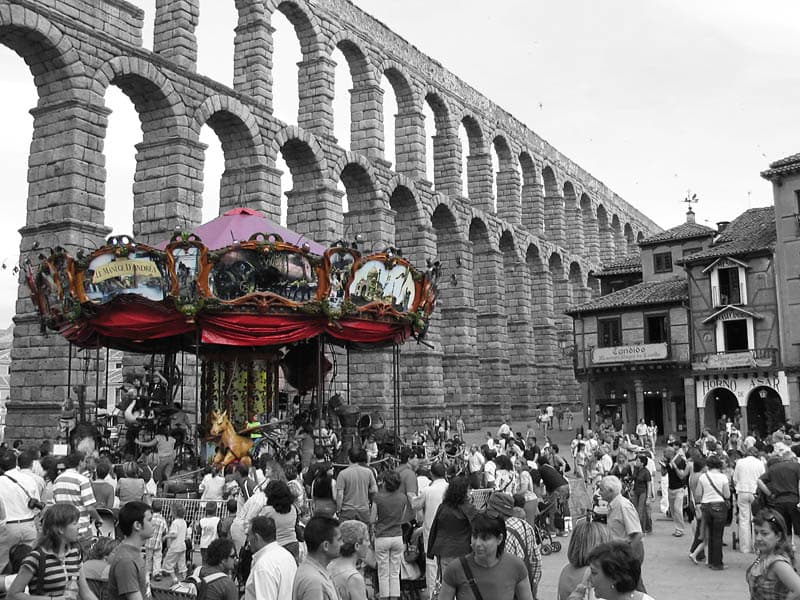
Titirimundi has turned Segovia into the world's puppetry capital every May since 1985, when Julio Michel founded it. In 2026 the 40th edition (May 12-17) brought together 40 companies from nine countries. Street shows are free; indoor performances are ticketed and sold online at tickets.turismodesegovia.com.
What Titirimundi is
Titirimundi is Segovia's International Puppet Theatre Festival, founded by Julio Michel in 1985 and held every May. The 40th edition ran from May 12 to 17, 2026, and the usual pattern is the second half of the month: check titirimundi.es for exact dates and the lineup for the next edition. This isn't a niche kids' festival: the program mixes traditional puppetry with contemporary object theatre, and several pieces are clearly aimed at adults. In 2026, 40 companies from nine countries took part; the capital's program alone listed 30 companies, 226 performances and 25 venues. Key tip: part of the lineup tours villages across the province from May 1st onward, so if you want the real festival — the one that fills squares and courtyards — you need to be in Segovia city during the core dates. And note: the school performances (May 11-14 in 2026) are not open to the general public.
Free in the street, paid indoors
Access is mixed, and it's worth understanding before you plan. Almost everything happening in streets and squares is free, no booking needed: parades, short pieces, roaming formats. Indoor shows — at the Teatro Juan Bravo, on the Plaza Mayor, and other festival venues — are ticketed, with numbered seats. Tickets for paid shows are sold online at tickets.turismodesegovia.com and also at the Visitor Reception Centre; for the children's cycle the festival programs at Sala Julio Michel (La Cárcel_Segovia), the published flat rate was 7 €. We won't quote other prices here, since they change every edition: check the official program. Key tip: don't count on buying at the door the same day. The venues are small, capacity sells out fast, and weekend shows go first. Buy as soon as tickets open and treat street shows as your flexible backup.
The venues and how to get around
There's no single site: the whole city becomes the stage. Regular venues include the Plaza Mayor, Plaza de San Martín, the area around the Aqueduct, the Teatro Juan Bravo, the Episcopal Palace, the Patio de Abraham Senior, the ruins and park of San Agustín, the Zuloaga Garden, and the Royal Mint (Real Casa de la Moneda) — the oldest surviving industrial architecture complex in Spain and one of the oldest in Europe, commissioned by Philip II in 1583 and traditionally attributed to Juan de Herrera, now a museum with reconstructions of its hydraulic machinery, whose courtyards host performances. Everything is walkable, but the old town is cobbled and quite hilly: the Royal Mint sits down by the Eresma river, so heading down is easy — climbing back up to the Plaza Mayor is not. Wear comfortable shoes and leave plenty of time between shows. To get to Segovia, the Avant/Alvia train from Madrid-Chamartín takes about 28 minutes to Segovia-Guiomar, with over thirty daily services; the station is outside the old town, connected by city bus line 11 (Estación AVE-Acueducto) or taxi. By bus, Avanza runs from Moncloa, about 1h20, with a more central stop. Check prices and schedules at renfe.com and avanzabus.com.
Practical tips
The classic mistake is treating the free shows as unlimited. Courtyards and cloisters have tight capacity, and locals tend to show up well ahead of time; arriving right on time usually means watching the backs of other people's heads. In smaller squares, arrive with a comfortable margin. With kids, favor open squares over indoor venues: you can watch standing up, leave without fuss, and skip the ticket cost. For meals between shows, the area around Plaza Mayor and San Martín has plenty of bars for a quick bite, but expect queues at lunchtime during festival dates: eat before 1:30pm or after 3pm. Segovia sits at around 1,000 meters altitude, inland: this isn't a beach or music festival, and May nights genuinely turn chilly. Bring a jacket for outdoor shows. Good combo: pair a show with a visit to the Alcázar and its gardens, in bloom around this time, then head down to the Aqueduct.
Frequently asked questions
Is Titirimundi free, or do you need a ticket?
Where do you buy tickets?
When is Titirimundi held?
Is it worth going with kids?
Some links on this page are affiliate links: if you book through them, Andelaria may earn a commission at no extra cost to you. Transparency & affiliate policy
Book tickets and tours: Titirimundi — Festival Internacional de Teatro de Títeres de SegoviaPlan your trip
Book the essentials for your trip to Segovia.
Other places in Segovia
Acueducto de Segovia
puenteSegovia's most photographed monument: a 1st-century AD Roman aqueduct stretching 728 meters with 167 granite arches built without mortar, reaching 28.5 meters high at the Plaza del Azoguejo. It still stands almost intact after two millennia and, along with the rest of the old town, is a UNESCO World Heritage site.
Alcázar de Segovia
alcazarA stone castle-palace perched on a rocky spur between the Eresma and Clamores rivers, its pointed turrets said to have inspired fairy-tale castles. It once served as a residence of the Catholic Monarchs and now houses a museum of weapons and period furniture. Climbing the Tower of Juan II rewards you with the best view in Segovia.
Catedral de Segovia
catedralKnown as 'the Lady of the Cathedrals' for its late Gothic elegance, it was built in the 16th century after the original church at the Alcázar was relocated. Highlights include the cloister, the Chapter House with its tapestries, and the tower, one of the tallest in Spain. It presides over the city's Plaza Mayor.
Judería de Segovia
barrioOnce a medieval Jewish quarter, active until the expulsion of 1492, with narrow streets running alongside the city wall and the Cathedral. It still holds houses with interior courtyards, the old synagogue (now the Corpus Christi convent), and the Judería Didactic Center, which explains Sephardic life in the city.
Iglesia de San Martín
iglesiaOne of the finest examples of Segovian Romanesque architecture (12th century), with a porticoed atrium wrapping around almost the entire building, a Mudejar tower and carved doorways. It stands on a quiet square in the historic center, along the route between the Aqueduct and the Plaza Mayor, and usually goes unnoticed by mass tourism.
Plaza Mayor de Segovia
plazaThe social heart of the city, arcaded and lined with trees, flanked by the Cathedral, the Town Hall and the Juan Bravo theater. A common starting point for exploring the old town and trying roast suckling pig at the restaurants under its arcades, with terraces open nearly year-round.
Ferias y Fiestas de San Juan y San Pedro de Segovia
fiestaSegovia's big fiestas always land around San Juan (June 24) and San Pedro (June 29). In 2026 the festive core ran from June 19 to 30, with the official opening on Saturday the 20th, and according to the municipal program reported by local press, 97% of it was free: verbenas almost every night in Plaza Mayor, parades, giants and bigheads. You only pay for the bullfight and a handful of concerts.
Fiestas de San Frutos, patrón de Segovia
fiestaSan Frutos is Segovia's patron saint, and his feast day never moves: October 25, every year. The symbol of the celebration is "the miracle of the turning page" — the metal book held by the saint's statue on the Cathedral, which turns a page right at midnight. Free and out in the open street; plan to sleep in Segovia, since there's no train or bus back at that hour.
Similar places in other cities
Fiestas de San Isidro
MadridThe San Isidro Festival honours Madrid's patron saint every 15 May with a pilgrimage to the Pradera de Carabanchel, beside the hermitage and the Manzanares river. Free and open to all, it brings together more than 100 activities: street dances, chotis performances, rosquillas pastries and the great Feria Taurina de Las Ventas running alongside.
Orgullo de Madrid (MADO)
MadridMadrid Pride (MADO) is Europe's largest LGBTQ+ event: its national march, free and open to all, runs along the Paseo del Prado to Colón and draws over two million people every first weekend of July. It was born in 1978 and has its heart in the Chueca neighbourhood.
Mad Cool Festival
MadridMad Cool is Madrid's flagship rock and indie festival: it launched in 2016 and now takes place every July at the Iberdrola Music venue (Villaverde). Four days, multiple stages and international headliners. It is a ticketed event — you need a pass (full festival or single day), and they sell out in waves.