Fiestas de San Frutos, patrón de Segovia
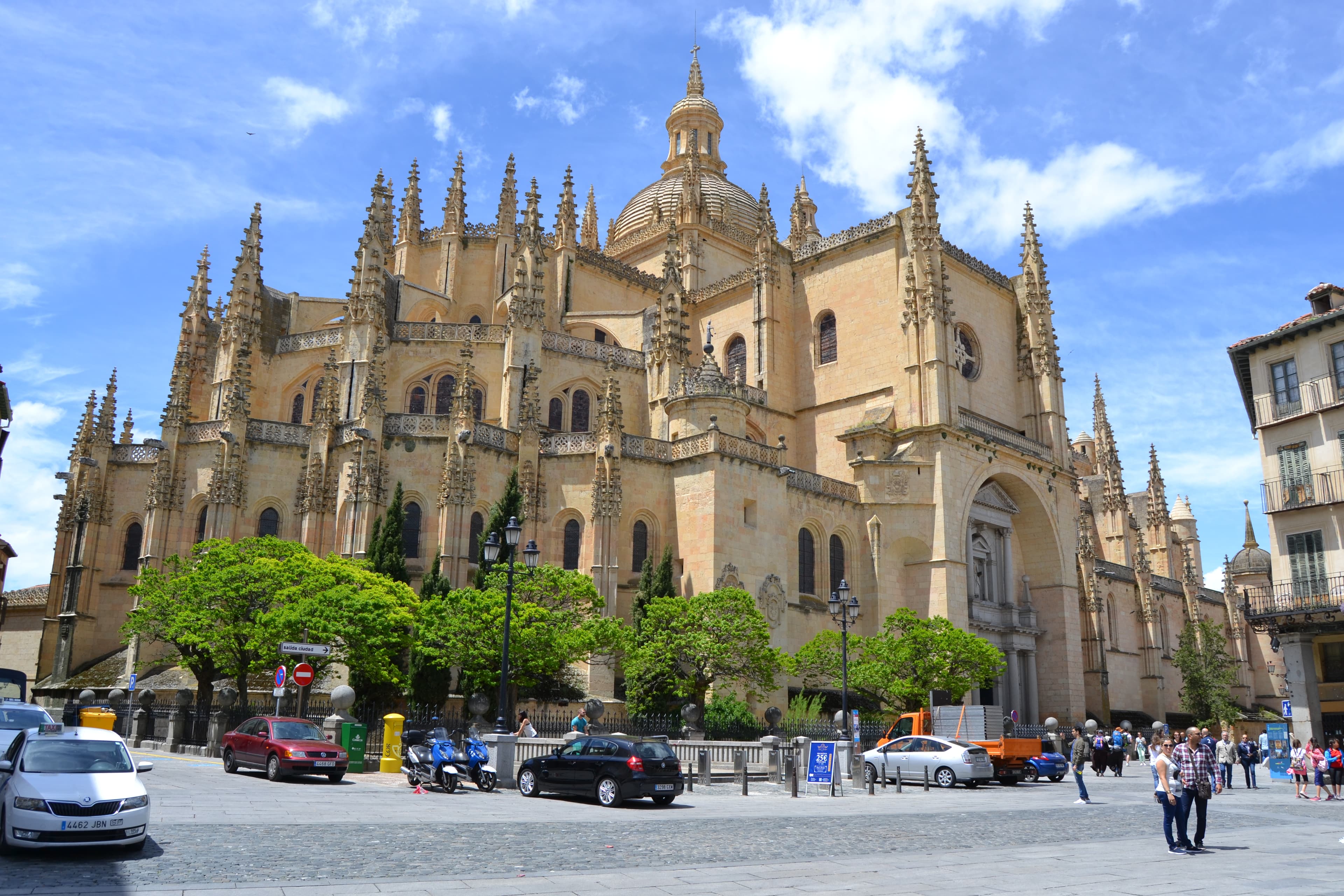
San Frutos is Segovia's patron saint, and his feast day never moves: October 25, every year. The symbol of the celebration is "the miracle of the turning page" — the metal book held by the saint's statue on the Cathedral, which turns a page right at midnight. Free and out in the open street; plan to sleep in Segovia, since there's no train or bus back at that hour.
A hermit from the Hoces with a city-wide feast day
San Frutos was a 7th-8th century hermit — tradition dates him to 642-715 — who withdrew with his siblings Valentín and Engracia to the Hoces del Duratón, about an hour's drive from Segovia. His feast day, though, is entirely urban and fixed: October 25, every year, with no dependence on the lunar calendar or weekends. The reason is simple and rather unromantic: his remains were moved to the Cathedral in the 11th century, where they're venerated in an urn in the retrochoir, a local pilgrimage point during these days. That's why everything centers on the Cathedral and Plaza Mayor, not the canyon. Critical tip: if you're expecting the hermitage pilgrimage (romería), that's a different plan altogether — another day, another logistical setup, a car is essential, parking is scarce and the final stretch is on foot. Don't mix it up with the night in the city. Also note that Segovia's local public holiday tied to San Frutos follows the year's official labor calendar (it may fall on the 25th itself or move to the following Monday if the 25th is a Sunday) — always check the official Segovia bulletin.
The turning page, at midnight, right at the door
The defining moment happens right at midnight between October 24 and 25, at the Puerta de San Frutos of the Cathedral itself: according to tradition, the metal book held by the saint's stone statue turns a page. Legend adds that when the last page turns, it'll be the end of the world — something already documented back in the 19th century, when Mariano Sáez y Romero recorded it as a popular joke told to ordinary folk, not as some ancient dogma. It's free, outdoors, and organized by the Venerable Cofradía del Paso de la Hoja. Critical tip: the moment lasts a split second, and from behind the crowd you won't see a thing. Position yourself facing the statue with plenty of time to spare and a clear line of sight; show up at the last minute and all you'll see is the backs of heads and phone screens. Some years there's a light projection inside the Cathedral — check that year's official program.
Sopas del santo, carol and verse
After midnight, the celebration moves down to the street. Locals hand out "sopas del santo" — Castilian garlic soup made with water, garlic, olive oil, paprika, ham, strands of egg, and salt, cooked by the city's own cooks; any proceeds go to charity, and the symbolic price per portion changes each year, so check the official program. In the Plaza Mayor, the "Romance del Santo Ermitaño" is recited and the Cathedral choir sings the traditional carol dedicated to San Frutos, before the main Mass on the 25th. Critical tip: portions are limited and there's a line; if you stay for the full show inside the Cathedral, you might reach the square only to find the soup's gone. Pick one: soup first or the ceremony first — the two rarely line up.
Program, cold weather and getting there
The city's official program runs roughly through the last ten days of October — confirm the exact dates each year at segovia.es — with theater, music, folk performances, food, and nature activities, almost entirely free, just like the religious events. The stable core is the night of the 24th into the 25th and the day itself; the rest of the lineup changes every year. Critical tip: you're at 1,000 meters of altitude in late October — once the sun sets, temperatures drop fast — and you'll be standing on stone for an hour. Bring real warm layers and shoes for cobblestones. To get there from Madrid, the Avant/Alvia train takes about 28 minutes to Segovia-Guiomar, with the station outside the old town connected by city bus or taxi; by bus, La Sepulvedana/Avanza runs from Moncloa. And there's no train or bus back to Madrid at midnight: book a place to stay in Segovia. The Cathedral's regular tourist visiting hours on the 25th are disrupted by the liturgy; check catedralsegovia.es for times.
Frequently asked questions
When is the San Frutos festival?
Do I need to pay to see it?
Where should I stand to see the turning page?
Can I see it and head back to Madrid the same night?
Some links on this page are affiliate links: if you book through them, Andelaria may earn a commission at no extra cost to you. Transparency & affiliate policy
Book tickets and tours: Fiestas de San Frutos, patrón de SegoviaPlan your trip
Book the essentials for your trip to Segovia.
Other places in Segovia
Acueducto de Segovia
puenteSegovia's most photographed monument: a 1st-century AD Roman aqueduct stretching 728 meters with 167 granite arches built without mortar, reaching 28.5 meters high at the Plaza del Azoguejo. It still stands almost intact after two millennia and, along with the rest of the old town, is a UNESCO World Heritage site.
Alcázar de Segovia
alcazarA stone castle-palace perched on a rocky spur between the Eresma and Clamores rivers, its pointed turrets said to have inspired fairy-tale castles. It once served as a residence of the Catholic Monarchs and now houses a museum of weapons and period furniture. Climbing the Tower of Juan II rewards you with the best view in Segovia.
Catedral de Segovia
catedralKnown as 'the Lady of the Cathedrals' for its late Gothic elegance, it was built in the 16th century after the original church at the Alcázar was relocated. Highlights include the cloister, the Chapter House with its tapestries, and the tower, one of the tallest in Spain. It presides over the city's Plaza Mayor.
Judería de Segovia
barrioOnce a medieval Jewish quarter, active until the expulsion of 1492, with narrow streets running alongside the city wall and the Cathedral. It still holds houses with interior courtyards, the old synagogue (now the Corpus Christi convent), and the Judería Didactic Center, which explains Sephardic life in the city.
Iglesia de San Martín
iglesiaOne of the finest examples of Segovian Romanesque architecture (12th century), with a porticoed atrium wrapping around almost the entire building, a Mudejar tower and carved doorways. It stands on a quiet square in the historic center, along the route between the Aqueduct and the Plaza Mayor, and usually goes unnoticed by mass tourism.
Plaza Mayor de Segovia
plazaThe social heart of the city, arcaded and lined with trees, flanked by the Cathedral, the Town Hall and the Juan Bravo theater. A common starting point for exploring the old town and trying roast suckling pig at the restaurants under its arcades, with terraces open nearly year-round.
Titirimundi — Festival Internacional de Teatro de Títeres de Segovia
fiestaTitirimundi has turned Segovia into the world's puppetry capital every May since 1985, when Julio Michel founded it. In 2026 the 40th edition (May 12-17) brought together 40 companies from nine countries. Street shows are free; indoor performances are ticketed and sold online at tickets.turismodesegovia.com.
Ferias y Fiestas de San Juan y San Pedro de Segovia
fiestaSegovia's big fiestas always land around San Juan (June 24) and San Pedro (June 29). In 2026 the festive core ran from June 19 to 30, with the official opening on Saturday the 20th, and according to the municipal program reported by local press, 97% of it was free: verbenas almost every night in Plaza Mayor, parades, giants and bigheads. You only pay for the bullfight and a handful of concerts.
Similar places in other cities
Fiestas de San Isidro
MadridThe San Isidro Festival honours Madrid's patron saint every 15 May with a pilgrimage to the Pradera de Carabanchel, beside the hermitage and the Manzanares river. Free and open to all, it brings together more than 100 activities: street dances, chotis performances, rosquillas pastries and the great Feria Taurina de Las Ventas running alongside.
Orgullo de Madrid (MADO)
MadridMadrid Pride (MADO) is Europe's largest LGBTQ+ event: its national march, free and open to all, runs along the Paseo del Prado to Colón and draws over two million people every first weekend of July. It was born in 1978 and has its heart in the Chueca neighbourhood.
Mad Cool Festival
MadridMad Cool is Madrid's flagship rock and indie festival: it launched in 2016 and now takes place every July at the Iberdrola Music venue (Villaverde). Four days, multiple stages and international headliners. It is a ticketed event — you need a pass (full festival or single day), and they sell out in waves.