Castilla y León · España
Segovia
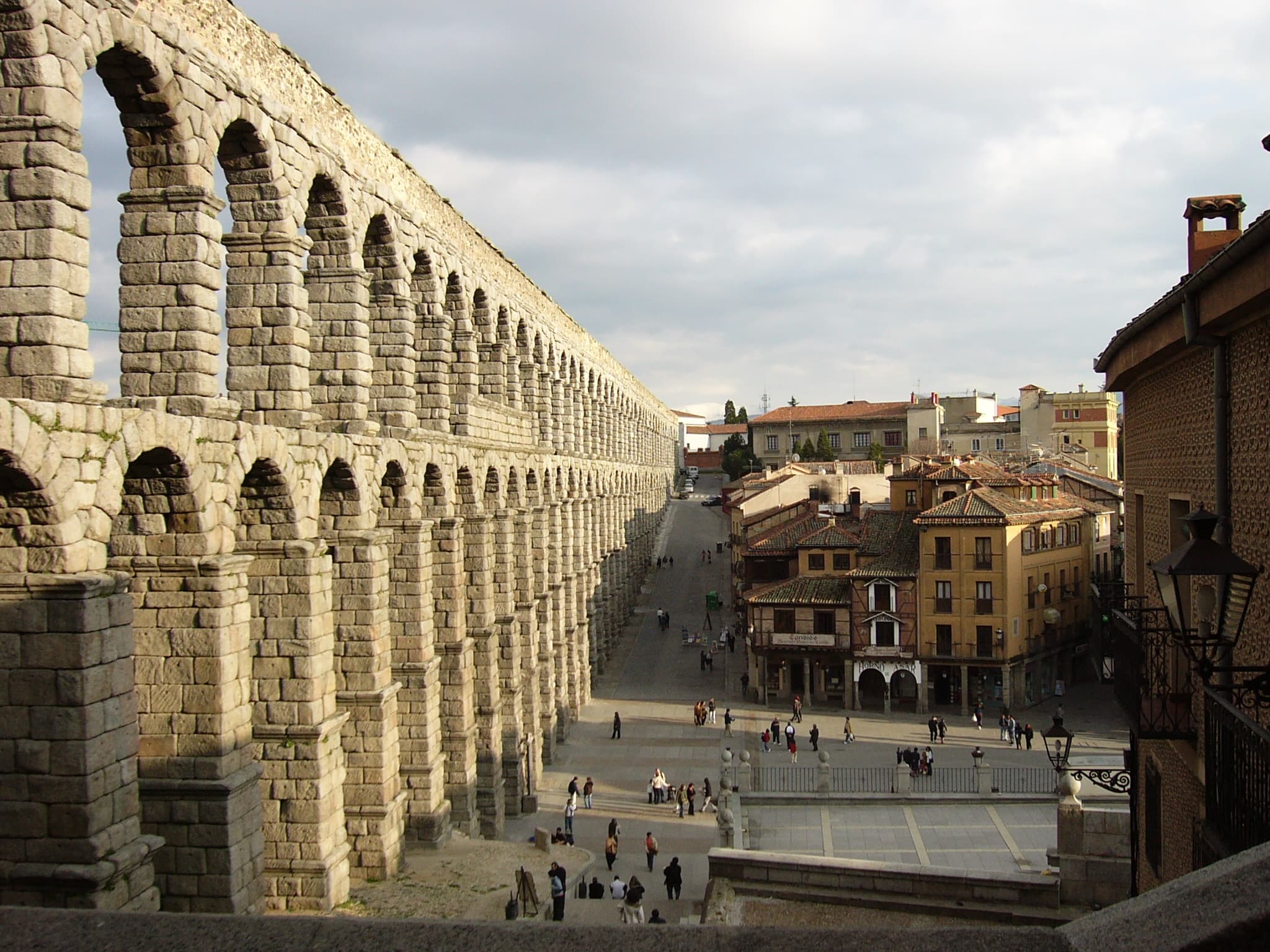
The 167-arch Roman aqueduct built without mortar, the Alcázar above the Eresma river, Spain's last Gothic cathedral, and roast suckling pig.
By Brandon Quiroz · Verified by the Andelaria editorial team
The essentials
- Best time
- May, October
- Cost per day
- 108€/día
- Must-see
- Acueducto de Segovia
About Segovia
Segovia reveals itself in three tiers. Down below, in the Azoguejo district, the Aqueduct cuts across the square with 167 granite arches laid without a single drop of mortar: the Romans built it in the late 1st or early 2nd century AD, and it kept supplying water to the city until 1973. From there, Calle Real climbs uphill — Cervantes, Juan Bravo, Isabel la Católica — up to the Plaza Mayor, where the Cathedral closes off the north side. It's the last Gothic cathedral built in Spain, begun in 1525, when the rest of Europe was already deep into the Renaissance; that delay explains its air of an elegant fossil. And at the tip of the ridge, perched above where the Eresma and Clamores rivers meet, stands the Alcázar: €7 for the palace and museum, €10 if you add the 152 steps up the Tower of Juan II. Climb it. The view over the Vera Cruz church and the valley beats anything you'll find indoors.
What tends to catch people off guard is the Judería, south of the Cathedral. Segovia had one of Castile's largest Jewish communities until 1492, and the tangle of narrow lanes between Calle Judería Vieja and the Puerta de San Andrés remains intact, anchored by the Didactic Center and the old main synagogue — now the Corpus Christi church. Two minutes away, the church of San Martín brings together Segovian Romanesque architecture at its purest: a porticoed gallery, Mudejar capitals, and hardly anyone looking at it.
As for when to come, let's be honest: Segovia sits at 1,000 meters and Castilian summers hit hard. July and August average highs of 30-31°C, with spikes above 35°C, and the granite slopes radiate the heat right back. May, June and September bring highs of 20-27°C, reasonable rainfall, and none of the crowds of peak summer. Mid-May overlaps with Titirimundi, the puppet festival that takes over courtyards and squares; late June brings the Ferias de San Juan y San Pedro. Travel on October 25th, San Frutos, and you'll see the city in local mode, not tourist mode.
Suckling pig at a grill house downtown runs €25-30; the fixed-price lunch menu, €13-20. The city bus costs €1.15 (€2.25 on lines 11/12 to the Segovia-Guiomar AVE station), but the old town is entirely walkable: you'll only need it for the climb back up.
Guides to plan your trip
How much does a trip to Spain cost
A mid-range trip runs about €90–150 per person per day with a shared hotel; budget style, €50–70. Real breakdown of hotel, food, transport, and entry fees.
Best time to visit Spain
May and October offer the best balance: 19–21 °C and fewer crowds. Summer is hot (interior above 40 °C), winter is cheap. A month-by-month guide based on
When to go
Best time to visit: May, October
Best avoided: July, August, December
Temperature, rainfall and crowds month by month.
| Month | Temp. | Rain | Crowds | Suitability |
|---|---|---|---|---|
| January | 9°C | 35 mm | Low | 58 |
| February | 11°C | 30 mm | Low | 65 |
| March | 14°C | 30 mm | Medium | 58 |
| April | 16°C | 45 mm | High | 48 |
| May | 19°C | 55 mm | Medium | 73 |
| June | 25°C | 35 mm | Medium | 65 |
| July | 29°C | 15 mm | High | 39 |
| August | 29°C | 15 mm | High | 39 |
| September | 24°C | 30 mm | Medium | 64 |
| October | 18°C | 45 mm | Medium | 72 |
| November | 12°C | 50 mm | Low | 64 |
| December | 9°C | 40 mm | Medium | 40 |
Suitability (0-100) computed from temperature, rainfall, crowds and events.
Festivals & events
Titirimundi — Festival Internacional de Teatro de Títeres de Segovia
2026-05-12 → 2026-05-16
Titirimundi has turned Segovia into the world's puppetry capital every May since 1985, when Julio Michel founded it. In 2026 the 40th edition (May 12-17) brought together 40 companies from nine countries. Street shows are free; indoor performances are ticketed and sold online at tickets.turismodesegovia.com.
Ferias y Fiestas de San Juan y San Pedro de Segovia
2026-06-20 → 2026-06-30
Segovia's big fiestas always land around San Juan (June 24) and San Pedro (June 29). In 2026 the festive core ran from June 19 to 30, with the official opening on Saturday the 20th, and according to the municipal program reported by local press, 97% of it was free: verbenas almost every night in Plaza Mayor, parades, giants and bigheads. You only pay for the bullfight and a handful of concerts.
Fiestas de San Frutos, patrón de Segovia
2026-10-24 → 2026-10-26
San Frutos is Segovia's patron saint, and his feast day never moves: October 25, every year. The symbol of the celebration is "the miracle of the turning page" — the metal book held by the saint's statue on the Cathedral, which turns a page right at midnight. Free and out in the open street; plan to sleep in Segovia, since there's no train or bus back at that hour.
Browse by category
What to see & where to eat
Acueducto de Segovia
puenteSegovia's most photographed monument: a 1st-century AD Roman aqueduct stretching 728 meters with 167 granite arches built without mortar, reaching 28.5 meters high at the Plaza del Azoguejo. It still stands almost intact after two millennia and, along with the rest of the old town, is a UNESCO World Heritage site.
Alcázar de Segovia
alcazarA stone castle-palace perched on a rocky spur between the Eresma and Clamores rivers, its pointed turrets said to have inspired fairy-tale castles. It once served as a residence of the Catholic Monarchs and now houses a museum of weapons and period furniture. Climbing the Tower of Juan II rewards you with the best view in Segovia.
Catedral de Segovia
catedralKnown as 'the Lady of the Cathedrals' for its late Gothic elegance, it was built in the 16th century after the original church at the Alcázar was relocated. Highlights include the cloister, the Chapter House with its tapestries, and the tower, one of the tallest in Spain. It presides over the city's Plaza Mayor.
Judería de Segovia
barrioOnce a medieval Jewish quarter, active until the expulsion of 1492, with narrow streets running alongside the city wall and the Cathedral. It still holds houses with interior courtyards, the old synagogue (now the Corpus Christi convent), and the Judería Didactic Center, which explains Sephardic life in the city.
Iglesia de San Martín
iglesiaOne of the finest examples of Segovian Romanesque architecture (12th century), with a porticoed atrium wrapping around almost the entire building, a Mudejar tower and carved doorways. It stands on a quiet square in the historic center, along the route between the Aqueduct and the Plaza Mayor, and usually goes unnoticed by mass tourism.
Plaza Mayor de Segovia
plazaThe social heart of the city, arcaded and lined with trees, flanked by the Cathedral, the Town Hall and the Juan Bravo theater. A common starting point for exploring the old town and trying roast suckling pig at the restaurants under its arcades, with terraces open nearly year-round.
Some links on this page are affiliate links: if you book through them, Andelaria may earn a commission at no extra cost to you. Transparency & affiliate policy
Book experiences and tours in SegoviaAverage prices
Approx. cost: ~108 €/day · Moderate
| Item | Price |
|---|---|
| Hotel (per night) | 65–110 € (3-4 estrellas, centro histórico) |
| Fixed-price lunch menu / meal | 13–20 € (25–30 € en restaurantes con cochinillo) |
| Coffee | 1,50–2 € |
| Public transport (city bus) | 1,15 € billete sencillo (2,25 € líneas 11/12 al AVE) |
| Alcázar de Segovia (Palace+Museum / with Tower) | 7 € / 10 € |
1-day estimate (1 person): hotel night + set menu + 2 coffees + 1 beer.
Getting there
- AVE/Avant Renfe from Madrid (Chamartín) to Segovia-Guiomar: roughly 27-30 min, from €7.40 in the basic fare tier (average around €19.8), about 19 trains a day each way. There's no direct line from Barcelona: you'll need to combine the AVE Barcelona-Madrid (about 2h30) with an AVE/Avant Madrid-Segovia. The Segovia-Guiomar station sits on the outskirts; city bus line 11 connects to downtown in about 15 minutes.
- From Madrid via the AP-6/A-6 and then the CL-601 or AP-61, about 90 km, roughly 1 hour. From Valladolid via the A-601, about 115 km (roughly 1h20).
- Parking inside the old town is heavily restricted (pedestrian streets/ORA zone); the usual approach is to leave the car in a park-and-ride lot on the outskirts (near the Alcázar or the Aqueduct area, for instance) or in a paid downtown car park, with rates running roughly €1-1.50/hour.
Plan your trip
Book the essentials for your trip to Segovia.
Book your visit
Frequently asked questions
How many days do you need to see Segovia?
What's the best time to visit Segovia to avoid heat and crowds?
Is it worth going inside the Alcázar, or is the outside enough?
How do you get around Segovia, and how do you get there from Madrid?
When is the best time to visit Segovia?
How much does it cost to visit Segovia per day?
More destinations
- Comunidad de Madrid
Madrid
The art triangle (Prado, Reina Sofía, Thyssen), the taverns of La Latina, and a street life that keeps going late.
- Castilla-La Mancha
Toledo
City of the Three Cultures on a hill wrapped by the Tagus: a Gothic cathedral, the Sephardic Judería, and the Toledo of El Greco.
- País Vasco
Bilbao
Gehry's Guggenheim, the estuary, the Casco Viejo's Siete Calles and pintxos: an industrial city reinvented as a design capital.
- País Vasco
San Sebastián
La Concha bay, pintxos in the Parte Vieja, Chillida's Peine del Viento and two festivals: Jazzaldia and the Zinemaldia film festival.
- Andalucía
Córdoba
The Mosque-Cathedral with its forest of columns, the former capital of the Umayyad caliphate, and the flower-filled patios of May.
- Comunidad Valenciana
Valencia
Calatrava's Ciudad de las Artes, the Art Nouveau Mercado Central, the Jardins del Túria and the Fallas that set the city ablaze every March.