Basílica de Sant Feliu
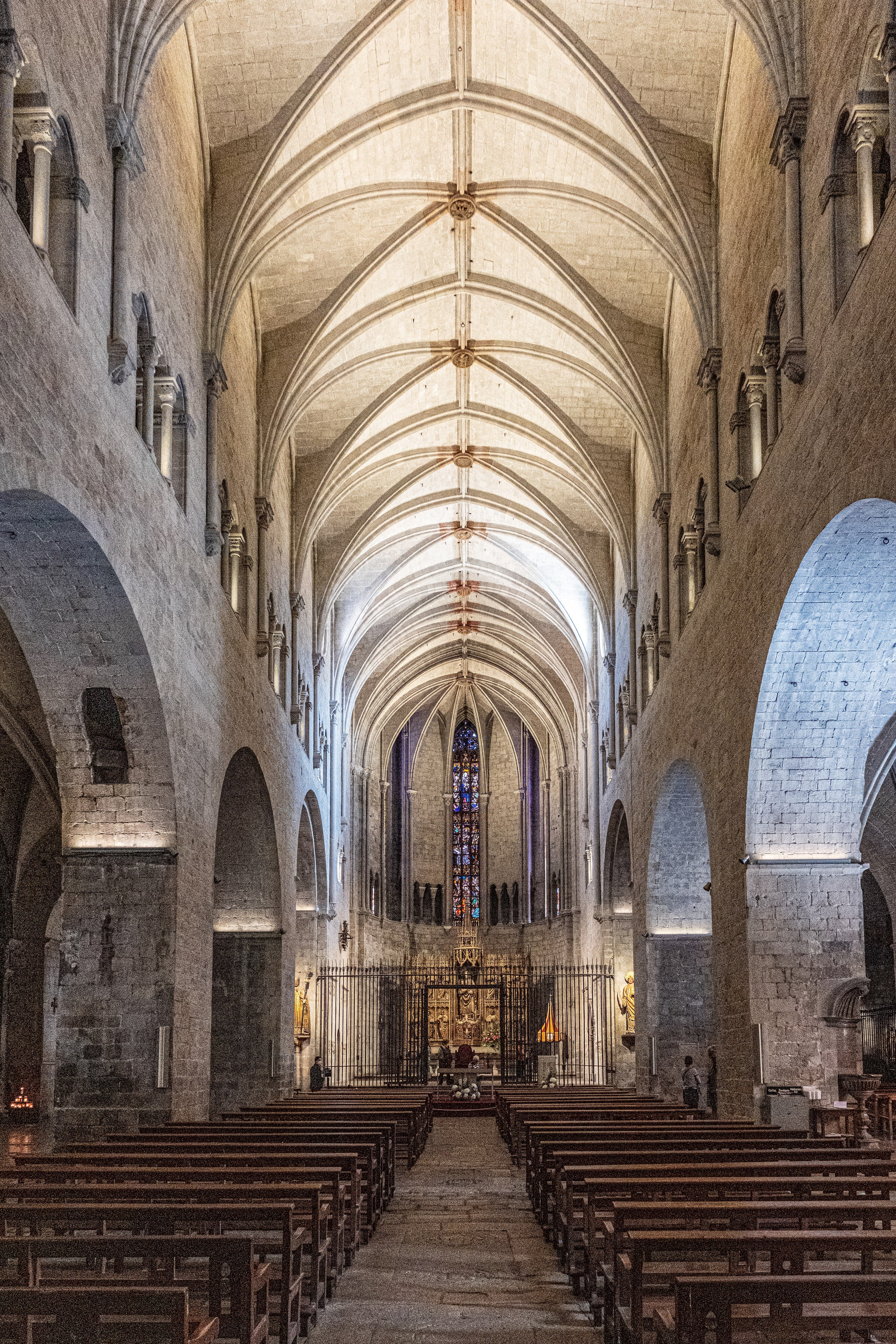
Romanesque-Gothic church with a bell tower truncated by lightning, the tallest in the city. It holds Roman early-Christian sarcophagi.
What it is and why it's worth the visit
The Basilica of Sant Feliu was Girona's first cathedral and the episcopal seat until the 10th century, long before the current cathedral took on that role. The cult began in the 4th century as a martyrium over the tomb of Felix the African, a martyr executed around 304 AD during the Diocletianic persecutions. The most striking sight inside is a set of eight Roman and early Christian sarcophagi (3rd–4th centuries) embedded in the presbytery walls — the best-preserved funerary ensemble in Catalonia, with scenes such as the 'Rape of Proserpina' and the 'Good Shepherd'. Outside, its Gothic octagonal bell tower (begun in 1368) is the tallest in the city and has a story behind it: a lightning bolt decapitated it on 10 January 1651, and the spire was never rebuilt, leaving the truncated silhouette that is today the most recognisable outline of Girona. Don't mistake it for a minor temple: Pope Benedict XVI granted it the title of minor basilica in 2011. Inside you'll also find the baroque Chapel of Saint Narcissus (1782–1792), with the Gothic tomb of the city's patron saint and the curious legend of the 'flies of Saint Narcissus'.
Tickets, opening hours and how to skip the queues
The basilica is visited with a combined ticket with Girona Cathedral: €7.50 general, €5 reduced and €1.50 for groups, with an audio guide included. If you want to add the Museu d'Art, the combined ticket rises to €12 (€8 reduced). Children under 7, members of religious orders and Girona residents enter free. You can buy online at tickets.catedraldegirona.cat — recommended in high season, though advance booking does not appear to be mandatory. Opening hours are Monday to Saturday 10:00–18:00, and Sundays and public holidays 13:00–18:00 (Sunday mornings access is restricted to worship). In summer some sources mention a later closing time, but it's worth checking the official website before visiting. To avoid groups, the best time is right at opening, between 10:00 and 11:30, or after 16:00 in July and August. Closed on 25 December, 1 January and Good Friday.
How to get there and tips from those who've been
The basilica is at Pujada de Sant Feliu, 29, in the heart of the Barri Vell (Old Quarter). From the train and bus station it's about a 10-minute walk, crossing the Onyar river over any of its bridges. If you're coming from Barcelona, the Rodalies train takes around 38 minutes to Girona station. By city bus, the nearest stop is 'Calderers' (TMG line L11), about 130 metres from the church; line L2 also connects to the historic centre. There is no metro or tram in Girona, so the final stretch is always on foot along cobbled streets — wear comfortable shoes, as the Barri Vell is all cobblestones and ramps. Allow about 45 minutes for the basilica alone, or between 1.5 and 2 hours if you combine it with the adjacent cathedral, which is right next door. One useful warning: access for Masses and celebrations can interrupt or restrict the cultural visit without prior notice, so check catedraldegirona.cat on the day if your schedule is tight. Contact phone: 972 201 407.
Frequently asked questions
How much does entry cost and do I need to book?
How long do I need to visit?
What is the best time to avoid crowds?
Some links on this page are affiliate links: if you book through them, Andelaria may earn a commission at no extra cost to you. Transparency & affiliate policy
Book tickets and tours: Basílica de Sant FeliuPlan your trip
Book the essentials for your trip to Girona.
Other places in Girona
Catedral de Girona (Santa María)
monumentoThe cathedral with the widest Gothic nave in the world, atop 90 Baroque steps. Inside, the famous 11th-century Tapestry of Creation.
Banys Àrabs
monumentoDespite the name, these are 12th-century Romanesque baths inspired by hammams. The cold room with its domed octagonal lantern is the most photographed.
Cases de l'Onyar i Pont de les Peixateries Velles
puenteThe colourful houses over the river and the red iron bridge built by Eiffel's firm in 1877. Girona's definitive postcard view.
El Call (barrio judío)
barrioOne of the best-preserved medieval Jewish quarters in Europe: very narrow stone alleys and the Museum of Jewish History.
Passeig de la Muralla
miradorFree walk along the top of the old Carolingian walls, with towers to climb and the best views over the rooftops and surrounding hills.
Revetlla de Sant Joan
fiestaThe Nit de Sant Joan is free and open to all, lighting up Girona on the night of 23–24 June (the 24th is a public holiday across Catalonia). Bonfires blaze in neighbourhoods and squares, the Flama del Canigó arrives at the Plaça del Vi, and coca and cava fill the tables: an inland midsummer festival, no beach, right beside the Onyar.
Temps de Flors
fiestaEvery May, Girona's Barri Vell becomes an ephemeral garden: Temps de Flors fills more than 100 spaces across the medieval old town — the cathedral, the Arab baths, private courtyards that only open for the occasion — with around 140 floral installations. Nine days, free admission, and over 400,000 visitors at the last edition.
Fires de Sant Narcís
fiestaThe Fires de Sant Narcís are Girona's Festa Major: roughly ten days in late October, around the 29th, with over 200 free events. Documented since the 14th century, it is the oldest fair in Catalonia, featuring the famous fira d'atraccions in the Parc de la Devesa and the old town spilling out into the streets.
Navidad en Girona
fiestaDecember turns Girona into one of Catalonia's most beautiful postcards: the Barri Vell and the bridges over the Onyar are lit up from late November, there's a free Christmas market in the Plaça de la Independència, and the Cathedral can be visited without queues — all with tourism at its lowest and crisp, dry cold.
Similar places in other cities
Sagrada Família
BarcelonaGaudí's unfinished basilica, under construction since 1882 and a UNESCO World Heritage Site. Its forest of columns and coloured stained glass is a unique experience; book your ticket in advance.
Casa Batlló
BarcelonaGaudí's most fantastical house on Passeig de Gràcia, with its bone-and-scale façade and a roof evoking the dragon of Saint George. A jewel of modernisme in the heart of the Eixample.
Església de Sant Bartomeu i Santa Tecla
SitgesThe church on the rock between two beaches, the symbol of Sitges.