Banys Àrabs
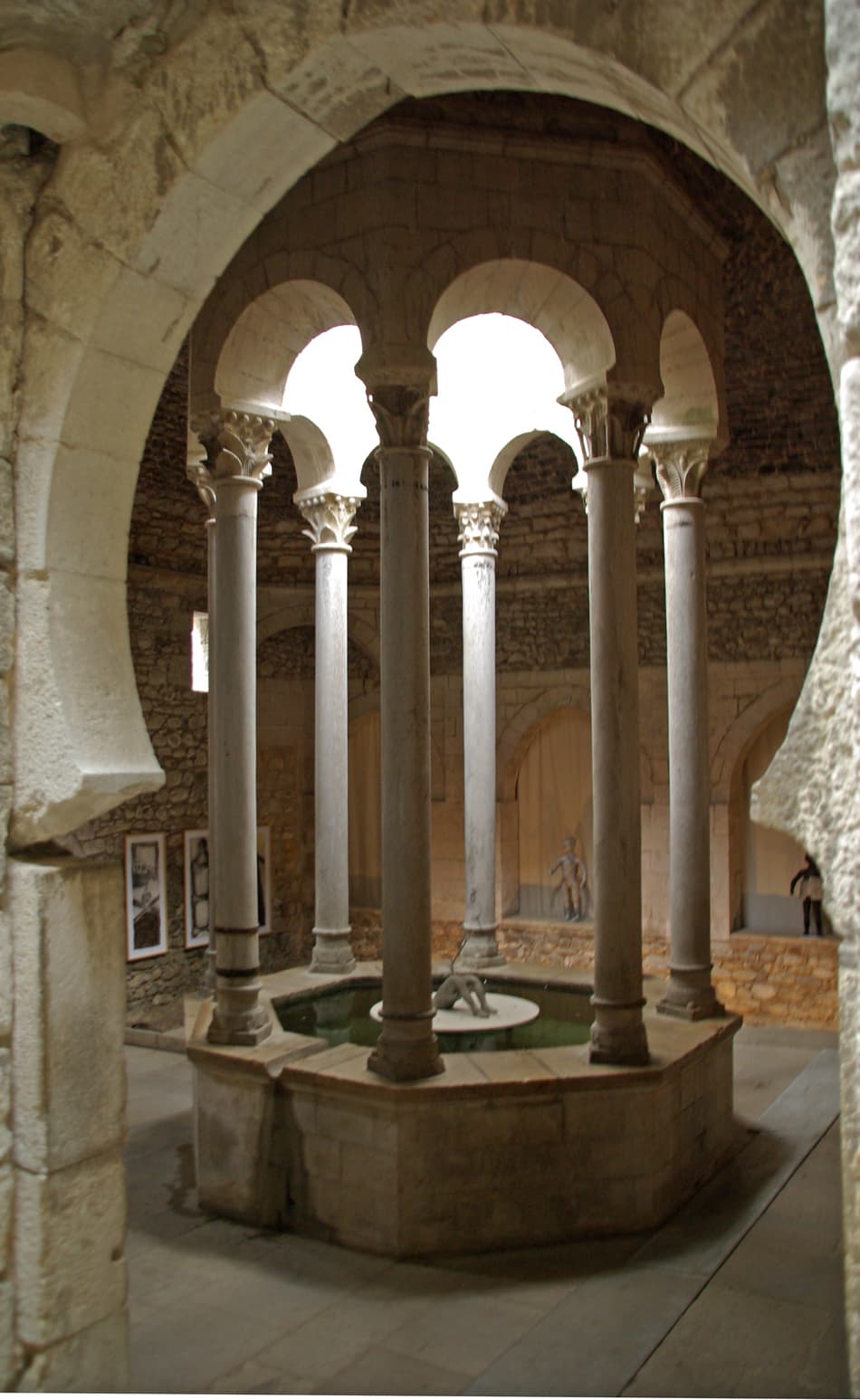
Despite the name, these are 12th-century Romanesque baths inspired by hammams. The cold room with its domed octagonal lantern is the most photographed.
The essentials
- Tickets
- desde 3 €
Neither Arab nor Roman: Romanesque, from 1194
The so-called Arab Baths are neither Arab nor Roman: they are a Christian building in late Romanesque style, built in 1194, copying the layout of Roman thermae by way of the North African Muslim bath models. The name caught on in the 19th century, long after they had stopped working, and it stuck.
From siege to nuns' pantry
The building's history explains why it survives so well. The 1285 siege left it badly damaged, and in 1294 James II of Aragon handed it to Ramón de Tolrà in exchange for restoring it. It worked as baths until it closed in the 15th century; it then passed into private hands and, in 1617, a convent of Capuchin nuns used it as a pantry, kitchen and laundry. That domestic use saved it from ruin. Not until 1929 did it pass into public ownership and get restored.
The octagonal lantern and the five rooms
The image almost everyone comes for is in the first room, the frigidarium or cold room. At its centre is an octagonal pool ringed by eight columns that hold up an open dome, an octagonal lantern rising 12.2 metres from the floor through which the light comes in. Notice that the arches are semicircular, not horseshoe-shaped, and that the capitals carry carved foliage and the odd animal: this is Romanesque, not Islamic art. From there the route is a lesson in how a bathhouse worked: the changing rooms, the warm room, the hot room with its floor over a hot-air chamber in the manner of the Roman hypocaust, and at the back the furnace and boiler that produced the steam.
Hours, price and how to get there
It opens Monday to Saturday from 10 am to 6 pm and on Sundays and holidays from 10 am to 2 pm, the same hours all year; it closes on 1 and 6 January and from 24 to 26 December. General admission is around €3, with a reduced rate of €2 for over-65s and €1 for students and groups; under-8s go free. Since rates and hours can change, confirm the day's details on the official website, banysarabs.cat. It is right in the old town, between the church of Sant Feliu, the city wall and the cathedral, so you reach it on foot in a couple of minutes from any of the three.
Our tip
We recommend going first thing: the space is small, and when a group turns up the cold room runs out of room to photograph the lantern in peace. As it is two minutes from the cathedral and the Call, the natural thing is to string the three together in one morning. It is a short visit, a good half hour, but you rarely see so clearly how people bathed eight hundred years ago. Then climb up to the roof terrace, where the second tier of the cupola shows through: it is the best spot to understand the dome you have just seen from inside.
Frequently asked questions
What are the opening hours of the Banys Àrabs in Girona?
How much does admission cost?
How long does a visit to the Banys Àrabs take?
Where are they and how do you get there?
Some links on this page are affiliate links: if you book through them, Andelaria may earn a commission at no extra cost to you. Transparency & affiliate policy
Book tickets and tours: Banys Àrabs· desde 3 €Plan your trip
Book the essentials for your trip to Girona.
Other places in Girona
Catedral de Girona (Santa María)
monumentoThe cathedral with the widest Gothic nave in the world, atop 90 Baroque steps. Inside, the famous 11th-century Tapestry of Creation.
Cases de l'Onyar i Pont de les Peixateries Velles
puenteThe colourful houses over the river and the red iron bridge built by Eiffel's firm in 1877. Girona's definitive postcard view.
El Call (barrio judío)
barrioOne of the best-preserved medieval Jewish quarters in Europe: very narrow stone alleys and the Museum of Jewish History.
Basílica de Sant Feliu
monumentoRomanesque-Gothic church with a bell tower truncated by lightning, the tallest in the city. It holds Roman early-Christian sarcophagi.
Passeig de la Muralla
miradorFree walk along the top of the old Carolingian walls, with towers to climb and the best views over the rooftops and surrounding hills.
Revetlla de Sant Joan
fiestaThe Nit de Sant Joan is free and open to all, lighting up Girona on the night of 23–24 June (the 24th is a public holiday across Catalonia). Bonfires blaze in neighbourhoods and squares, the Flama del Canigó arrives at the Plaça del Vi, and coca and cava fill the tables: an inland midsummer festival, no beach, right beside the Onyar.
Temps de Flors
fiestaEvery May, Girona's Barri Vell becomes an ephemeral garden: Temps de Flors fills more than 100 spaces across the medieval old town — the cathedral, the Arab baths, private courtyards that only open for the occasion — with around 140 floral installations. Nine days, free admission, and over 400,000 visitors at the last edition.
Fires de Sant Narcís
fiestaThe Fires de Sant Narcís are Girona's Festa Major: roughly ten days in late October, around the 29th, with over 200 free events. Documented since the 14th century, it is the oldest fair in Catalonia, featuring the famous fira d'atraccions in the Parc de la Devesa and the old town spilling out into the streets.
Navidad en Girona
fiestaDecember turns Girona into one of Catalonia's most beautiful postcards: the Barri Vell and the bridges over the Onyar are lit up from late November, there's a free Christmas market in the Plaça de la Independència, and the Cathedral can be visited without queues — all with tourism at its lowest and crisp, dry cold.
Similar places in other cities
Sagrada Família
BarcelonaGaudí's unfinished basilica, under construction since 1882 and a UNESCO World Heritage Site. Its forest of columns and coloured stained glass is a unique experience; book your ticket in advance.
Casa Batlló
BarcelonaGaudí's most fantastical house on Passeig de Gràcia, with its bone-and-scale façade and a roof evoking the dragon of Saint George. A jewel of modernisme in the heart of the Eixample.
Església de Sant Bartomeu i Santa Tecla
SitgesThe church on the rock between two beaches, the symbol of Sitges.