Park Güell
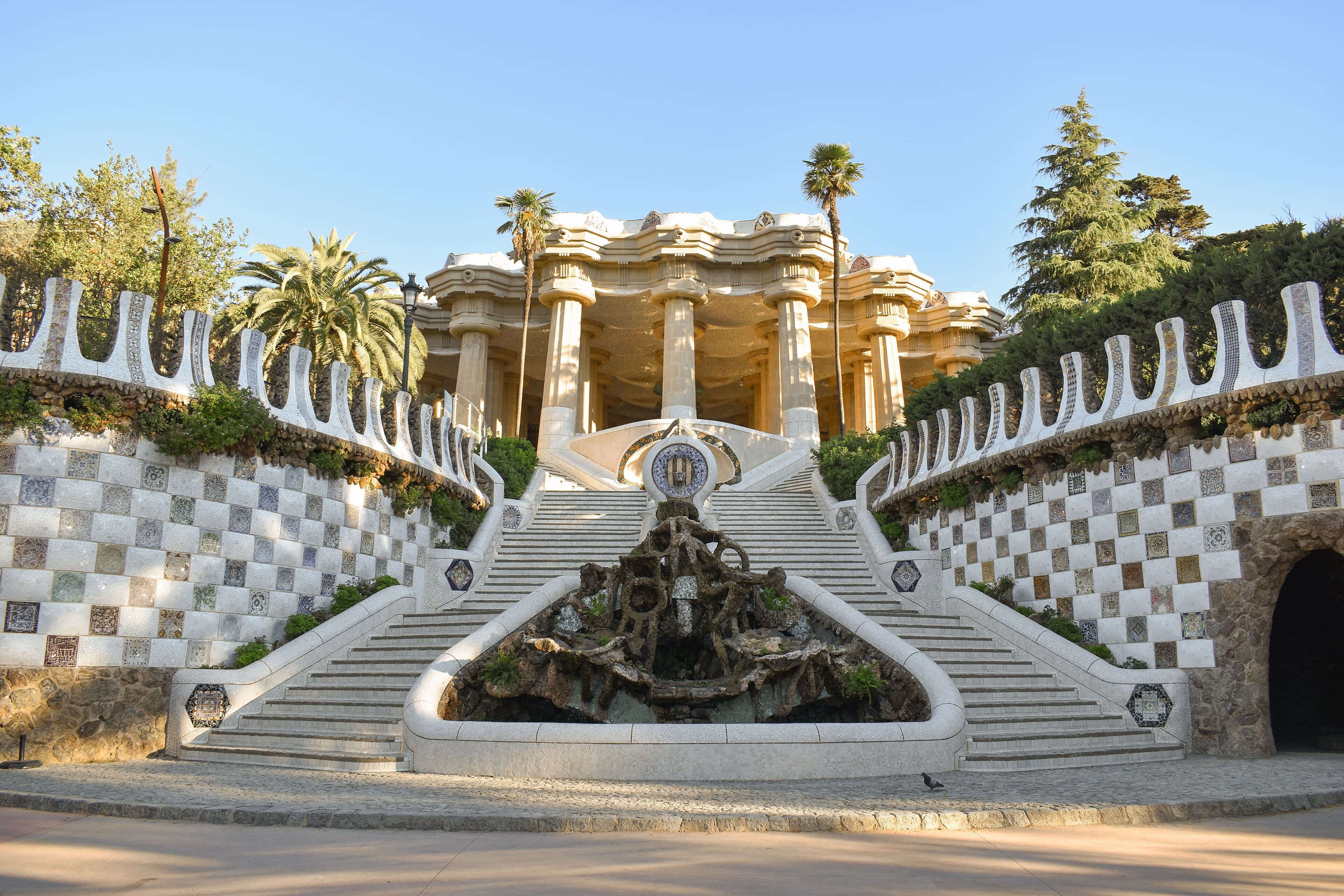
Gaudí's modernista park on the Carmel hill, with the wavy trencadís-tiled bench terrace and views over the whole city. The monumental area has timed, capacity-limited tickets.
The essentials
- Tickets
- desde 18 €
A housing estate that flopped
Gaudí designed Park Güell between 1900 and 1914 for Eusebi Güell, an industrialist who dreamed of a luxury housing estate on the slope of Carmel hill. The plan was to sell sixty plots to well-off families. Two sold. The venture collapsed, work stopped around 1914, and the estate sat half-empty until the city council bought it in 1926 and opened it as a public park. It has stayed that way ever since, spread across a 17.18-hectare hill in the Gràcia district. UNESCO listed it as a World Heritage Site in 1984.
The dragon, the columns and the bench
What almost everyone comes to photograph is up top, in the so-called monumental zone. The entrance staircase climbs toward the mosaic dragon —actually a salamander— and leads into the hypostyle hall, a forest of Doric columns meant to be the market for an estate that never came. Above that roof opens the great terrace, ringed by the wavy bench that runs the whole perimeter: kilometres of trencadís, the broken ceramic that Gaudí and Josep Maria Jujol set by hand, piece by piece. From the bench you see most of Barcelona dropping toward the sea; on a clear day you can pick out the towers of the Sagrada Família.
Two parks: one paid, one free
There's one thing worth knowing before you head up, because plenty of people get caught out: the park has two parts. The monumental zone is paid, capacity-limited and entered by time slot, and you can only buy online; there's no longer a box office. General admission runs about €18, with a reduced fare around €13.50 for children aged 7 to 12 and over-65s, and under-6s enter free. The rest of the park —the Mediterranean woodland, the stone paths, the viaducts held up by leaning columns— is free and open to wander. Prices and hours shift by season, so confirm them at parkguell.barcelona before you go (official site, checked in 2026); broadly it opens around 9:30 and closes at 19:30 from April to October, earlier in winter.
How to get up there and when to go
It's up high and the climb is tiring. From Vallcarca metro (L3) there are escalators along the Baixada de la Glòria that swallow much of the slope; from Lesseps (L3) the walk is longer. We recommend booking the first morning slot or the last of the afternoon: by midday the terrace fills with groups and the light flattens your photos. If you come in summer, bring water and a hat, because there's little shade up top. And it pairs well with the Sagrada Família on the same day —they're about twenty minutes apart by metro— if you book both with separate time slots, since both sell out in high season. It isn't the most famous Gaudí, but it's the one you enjoy in the open air, sitting a while on the bench watching the city.
Frequently asked questions
How much does Park Güell cost?
What are Park Güell's opening hours?
Do you need to book tickets online?
How do you get to Park Güell by metro?
Some links on this page are affiliate links: if you book through them, Andelaria may earn a commission at no extra cost to you. Transparency & affiliate policy
Book tickets and tours: Park Güell· desde 18 €Plan your trip
Book the essentials for your trip to Barcelona.
Other places in Barcelona
Sagrada Família
monumentoGaudí's unfinished basilica, under construction since 1882 and a UNESCO World Heritage Site. Its forest of columns and coloured stained glass is a unique experience; book your ticket in advance.
Casa Batlló
monumentoGaudí's most fantastical house on Passeig de Gràcia, with its bone-and-scale façade and a roof evoking the dragon of Saint George. A jewel of modernisme in the heart of the Eixample.
Barri Gòtic
barrioThe medieval heart of the Ciutat Vella: stone alleys, the cathedral, remains of the Roman wall and hidden squares. The best place to get lost on foot in Barcelona.
Mercat de la Boqueria
mercadoThe city's most famous market, just off the Rambla: stalls of fruit, ham, fish and bar counters for tapas. Crowded but authentic if you go early in the morning.
Montjuïc
miradorThe hill above the harbour, with its castle, gardens, the MNAC museum, the 1992 Olympic legacy and the Magic Fountain. The best lookout over the skyline and the sea at sunset.
La Barceloneta
playaThe old fishermen's quarter and its urban beach, the most central in the city. A seafront promenade, beach bars and rice dishes facing the Mediterranean, minutes from the Gothic Quarter.
Revetlla de Sant Joan
fiestaOn the night of June 23rd to 24th, Barcelona catches fire: more than 92,000 people packed the beaches in 2025 (Guàrdia Urbana). Free street parties across all ten districts, coca de Sant Joan, cava, firecrackers and the Flama del Canigó brought down from the Pyrenees. June 24th is a public holiday throughout Catalonia. Here's how to enjoy it without nasty surprises.
Primavera Sound
fiestaPrimavera Sound is a paid mega-festival that fills Barcelona's Parc del Fòrum in early June. Founded in 2001, it now draws around 75,000 people a day with an international lineup of indie, electronic, hip hop and pop. It isn't free: you get in with a full pass or a day ticket, and it usually sells out months ahead.
Festa Major de Gràcia
fiestaThe Festa Major de Gràcia is Barcelona's most iconic neighbourhood festival — and it's completely free. From 15 to 21 August 2026 (with the pregó on Friday 14), 23 streets in the barrio compete with themed decorations that local residents spend months building from recycled materials. Over 600 free activities: concerts, castells, correfoc and gegants.
Santa Eulàlia
fiestaSanta Eulàlia, co-patron of Barcelona alongside the Mare de Déu de la Mercè, gives her name to the city's winter festa major: four days around 12 February with gegants, castells, correfoc and sardanes in the Barri Gòtic. Nearly a hundred events, all free and open to the public, and far less crowded than La Mercè.
Sónar
fiestaSónar is Barcelona's electronic music and multimedia art festival, founded in 1994 and now a global benchmark with over 30 editions. It is a ticketed event held normally in mid-June, combining live performances, DJ sets, installations, and the technology congress Sónar+D. Dates and lineups are announced each year at sonar.es.
La Mercè
fiestaLa Mercè is Barcelona's greatest festival, centred around 24 September (a local public holiday). Five days, over 500 free and open-access events: castellers, gegants, correfoc, concerts and a closing piromusical. Everything happens in the street, no tickets required. Check dates and the line-up for the next edition at barcelona.cat/lamerce.
Similar places in other cities
Jardines del Turia
ValenciaNine kilometres of linear urban parkland built over the old Turia riverbed, rerouted after the 1957 floods. Gardens, fountains, football pitches, athletics tracks and the Gulliver Park — complete with slides — form the green lung connecting the historic centre with the Ciudad de las Artes.
Parque del Buen Retiro
MadridDeclared a UNESCO World Heritage Site in 2021, El Retiro covers 125 hectares in the heart of Madrid. Its Estanque Grande with the Monument to Alfonso XII, the Palacio de Cristal and the rose garden with more than 4,000 rosebushes make it Madrileños' favourite green lung.