Festival F
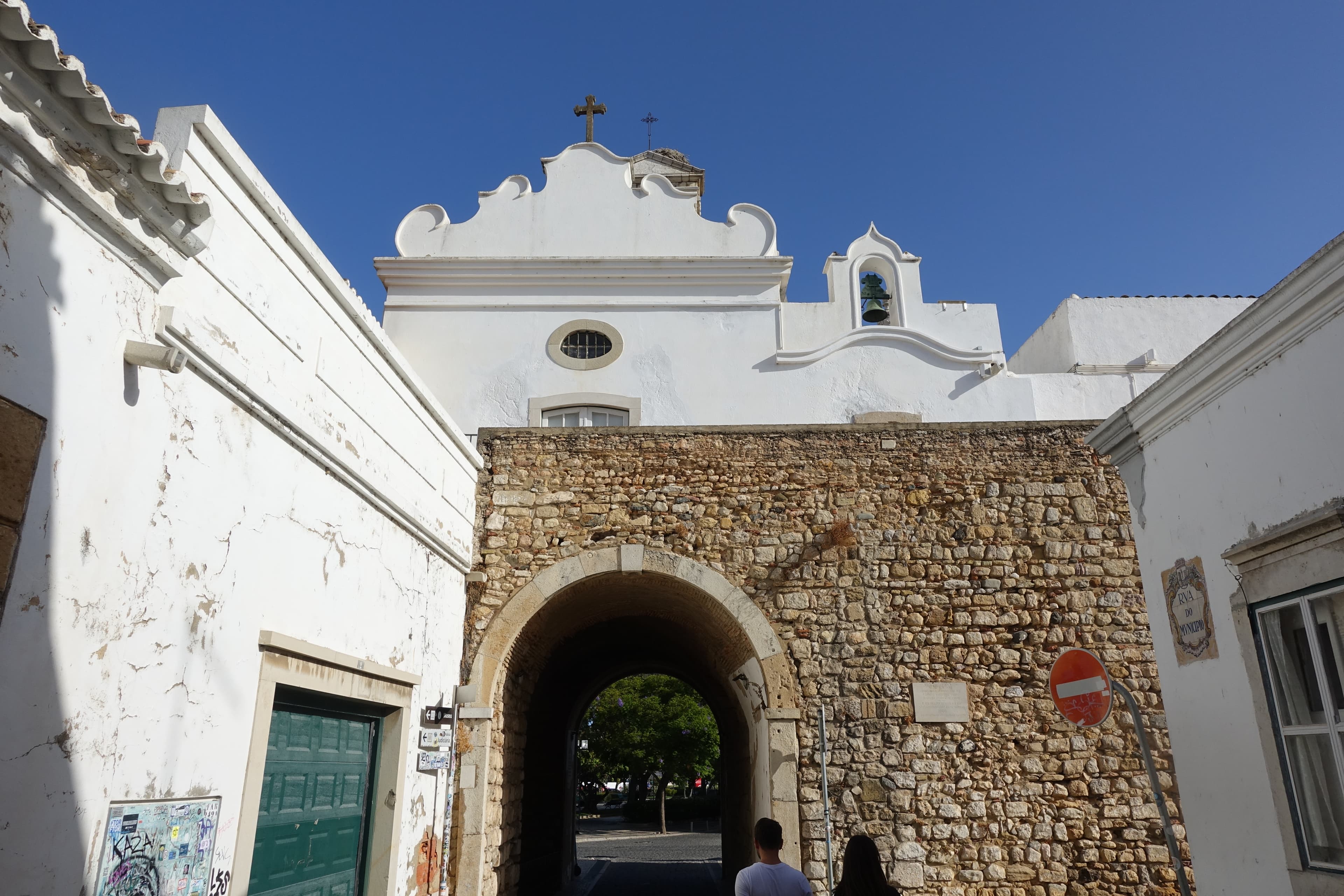
Festival F takes over Faro's old town: the baixa and the walled Cidade Velha fill with named stages (Arco, Sé, Museu, Ria) in early September. It's a paid event — day or festival pass via Ticketline — and it bills itself as "o último grande festival de verão," Portugal's last big summer send-off.
A festival woven into the city
Festival F isn't set up on some field outside town — the venue is Faro itself. The baixa and the walled Cidade Velha shut down in early September (the 2026 edition kicked off on Thursday the 3rd), with stages scattered across squares, courtyards and churches, and more than sixty concerts on the bill. It's run by the Município de Faro, the Teatro das Figuras and AmbiFaro, and calls itself "o último grande festival de verão" — the last big festival before Portugal's summer winds down. That setup changes the whole experience: there's no campsite, no single fenced-off ground — you walk between the walls from one concert to the next, and you might grab dinner at an ordinary restaurant in the middle of the night. The one thing to know: it's all cobblestone, with an uphill stretch toward Vila Adentro and narrow streets that jam up the moment a big-name set ends. Wear proper shoes, nothing with a smooth sole, and expect to file out single-file from the smaller stages. Dates and lineup for each edition are posted at festivalf.pt.
The stages and how to get around
Each stage has its own name and a spot you'll recognize: Palco Arco by the Arco da Vila, Palco Sé on the square in front of the cathedral, Palco Museu next to the municipal museum, plus Palco Fábrica, Palco Ria overlooking the Ria Formosa, Palco Quintalão and Palco Músicos. It all runs from Vila Adentro down to the waterfront, so in practice everything's a few minutes' walk away — organizers have even added spaces like the Castelo and a Silent Party in past editions. Distance isn't the issue — the bottleneck is. The passages between the walls and the squares are narrow, and they fill up fast around headline sets. Two rules that actually work: first, set times overlap, so decide in advance what you're willing to skip rather than trying to catch half of everything; second, leave five minutes before a set ends if you want a good spot at the next stage.
Tickets, prices and where to sleep
This is a paid festival, not a free street party — there's a day pass and a three-day pass, sold through Ticketline and the official festivalf.pt channels. Prices are reasonable for what you get, but they change every edition and climb once early-bird sales end, so don't trust third-party numbers — check the official site before buying. Passes sell out depending on how strong the lineup is, and that's the classic mistake of anyone who waits too long. Accommodation is the part that stings most. There's no campsite — you sleep in the city, and Faro's prices rise while rooms disappear weeks in advance. Book as soon as dates are announced, and if you come up empty, look at towns along the Algarve rail line — but check cp.pt for the last train time first, since concerts run into the early hours and it might not still be running.
Portuguese music, no prior knowledge needed
The lineup is almost entirely Portuguese music, which is exactly why it works so well as an entry point. Past editions have featured HMB (soul and funk sung in Portuguese, Globo de Ouro for Best Music in 2017 for "O Amor É Assim" with Carminho), D.A.M.A — Lisbon pop whose "Uma Questão de Princípio" hit number one and went double platinum in 2014 — Bárbara Tinoco, PAUS with their twin-drummer setup and their "Madeira," which reached number one in 2018, and Femme Falafel. Listen to them beforehand: showing up already knowing three songs from each act makes the night. If you want the roots, fado has been a UNESCO Intangible Cultural Heritage since 2011, and it's worth telling apart Lisbon fado — sung in fado houses, in duple time — from Coimbra fado, a street serenade in triple time. One tip: don't try to catch every big name — pick one act you've never heard of each night.
Frequently asked questions
Is Festival F free?
When does it happen, and where exactly?
Is there a campsite?
Should I drive or take public transport?
Some links on this page are affiliate links: if you book through them, Andelaria may earn a commission at no extra cost to you. Transparency & affiliate policy
Book tickets and tours: Festival FPlan your trip
Book the essentials for your trip to Faro.
Other places in Faro
Sé Catedral de Faro
catedralA 13th-century Gothic-Renaissance cathedral built over a former Arab mosque, with a climbable bell tower offering views over the Ria Formosa and the old town. Inside, Baroque azulejos mix with a gilded organ and a small necropolis. It's Faro's most photographed monument.
Arco da Vila
puertaA monumental neoclassical marble gate built in 1812 over the remains of an old Arab gateway, the main entrance into Faro's walled Cidade Velha. A pair of storks — the city's symbol — regularly nests atop the arch. It marks the start of the pedestrian historic quarter.
Cidade Velha (Casco Antiguo de Faro)
barrioA walled neighbourhood of Arab and Roman origin, with cobbled streets, whitewashed buildings, the Sé Cathedral and the Paço Episcopal. Its medieval walls still ring part of the enclosure. It's the oldest and best-preserved historic core in the Algarve.
Igreja do Carmo y Capela dos Ossos
iglesiaAn 18th-century Baroque church with a gilded carved facade and, in its rear courtyard, the unsettling Capela dos Ossos, its walls covered with the bones and skulls of more than a thousand Carmelite monks exhumed in the 19th century. One of only two bone chapels in Portugal.
Parque Natural da Ria Formosa
parqueA system of lagoons, channels, dunes and barrier islands stretching along the coast at Faro, a key habitat for flamingos and the endangered Mediterranean chameleon. Boats leave from the harbour for sandy islands such as Ilha Deserta and Ilha de Faro. A nature reserve of internationally recognised importance.
Museu Municipal de Faro (Museu Arqueológico Infante D. Henrique)
museoHoused in the former 16th-century Convento de Nossa Senhora da Assunção, it holds the Roman Oceanus mosaic, artefacts from ancient Ossonoba and religious art. The Renaissance cloister is itself one of Faro's architectural gems.
Feira de Santa Iria
fiestaFaro's patron saint fair traces back to 1596, when the Earl of Essex sacked and burned the city, forcing it to bounce back with a tax-free open fair. It still runs at Largo de São Francisco in the second half of October: crafts, food stalls, loud rides, and free entry to the grounds.
FOLKFARO — Festival Internacional de Folclore
fiestaFOLKFARO is Faro's international folk festival: every August, Portuguese ranchos and guest groups from several countries fill the pedestrian baixa and the marina front with regional costumes, accordion and corridinho. Free access in the open spaces of the centre, parades in the late afternoon, and performances that kick off at night, never under the midday sun.
Similar places in other cities
Carnaval de Cádiz
CádizCádiz Carnival is officially recognized as a Fiesta of International Tourist Interest, and it has nothing to do with float parades. Here, the coupla song rules. Two carnivals run in parallel: the official contest (COAC) at the Gran Teatro Falla, ticketed, and the street carnival, free and stageless, where the so-called "illegal" groups sing on any corner.
Semana Santa de Cádiz
CádizAbout 30 brotherhoods make their official penitential walk to Cádiz Cathedral, and the whole official route fits inside the old town: Calle Nueva, San Juan de Dios, Pelota and Plaza de la Catedral. The date moves every year, from Palm Sunday to Easter Sunday. Watching the processions from the street costs nothing.
Semana Santa de Sevilla
SevillaSeville's Holy Week is free and open to all: you only pay for seats and grandstands along the Official Route. In 2026 it runs from 29 March to 5 April, with the eve celebrations on the 27th. Its peak is La Madrugá, when five major brotherhoods process from 1:00 a.m. until noon.