Semana Santa de Cádiz
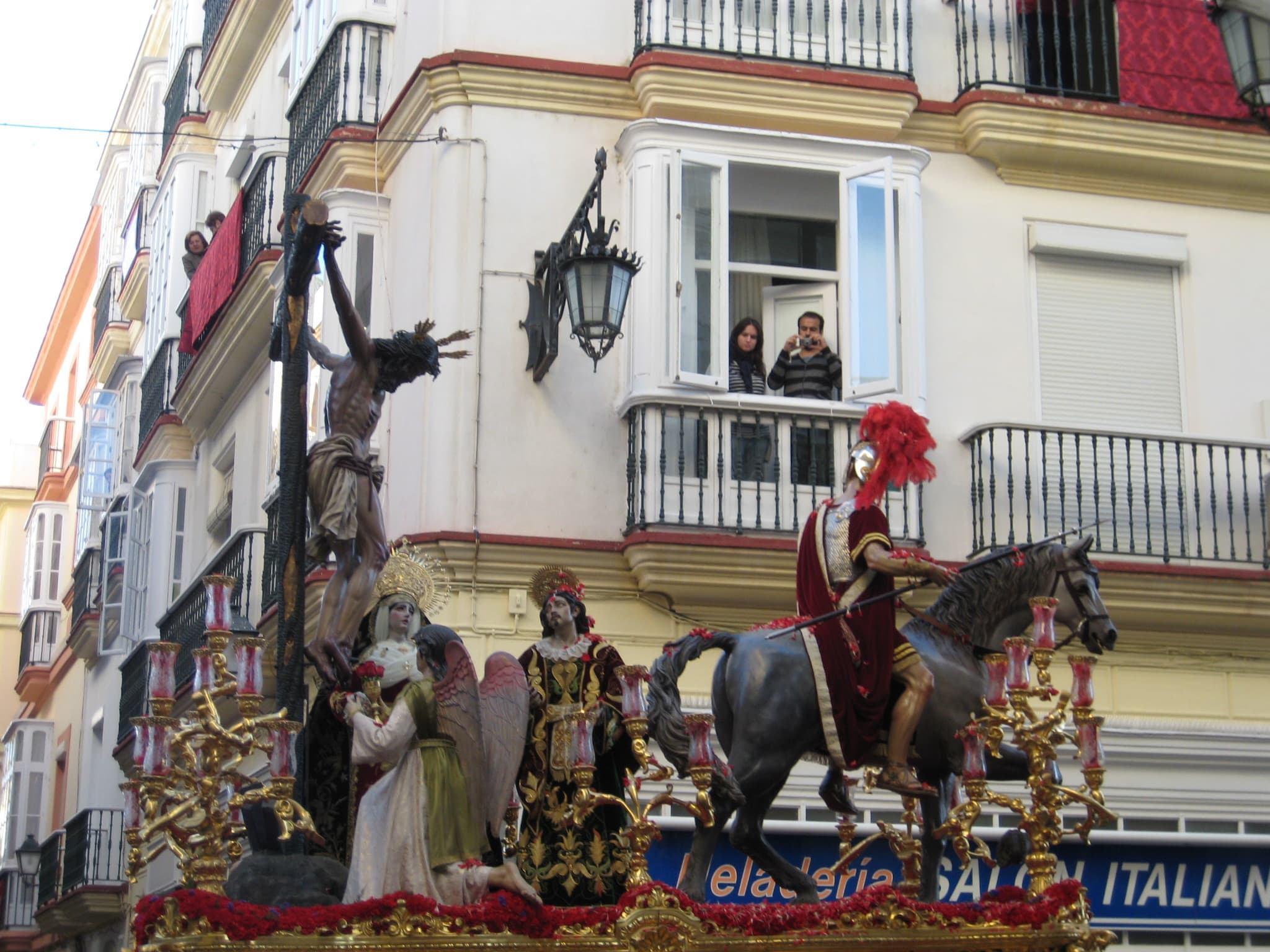
About 30 brotherhoods make their official penitential walk to Cádiz Cathedral, and the whole official route fits inside the old town: Calle Nueva, San Juan de Dios, Pelota and Plaza de la Catedral. The date moves every year, from Palm Sunday to Easter Sunday. Watching the processions from the street costs nothing.
When it falls and how to read the schedule
Semana Santa doesn't have a fixed date: it runs from Palm Sunday to Easter Sunday and shifts with Easter, so it can land in March or April depending on the year. That means last year's dates are useless — check the calendar for the specific edition at semanasantacadiz.com and turismo.cadiz.es, and wait for the program from the Consejo de Hermandades, which publishes which brotherhood processes on which day and the exact routes. Around 30 brotherhoods hold an official penitential procession in Cádiz, plus two vísperas confraternities and the Congregación Mariana Ecce Mater Tua. Practical tip: don't plan down to the minute. Published times slip constantly, and a procession "due at nine" can show up much later. Pick two or three viewing spots and accept you'll see less than you mapped out.
Cádiz isn't Seville (and isn't trying to be)
The comparison with Seville is unavoidable, so it's worth getting it right. Seville moves around 60 brotherhoods toward its cathedral, plus another 16 at vísperas, along wide axes — Campana, Sierpes, Plaza de San Francisco, Avenida de la Constitución — with official grandstands, private boxes and a seat market run by subscription. Cádiz is a different scale entirely: an old town of four neighborhoods (El Pópulo, Santa María, La Viña, El Mentidero) packed onto a narrow tombolo with zero room to expand, in one of Spain's densest cities. The narrowness of those streets is precisely what's credited with shaping the local pasos — narrow and notably tall. The result is a very neighborhood-scale Semana Santa, watched from a few feet away, with brotherhoods coming and going from tiny churches. Practical tip: if you're after massive crowds and grandstands, you've picked the wrong city. Here the value is proximity and silence, not volume.
Where to stand for free
Watching the processions from the street is free. Paid chairs and boxes exist along the official route, sold by subscription through the Consejo de Hermandades: if you're interested, ask the Consejo directly about deadlines and sales points, since these change every year and word-of-mouth prices aren't reliable. The core axis is Plaza de la Catedral, where brotherhoods enter through the main door after passing along Calle Nueva, San Juan de Dios and Pelota; they then exit via Arquitecto Acero, Compañía, the Túnel de Santiago, Plaza de la Candelaria and Calle Montañés up to Palillero. For smaller crowds, head to the neighborhood departures and arrivals: El Pópulo and Santa María, with their alleys and slopes, or Plaza de San Antonio and Calle Ancha. Practical tip: inside the official route at peak hours, getting out isn't quick — with small children, a stroller or reduced mobility, stick to the neighborhood stretches.
Eating, getting around, and a backup plan
These days the city eats vigil-style: torrijas and pestiños in the old town's bakeries, potaje and bacalao in the usual bars, and fried fish that never disappoints. Many bars in the old town swap their menu for the week, so don't assume the regular one applies. Getting there is easy without a car: Cádiz's train station sits right at the edge of the old town, served by the C-1 Cercanías line (Cádiz-Jerez-Sevilla) plus medium- and long-distance trains, alongside the metropolitan tram and Consorcio de la Bahía buses. Forget the car: the center closes to traffic along the procession routes, and the city council publishes the annual notice with closures and parking rules. Practical tip: processions get cancelled for rain without advance notice, so have an indoor backup — the Cathedral, museums, the market — and warm clothing: in March or April the levante wind and sea humidity make the night feel cold.
Frequently asked questions
Do you have to pay to watch the processions?
Which day is the most intense?
Can you go with children?
What happens if it rains?
Some links on this page are affiliate links: if you book through them, Andelaria may earn a commission at no extra cost to you. Transparency & affiliate policy
Book tickets and tours: Semana Santa de CádizPlan your trip
Book the essentials for your trip to Cádiz.
Other places in Cádiz
Catedral de Cádiz
catedralAn 18th-century Baroque-Neoclassical cathedral with a golden tiled dome, a symbol of Cádiz's maritime skyline. Composer Manuel de Falla is buried in its underground crypt. You can climb the Torre de Poniente for a panoramic view over the city and the Atlantic.
Torre Tavira
torreThe city's former watchtower and Cádiz's tallest tower, home to a camera obscura that projects the streets and monuments live onto a circular screen in real time. From its terrace you can pick out the roughly 130 watchtowers dotting the city's rooftops, a legacy of Cádiz's trading past with the Americas.
Playa de La Caleta
playaA small urban beach between the San Sebastián and Santa Catalina castles, the city's most iconic and the setting for a James Bond scene. Its fine sand, the Balneario de la Palma promenade and the sunset views make it a must, though it fills up fast in summer.
Castillo de Santa Catalina
castilloA star-shaped fortress built in the late 16th century after the Anglo-Dutch attack of 1596, standing right by La Caleta beach. Today it hosts temporary exhibitions and offers one of the best free viewpoints over the Atlantic and the old town.
Teatro Romano y Barrio del Pópulo
barrioCádiz's oldest quarter, with remains of the city's medieval gates (Arco de los Blancos, del Pópulo and de la Rosa) and, beneath its houses, the second-largest Roman theatre in Hispania, dating from the 1st century BC. Its narrow streets pack in more than three thousand years of urban history.
Mercado Central de Abastos
mercadoA neoclassical food market from 1838, one of Spain's oldest, ringed by a stone colonnade. Stalls selling fish and shellfish fresh off the bay, fried-fish counters and tapas bars make this market a living portrait of Cádiz's food culture.
Carnaval de Cádiz
fiestaCádiz Carnival is officially recognized as a Fiesta of International Tourist Interest, and it has nothing to do with float parades. Here, the coupla song rules. Two carnivals run in parallel: the official contest (COAC) at the Gran Teatro Falla, ticketed, and the street carnival, free and stageless, where the so-called "illegal" groups sing on any corner.
Similar places in other cities
Semana Santa de Sevilla
SevillaSeville's Holy Week is free and open to all: you only pay for seats and grandstands along the Official Route. In 2026 it runs from 29 March to 5 April, with the eve celebrations on the 27th. Its peak is La Madrugá, when five major brotherhoods process from 1:00 a.m. until noon.
Feria de Abril de Sevilla
SevillaTwo weeks after Easter, Sevilla sets up its Real in Los Remedios: around 1,059 casetas (up to ~1,250 plots with the expansion), flamenco dresses, horses and sevillanas. Entry is free, but most are private and only accessible with an invitation from a member. Only around 14–16 are open to the public.
Velá de Santiago y Santa Ana
SevillaSeville's oldest festival, with more than 750 years of history, doesn't take place in the city centre — it happens in Triana. The Velá de Santa Ana falls in the last week of July, around the 26th: free casetas along the Guadalquivir, the cucaña grease-pole contest over the river, and not a flamenco dress or equestrian parade in sight.