Arco da Vila
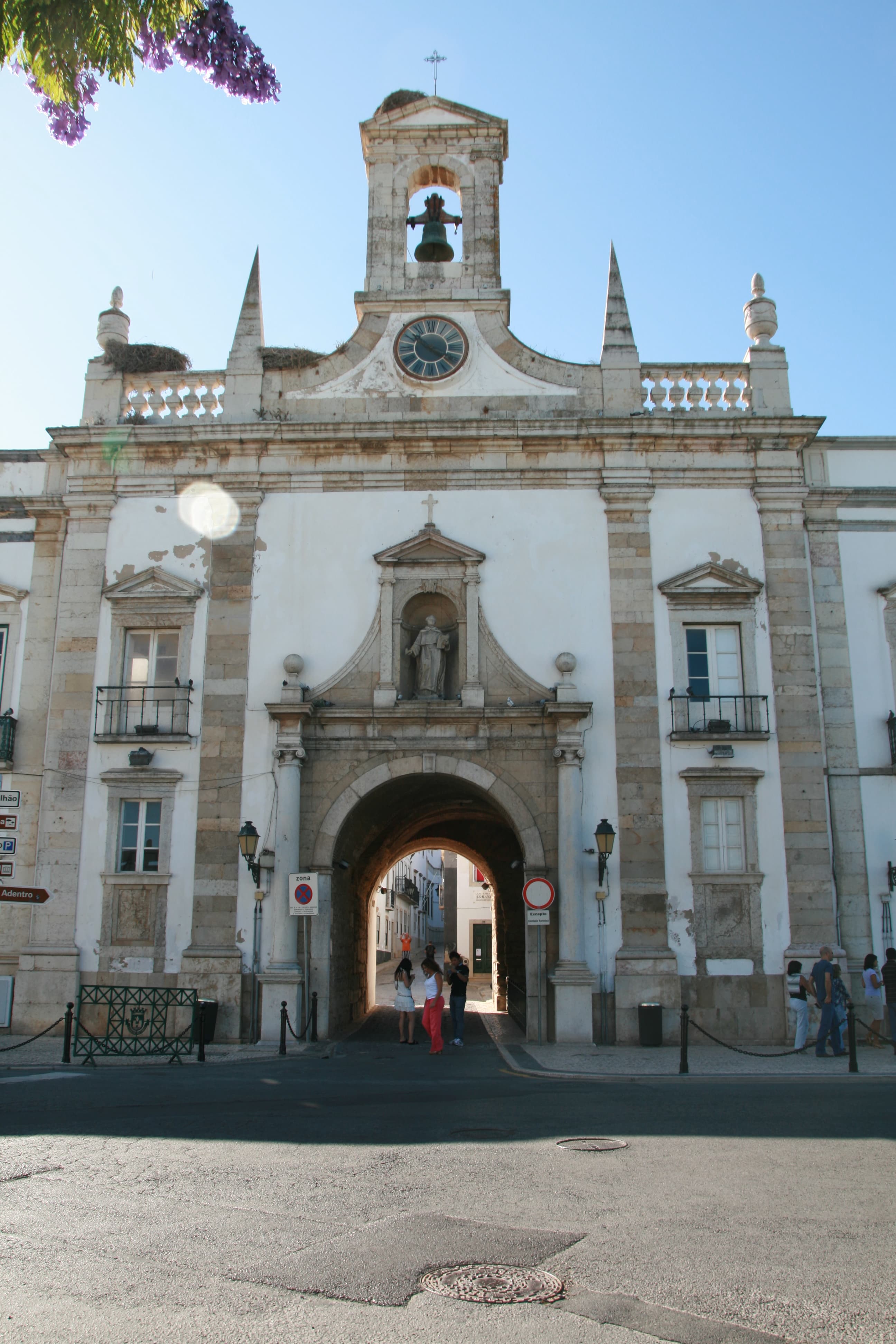
A monumental neoclassical marble gate built in 1812 over the remains of an old Arab gateway, the main entrance into Faro's walled Cidade Velha. A pair of storks — the city's symbol — regularly nests atop the arch. It marks the start of the pedestrian historic quarter.
What the Arco da Vila is and why it's worth the stop
The Arco da Vila is the monumental gate that leads into Faro's Cidade Velha, the walled old town that closes in on itself right next to the marina. It's not a museum, nor a monument with a set route through it — it's a threshold. You walk under it and the noise of the avenue, the terraces and the traffic vanish in an instant; on the other side, cobbled streets, whitewashed walls and the cathedral square wait for you. That two-second contrast is, honestly, the real reason it's worth it and why almost everyone stops right here for the photo.
Let's be clear about expectations: you won't spend the afternoon at the Arco da Vila. It's a passageway element, pretty and photogenic, built into what's left of the city walls. Its value lies in the whole: it works as the starting gate for a visit to old Faro, not as a standalone stop. If you've read that storks tend to nest at the top, that's an image closely associated with Faro's rooftops and monuments, but confirm it on the ground or with the tourist office before counting on it for your dates.
Tickets, hours, and when to avoid the crowd bottleneck
Since this is a pedestrian city gate you enter the old town through, there's no ticket booth or a set-in-stone paid indoor route: you see it and walk through it from the street. Even so, if you're traveling on a specific date and want to confirm prices, indoor access or any associated guided visit, check Faro's official tourism website or ask at the tourist office, which is very close by — schedules and rates change, and we don't want you relying on an old figure.
On crowds: there's no entry queue, but there is a photo bottleneck. The arch is narrow, and in high season groups and people coming from the marina pile up. Early morning is when it's most clear and the light is best; at sunset the stone takes on a warm, flattering tone, though there will be more people. Budget 5-10 minutes to see and photograph it, and follow straight on to the Sé de Faro and a walk along the walls.
How to get there and practical tips
Faro is a small, flat city, and that's the good news: the Arco da Vila is walkable from almost any useful point in the center. From Faro's train station and from the harbor/marina area, it's a short, flat walk along the Manuel Bivar garden toward the old town; you'll spot the arch before you even look for it. It's not worth taking a bus for this stretch — only check local lines and schedules if you're coming from outer neighborhoods or the airport.
Two tips from someone who's done it. One: don't visit it as a standalone stop — go in through it and come out through the Arco do Repouso or along the wall; the old town takes under an hour to cover fully, and that's when the arch makes real sense. Two: the cobblestones inside are uneven, so wear flat shoes. If you go in full summer, the stone radiates heat at midday, and shade is scarce inside the walled enclosure. And if you run into construction, scaffolding or a temporary closure — it's a historic feature restored in stages, so it's not unusual — check the current status with the tourist office before going too far out of your way.
Frequently asked questions
Do I need to pay for a ticket or book in advance to see the Arco da Vila?
How much time do I need to visit it?
What's the best time of day to go?
Some links on this page are affiliate links: if you book through them, Andelaria may earn a commission at no extra cost to you. Transparency & affiliate policy
Book tickets and tours: Arco da VilaPlan your trip
Book the essentials for your trip to Faro.
Other places in Faro
Sé Catedral de Faro
catedralA 13th-century Gothic-Renaissance cathedral built over a former Arab mosque, with a climbable bell tower offering views over the Ria Formosa and the old town. Inside, Baroque azulejos mix with a gilded organ and a small necropolis. It's Faro's most photographed monument.
Cidade Velha (Casco Antiguo de Faro)
barrioA walled neighbourhood of Arab and Roman origin, with cobbled streets, whitewashed buildings, the Sé Cathedral and the Paço Episcopal. Its medieval walls still ring part of the enclosure. It's the oldest and best-preserved historic core in the Algarve.
Igreja do Carmo y Capela dos Ossos
iglesiaAn 18th-century Baroque church with a gilded carved facade and, in its rear courtyard, the unsettling Capela dos Ossos, its walls covered with the bones and skulls of more than a thousand Carmelite monks exhumed in the 19th century. One of only two bone chapels in Portugal.
Parque Natural da Ria Formosa
parqueA system of lagoons, channels, dunes and barrier islands stretching along the coast at Faro, a key habitat for flamingos and the endangered Mediterranean chameleon. Boats leave from the harbour for sandy islands such as Ilha Deserta and Ilha de Faro. A nature reserve of internationally recognised importance.
Museu Municipal de Faro (Museu Arqueológico Infante D. Henrique)
museoHoused in the former 16th-century Convento de Nossa Senhora da Assunção, it holds the Roman Oceanus mosaic, artefacts from ancient Ossonoba and religious art. The Renaissance cloister is itself one of Faro's architectural gems.
Feira de Santa Iria
fiestaFaro's patron saint fair traces back to 1596, when the Earl of Essex sacked and burned the city, forcing it to bounce back with a tax-free open fair. It still runs at Largo de São Francisco in the second half of October: crafts, food stalls, loud rides, and free entry to the grounds.
FOLKFARO — Festival Internacional de Folclore
fiestaFOLKFARO is Faro's international folk festival: every August, Portuguese ranchos and guest groups from several countries fill the pedestrian baixa and the marina front with regional costumes, accordion and corridinho. Free access in the open spaces of the centre, parades in the late afternoon, and performances that kick off at night, never under the midday sun.
Festival F
fiestaFestival F takes over Faro's old town: the baixa and the walled Cidade Velha fill with named stages (Arco, Sé, Museu, Ria) in early September. It's a paid event — day or festival pass via Ticketline — and it bills itself as "o último grande festival de verão," Portugal's last big summer send-off.