Kursaal (Palacio de Congresos y Auditorio)
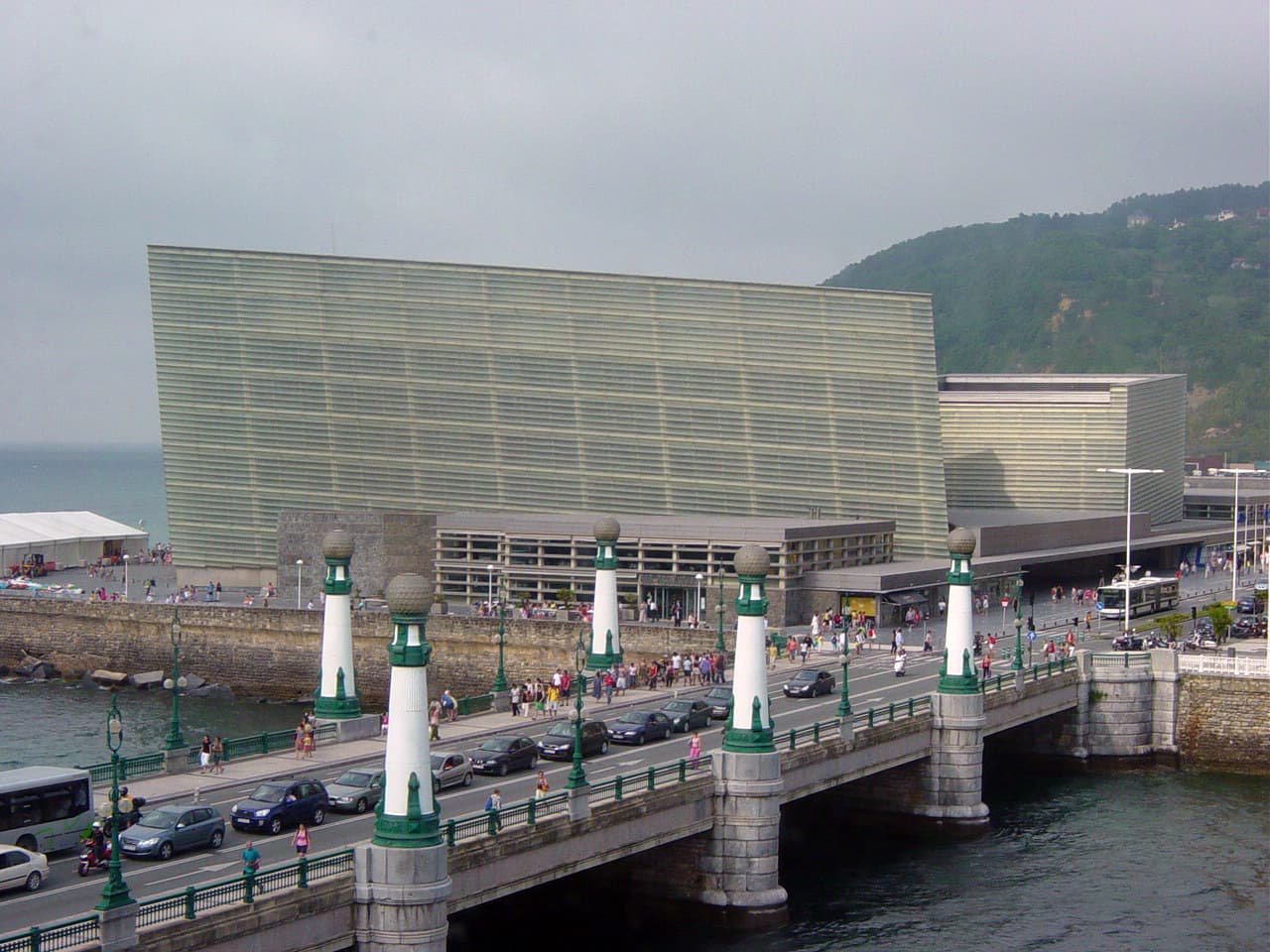
Two cubes of translucent glass designed by Rafael Moneo (1999) on the banks of the Urumea river, winners of the Mies van der Rohe Award. Home to the San Sebastián International Film Festival (one of the world's most prestigious) and the Quincena Musical. An icon of contemporary Spanish architecture, dramatically lit after dark.
The essentials
- Tickets
- Gratis (exterior)
Two stranded rocks at the mouth of the Urumea
The Kursaal makes no attempt to hide: two translucent glass cubes planted where the Urumea river meets the Bay of Biscay, beside the Zurriola beach. Rafael Moneo conceived them in 1989 as “two stranded rocks”, stones cast ashore by the sea, and that idea of engaging in dialogue with the geography rather than blending into it was what convinced the jury over proposals by Foster, Botta and Isozaki. The site had stood empty for 26 years (the Gran Kursaal of 1921 was demolished in 1973) until the building opened on 23 August 1999. In 2001 it won the Mies van der Rohe Award, the most important prize for contemporary architecture in Europe. Today it is home to the San Sebastián International Film Festival (Zinemaldia), the only Category A festival in Spain, and the Quincena Musical, the oldest classical music festival in the country. Over 300 events and 600,000 visitors a year make it one of the most vibrant cultural venues in northern Spain.
Entry is free: lobby, terraces and guided tours
Here’s the good news: visiting the lobby and public areas is free and open access when no event is on, typically 10:00–20:00 on days without major programming. There are also free guided tours (~60 min, covering the auditoriums and exhibition spaces) that take you through the building, but they require advance booking — mandatory — by email (tickets@kursaal.eus) or phone (943 003 000); without a reservation your place is not guaranteed. For concerts, film screenings or conferences, prices vary by event and tickets can be bought at kursaal.eus or taquilla.com. To avoid groups and corporate events, visit on a weekday morning (10:00–12:00). And a key warning: around the Film Festival (September) and the Quincena Musical (August, 87th edition, 2–30 August 2026) the building restricts free access, so check kursaal.eus before you show up.
Getting there and tips from those who’ve been
The address is Zurriola Hiribidea 1, 20002 Donostia. San Sebastián has no metro or tram: the only urban public transport is the DBUS bus network, and lines 17, 29, 31 and 40 stop nearby (info at dbus.eus or the Dbus app). On foot it’s 15–20 minutes from the Old Town or from Renfe/Atotxa station, a pleasant walk along the river. If you come by car, the building has its own underground car park with 500 spaces. For the exterior and lobby alone, allow 20–30 minutes. The tip that’s really worth it: come back at dusk and watch the illuminated cubes from the bank of the Urumea or from Zurriola beach; the 1,500 m² LED screen on the west facade (one of the largest in Europe) amplifies the effect and is the best photo moment at the Kursaal. The building is fully accessible (ramps, lifts, adapted toilets, induction loop) and there is free Wi-Fi in common areas. The lobby café opens during normal hours.
Frequently asked questions
How much does it cost to enter the Kursaal?
How long do I need to visit?
What is the best time to visit?
Some links on this page are affiliate links: if you book through them, Andelaria may earn a commission at no extra cost to you. Transparency & affiliate policy
Book tickets and tours: Kursaal (Palacio de Congresos y Auditorio)· Gratis (exterior)Plan your trip
Book the essentials for your trip to San Sebastián.
Other places in San Sebastián
Playa de la Concha
playaThe most beautiful urban beach in Europe, with its unmistakable shell-like shape and the elegant 2 km Paseo de la Concha. Flanked by Monte Urgull and the island of Santa Clara, it offers fine sand, calm waters and postcard-perfect views of Palacio Miramar. The absolute symbol of Donostia and the epicentre of Basque summer life.
Parte Vieja (Casco Histórico)
barrioA labyrinth of medieval streets rebuilt after the fire of 1813, home to the world's highest concentration of pintxos bars per square metre. The gastronomic and festive heart of Donostia: Plaza de la Constitución — with the numbered balconies of the former bullring — and the Basílica de Santa María are its architectural jewels.
Monte Urgull y Castillo de la Mota
castilloA 123 m hill crowning the old town, topped by the Castillo de la Mota (12th century) and a monumental statue of the Sacred Heart (11 m). Paths through gardens and cannon batteries lead to viewpoints with panoramic views over La Concha bay and the port. Free entry all year round.
El Peine del Viento
monumentoThree Corten steel sculptures by Eduardo Chillida (1977) anchored in the rocks at the far end of Ondarreta beach, where the city merges with the Cantabrian Sea. Architect Luis Peña Ganchegui designed the surroundings with granite paving and water jets that emerge with the tides. The defining masterpiece of 20th-century Basque art.
Monte Igueldo
miradorAt 181 m altitude, this offers the most spectacular views of La Concha bay and the Cantabrian horizon. You reach the top on the 1912 wooden funicular, one of the oldest in the Basque Country. At the summit, a charming century-old amusement park rounds off the experience. An unmissable stop at sunset.
Tamborrada de San Sebastián (Danborrada)
fiestaLa Tamborrada is Donostia's patron festival: every January 20th — a fixed date, never moved — the entire city beats drums and barrels for exactly 24 hours, midnight to midnight. More than 176 adult comparsas (+20,000 people) march through every neighbourhood. UNESCO Intangible Cultural Heritage (2018). Free and open to all.
Festival Internacional de Cine de San Sebastián (Zinemaldia)
fiestaZinemaldia is Spain's most prestigious film festival and the only one with FIAPF Category A status, alongside Cannes, Venice and Berlin. Every third or fourth week of September, San Sebastián awards its Golden Shell. Watching the red carpet is free; screenings are ticketed, with seats from around €8.75 per session.
Aste Nagusia — Semana Grande de San Sebastián
fiestaAste Nagusia is the main festival of Donostia-San Sebastián, held around 15 August (Assumption Day). In 2026 it runs from 8 to 15 August — nine free days that kick off with the cannon shot in Alderdi Eder. Its global trademark: the International Fireworks Competition, drawing ~90,000 people each night over La Concha bay.
Similar places in other cities
Museo del Prado
MadridSpain's most important painting museum holds more than 8,000 works on display, among them Velázquez's Las Meninas, Bosch's The Garden of Earthly Delights and Goya's cartoons. Juan de Villanueva's neoclassical building, opened in 1819, is itself a monumental piece of architecture on the Paseo del Arte.
Museu del Cau Ferrat
SitgesSantiago Rusiñol's house-studio, a Modernist gem with works by El Greco.
La Lonja de la Seda
ValenciaA masterpiece of Valencian civic Gothic, declared a UNESCO World Heritage Site in 1996. Built between 1482 and 1548 as the city's silk-trading exchange, its Sala de Contratació — with 16 helical columns rising 16 metres — still impresses. Free entry on Sundays and public holidays.