Alentejo · España
Évora
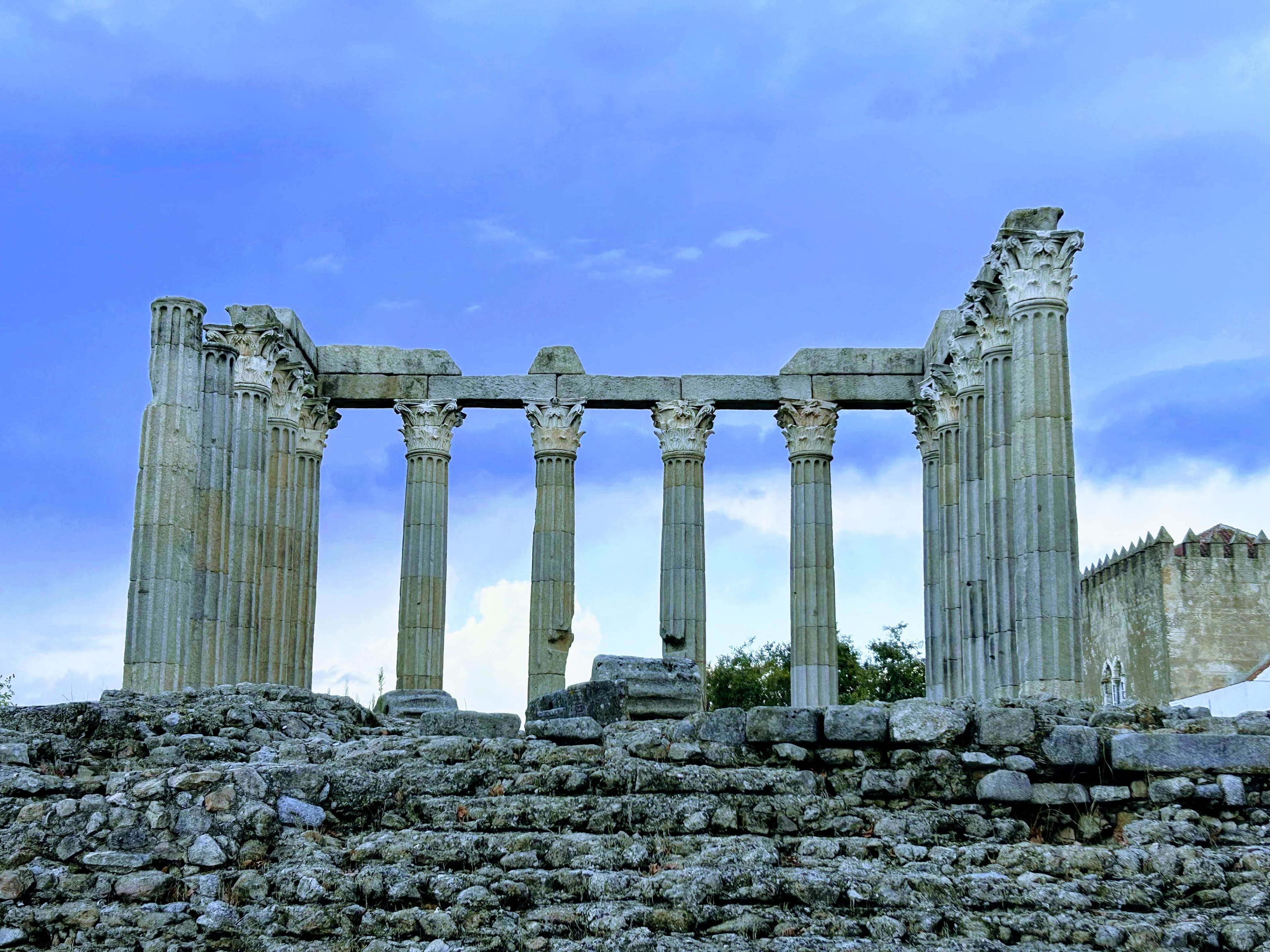
Walled Alentejo city with a Roman temple, the Capela dos Ossos and an aqueduct with houses built right into its arches.
By Brandon Quiroz · Verified by the Andelaria editorial team
The essentials
- Best time
- February
- Cost per day
- 97€/día
- Must-see
- Templo de Diana
About Évora
Évora fits entirely inside a city wall, and that's the first useful thing to know: you can cover it on foot in two days without ever boarding a bus. From Praça do Giraldo, where everyone ends up for that first bica (0.80–1.20 €), the streets climb toward the high point of the city, where the Temple of Diana, the Sé and the Palácio dos Duques de Cadaval sit literally less than a hundred metres apart. The Roman temple has no entry fee or opening hours — it's outdoors, and at sunset people pile onto the low wall opposite. The Sé does charge (2 € for the cathedral alone, up to 4.50 € with the cloister, terrace and museum), and the terrace is what makes the ticket worth it: from up there you look down on the Roman columns and out over a sea of rooftops toward the flat Alentejo.
The Capela dos Ossos, inside the Igreja de São Francisco, is the most photographed spot in town and also the most unsettling one: walls lined with the bones of around 5,000 skeletons, plus that inscription at the entrance reminding you that those inside are waiting for those outside. Queues build up in high season, so go early. Less crowded, and rarely mentioned in guidebooks: the Aqueduto da Água de Prata, which enters the city along Rua do Cano and ends with houses wedged between its arches — people living under a 16th-century aqueduct. The Universidade de Évora, housed in the Colégio do Espírito Santo, costs just a few euros to visit and is worth it for the azulejo-tiled classrooms, which are still used for teaching today.
Heat is the big constraint here. July and August push past 33°C, and by midday the city empties out because there's no shade on the squares. The months that work are April, May, June, September and October: 20–31°C depending on the month (April/October milder; June/September already around 29–31°C) and little rain. June brings the Feira de São João, the big festival, when the city fills with Alentejo locals. And watch out for 2027: Évora is European Capital of Culture, so hotel prices (currently 55–105 € for a double) are set to move.
Guides to plan your trip
How much does a trip to Spain cost
A mid-range trip runs about €90–150 per person per day with a shared hotel; budget style, €50–70. Real breakdown of hotel, food, transport, and entry fees.
Best time to visit Spain
May and October offer the best balance: 19–21 °C and fewer crowds. Summer is hot (interior above 40 °C), winter is cheap. A month-by-month guide based on
When to go
Best time to visit: February
Best avoided: June, August, September
Temperature, rainfall and crowds month by month.
| Month | Temp. | Rain | Crowds | Suitability |
|---|---|---|---|---|
| January | 14.5°C | 84 mm | Low | 64 |
| February | 16°C | 78 mm | Low | 75 |
| March | 18.5°C | 55 mm | Medium | 66 |
| April | 20.5°C | 55 mm | High | 57 |
| May | 24°C | 45 mm | High | 53 |
| June | 29°C | 20 mm | High | 43 |
| July | 33°C | 4 mm | Medium | 45 |
| August | 33°C | 5 mm | Medium | 44 |
| September | 28°C | 25 mm | High | 40 |
| October | 22°C | 75 mm | High | 47 |
| November | 17°C | 85 mm | Low | 71 |
| December | 14.5°C | 95 mm | Medium | 46 |
Suitability (0-100) computed from temperature, rainfall, crowds and events.
Festivals & events
Feira de São João de Évora
2026-06-23 → 2026-07-05
Évora's biggest fair has run since 1569, when it was the livestock market that set prices across the Alentejo. Today it's roughly two weeks of tasquinhas (food stalls) and free concerts on the Rossio de São Brás, just outside the walls. Entry is free to the whole site, shows included.
Festival Imaterial
Imaterial is Évora's intangible heritage and world music festival, run by the Município together with the Fundação Inatel under the motto "Pensar e Viver o Património" (Thinking and Living Heritage). It takes place in mid-to-late May in the Jardim Público. Talks and workshops are free; the evening concerts are ticketed, sold as double bills.
Apertura de Évora 2027, Capital Europea de la Cultura
2027-02-06 → 2027-02-06
The official countdown (running since 6 February 2026) to the year Évora becomes European Capital of Culture 2027, with a cultural programme building through 2026.
Browse by category
What to see & where to eat
Templo de Diana
temploThe best-preserved Roman temple on the Iberian Peninsula, dating from the 1st century and dedicated to the imperial cult (most likely Augustus, despite the popular name). It survived because it was absorbed into a castle during the Middle Ages. Its 14 Corinthian columns, right in the historic centre, are Évora's most photographed sight.
Sé de Évora (Catedral)
catedralPortugal's largest medieval cathedral, built between 1280 and 1340, blending Gothic with late Romanesque and featuring two asymmetrical towers. Entry to the cathedral alone costs 2 €; adding the cloister, panoramic terrace and museum brings it up to 4.50 €. You can climb the bell tower via a 135-step spiral staircase to a terrace with views over the whole Alentejo.
Capela dos Ossos
capillaAttached to the Igreja Real de São Francisco, its walls and columns are covered with the bones and skulls of around 5,000 people, the work of 17th-century Franciscan monks. Above the door, an inscription warns: 'Nós ossos que aqui estamos, pelos vossos esperamos' ('We bones here await yours'). The ticket (6–7 €, free under 12) includes the museum core, the nativity-scene (presépios) gallery and the panoramic terrace.
Praça do Giraldo
plazaÉvora's living room since the 16th century, anchored at one end by the Igreja de Santo Antão and its eight-spout marble fountain. Ringed by arcades, cafés and shops, it once hosted Inquisition autos-da-fé and is now the starting point for any walk through the historic centre.
Aqueduto da Água de Prata
acueductoAn 18-kilometre aqueduct built in the 16th century by the architect Francisco de Arruda — the same behind the Torre de Belém — to supply the city with water. Its most photogenic stretch runs along Rua do Cano, where the arches have been built directly into the fronts of the houses.
Universidade de Évora (Colégio do Espírito Santo)
universidadFounded in 1559 by the Jesuits, it's Portugal's second-oldest university after Coimbra. Its two-storey Renaissance cloister and 18th-century azulejo-lined classrooms, including the famous 'Sala dos Actos', can be visited while it continues to function as an active university; entry (3 €) is usually free outside the 25 July–31 August period.
Some links on this page are affiliate links: if you book through them, Andelaria may earn a commission at no extra cost to you. Transparency & affiliate policy
Book experiences and tours in ÉvoraAverage prices
Approx. cost: ~97 €/day · Moderate
| Item | Price |
|---|---|
| Hotel (per night) | 55-105 € aprox. (doble, temporada media) |
| Set lunch menu / meal | 12–18 € |
| Coffee (bica) | 0,80–1,20 € |
| City bus (Trevo, single ticket) | 1,30-1,50 € aprox. (verificar en Trevo) |
| Lisbon–Évora coach (one way) | desde ~4-6 € con antelación, habitual 10-13 € (tarifa dinámica, consulta la web oficial) |
| Cathedral (Sé) ticket + cloister/terrace | 2-4,50 € según recorrido |
1-day estimate (1 person): hotel night + set menu + 2 coffees + 1 beer.
Getting there
- There's no direct high-speed rail to Évora. From Lisbon (Oriente): CP runs about 9 direct trains a day, roughly 1h25min, 108 km, tickets from about 7 € (booked ahead) up to around 13 € on average; schedule in effect since 14 December 2025. From Madrid or Barcelona there's no direct train: you need to reach Lisbon first (high-speed train or flight) and connect with the CP regional train to Évora.
- From Lisbon via the A6, about 130 km, 1h15–1h30min. From Madrid, about 480 km via the A5/A6 (roughly 5 hours). A good option for combining with other Alentejo towns.
- The historic centre (inside the walls) is largely restricted-traffic or pedestrian; there are paid car parks around the perimeter (for example near the Jardim Público and close to the town gates) and metered on-street parking zones.
Plan your trip
Book the essentials for your trip to Évora.
Book your visit
Frequently asked questions
How many days do you need to see Évora?
What's the best time of year to visit Évora?
Is the Capela dos Ossos worth visiting?
How do you get around Évora?
When is the best time to visit Évora?
How much does it cost to visit Évora per day?
More destinations
- Centro
Coimbra
Portugal's oldest university (a UNESCO World Heritage Site), the Biblioteca Joanina, Coimbra-style fado and the Mondego River.
- Andalucía
Sevilla
The Real Alcázar, the Cathedral with La Giralda, the flamenco of Triana, and two festivals that define it: Semana Santa and the Feria de Abril.
- Andalucía
Cádiz
Carnival and its chirigotas, an old town wrapped in sea, the fried-fish joints of La Viña, and the camera obscura at the Torre Tavira.
- Andalucía
Córdoba
The Mosque-Cathedral with its forest of columns, the former capital of the Umayyad caliphate, and the flower-filled patios of May.
- Andalucía
Ronda
The Puente Nuevo over the Tajo, a gorge more than 100 m deep that splits the city in two, and its historic bullring
- Castilla-La Mancha
Toledo
City of the Three Cultures on a hill wrapped by the Tagus: a Gothic cathedral, the Sephardic Judería, and the Toledo of El Greco.