Aste Nagusia (Semana Grande de Bilbao)
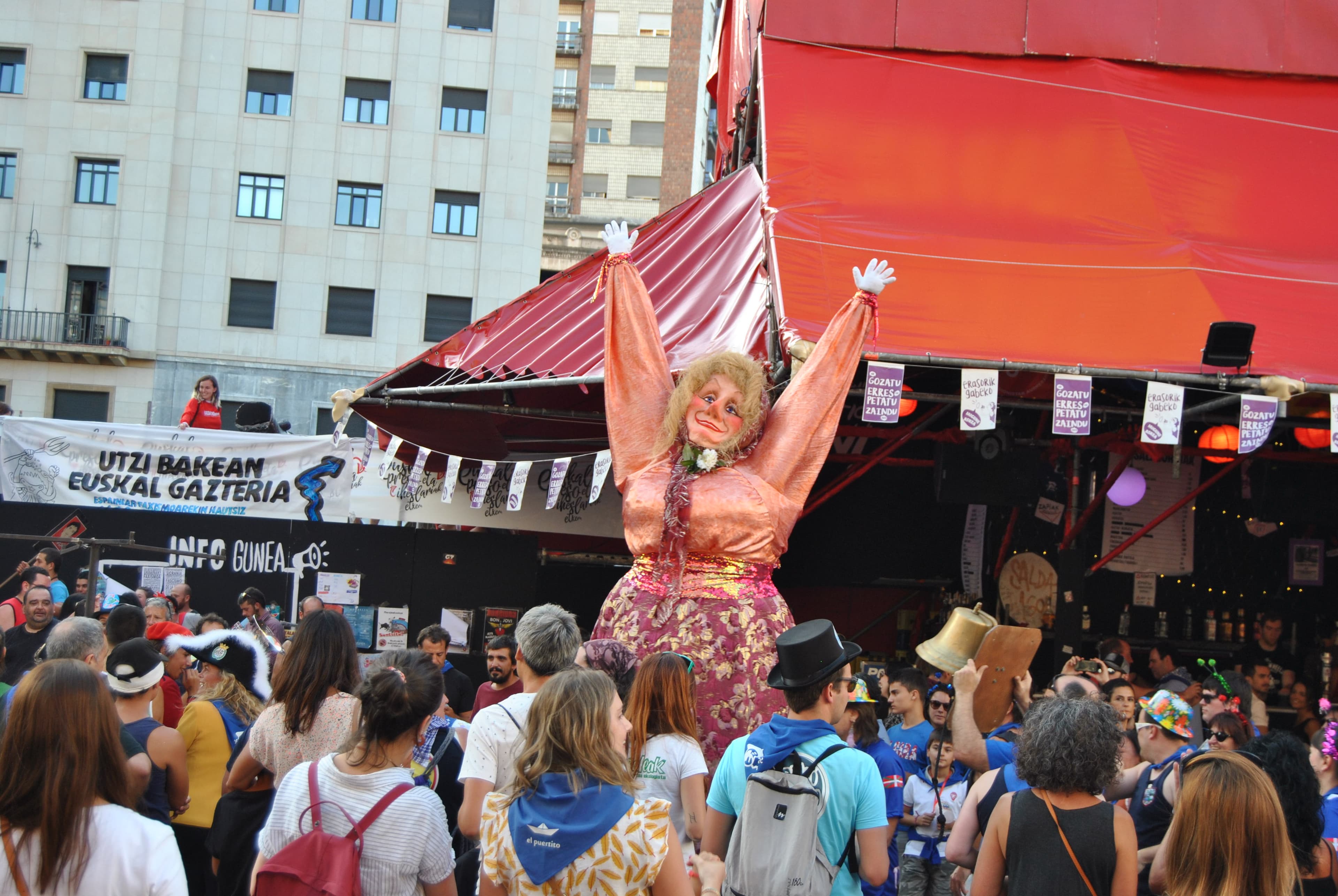
Nine days of free street partying in August, no fenced-off venue required: Aste Nagusia kicks off the first Saturday after August 15th with the txupinazo in front of Teatro Arriaga and ends by burning Marijaia. Over 100 free performances across eight stages and fireworks every night over the estuary.
What it is and why it exists
Aste Nagusia (Semana Grande, or "Great Week") is Bilbao's main festival, celebrated without a break since 1978, when a group of neighbors and comparsas (festival crews) reinvented from scratch a celebration that Franco's regime had reduced to little more than official ceremonies and bullfights. That origin explains why the festival looks so little like a typical festival: there's no fenced venue, no ticket, and the program is driven by the comparsas, not a promoter. It runs for nine days in August, from the Saturday after the 15th through the following Sunday (in 2026, August 22 to 30). Critical tip: don't confuse it with San Sebastián's Semana Grande, a different city and a different event entirely; for dates or the lineup, always check Bilbao's official website rather than aggregators, since the calendar shifts every year depending on which day of the week the 15th falls on.
Marijaia and the nine-day arc
Everything revolves around Marijaia, the giant doll with arms raised who appears on the Teatro Arriaga balcony on the first Saturday during the txupinazo (opening rocket), and who goes up in flames on the final Sunday. Between those two bookends, the rhythm stays the same: quiet mornings, comparsa-filled afternoons, and long nights. If you can only make it one day, pick one: the first Saturday for the opening energy, or the last Sunday for the send-off. Critical tip: the txupinazo packs a huge crowd into the small square in front of the Arriaga, under the August heat with almost no shade. Arrive well ahead of time or watch from the surrounding streets rather than pushing into the core of the crowd; with kids or a stroller, skip that spot and that hour altogether and join the atmosphere later, further down the street.
Where the real atmosphere is
The street pulse is in the Casco Viejo (the Siete Calles, or Seven Streets) and Plaza Nueva, where the comparsas set up their txoznas: stalls run by peñas like Bilbo Zaharra or Ahusgarratz serving pintxos, kalimotxo, and small beers at neighborhood prices. That's where the week's most useful money-saving tip kicks in: ordering at a txozna or a regular local bar instead of the tourist terrace next door can mean paying 3 euros instead of 9 for the exact same thing. Critical tip: Plaza Nueva and its surroundings act as an echo chamber, and the noise doesn't die down until very late, so if you're sleeping in the Casco Viejo during these nights, accept that you won't get much rest. If you're traveling with someone who needs quiet, book on the other side of the estuary.
Concerts, fireworks, and getting around
Over a hundred free music performances are spread across eight stages, including Bilborock, Parque Europa, Abandoibarra, Plaza de la Convivencia, and the Pérgola de Doña Casilda; the occasional paid concert pops up outside the official program, but the core of it is free. Fireworks light up the estuary every night, and the bridges — the Ayuntamiento bridge and the Zubizuri — are the natural viewpoints, so they fill up well before showtime. Critical tip: skip the car. The Casco Viejo closes to traffic, and the metro and Bizkaibus add extra service on those nine nights (check schedules at metrobilbao.eus and bizkaibus, since the special timetable only covers the festival period). Take the metro to Casco Viejo and walk from there. Accommodation is the first thing to sell out: book months ahead.
Frequently asked questions
When does Aste Nagusia take place?
Do you need a ticket to get in?
Where's the best spot to watch the fireworks?
Is it worth staying in the Casco Viejo?
Some links on this page are affiliate links: if you book through them, Andelaria may earn a commission at no extra cost to you. Transparency & affiliate policy
Book tickets and tours: Aste Nagusia (Semana Grande de Bilbao)Plan your trip
Book the essentials for your trip to Bilbao.
Other places in Bilbao
Museo Guggenheim Bilbao
museoThe most photogenic building of the 20th century: Frank Gehry clad it in 24,000 titanium panels that shift color with the light. Since 1997 it has housed contemporary art by Koons, Serra and Bourgeois. The spider sculpture Maman at the entrance stands 9 meters tall. Free for under-18s.
Casco Viejo (Siete Calles)
barrioFounded in the 14th century by Diego López de Haro, the medieval maze of the Siete Calles is Bilbao's beating heart: pintxos on Calle Somera, markets, the Catedral de Santiago and the Plaza Nueva. A pedestrian zone since 1979. Free access.
Mercado de la Ribera
mercadoEurope's largest covered market: 10,000 m² beside the Puente de San Antón, opened in 1929 to an Art Deco design by Pedro Ispizua. Three floors with 60 stalls selling fresh fish, produce and pintxos — perfect for an authentic local lunch.
Puente Colgante de Vizcaya
puenteThe world's first transporter bridge (1893), a UNESCO World Heritage Site since 2006. Designed by Alberto de Palacio, a disciple of Eiffel, it spans the Nervión estuary at 45 m, linking Getxo and Portugalete. Riding the pedestrian gondola costs about €8.
Puente Zubizuri
puente"White bridge" in Basque: a pedestrian footbridge designed by Santiago Calatrava in 1997. Its glazed arch over the Nervión is a symbol of Bilbao's urban transformation. Crossing is free and offers the best views toward the Guggenheim and the Isozaki towers.
Museo de Bellas Artes de Bilbao
museoOne of Spain's finest museums: 10,000 pieces spanning the 12th century to today, including El Greco, Goya, Murillo, Sorolla and Francis Bacon. Founded in 1914 next to the Parque de Doña Casilda. Undergoing expansion works in 2026; partial free access.
Bilbao BBK Live
fiestaBBK Live isn't a free street party—it's a private, ticketed festival on Mount Kobetamendi, technically within Bilbao but well outside the city center. The 20th-anniversary edition landed on July 9-11, 2026, with 12 stages and over 80 acts. Check the official site for dates and lineup.
Feria de Santo Tomás de Bilbao
fiestaEvery December 21st, without fail, Bilbao's Old Town turns into a farmers' market: the Santo Tomás Fair. Free entry, centered on the arcades of Plaza Nueva and the El Arenal area, and a very long line for talo with chorizo washed down with cider or txakoli.
Similar places in other cities
Tamborrada de San Sebastián (Danborrada)
San SebastiánLa Tamborrada is Donostia's patron festival: every January 20th — a fixed date, never moved — the entire city beats drums and barrels for exactly 24 hours, midnight to midnight. More than 176 adult comparsas (+20,000 people) march through every neighbourhood. UNESCO Intangible Cultural Heritage (2018). Free and open to all.
Festival Internacional de Cine de San Sebastián (Zinemaldia)
San SebastiánZinemaldia is Spain's most prestigious film festival and the only one with FIAPF Category A status, alongside Cannes, Venice and Berlin. Every third or fourth week of September, San Sebastián awards its Golden Shell. Watching the red carpet is free; screenings are ticketed, with seats from around €8.75 per session.
Aste Nagusia — Semana Grande de San Sebastián
San SebastiánAste Nagusia is the main festival of Donostia-San Sebastián, held around 15 August (Assumption Day). In 2026 it runs from 8 to 15 August — nine free days that kick off with the cannon shot in Alderdi Eder. Its global trademark: the International Fireworks Competition, drawing ~90,000 people each night over La Concha bay.