Palácio Nacional da Pena
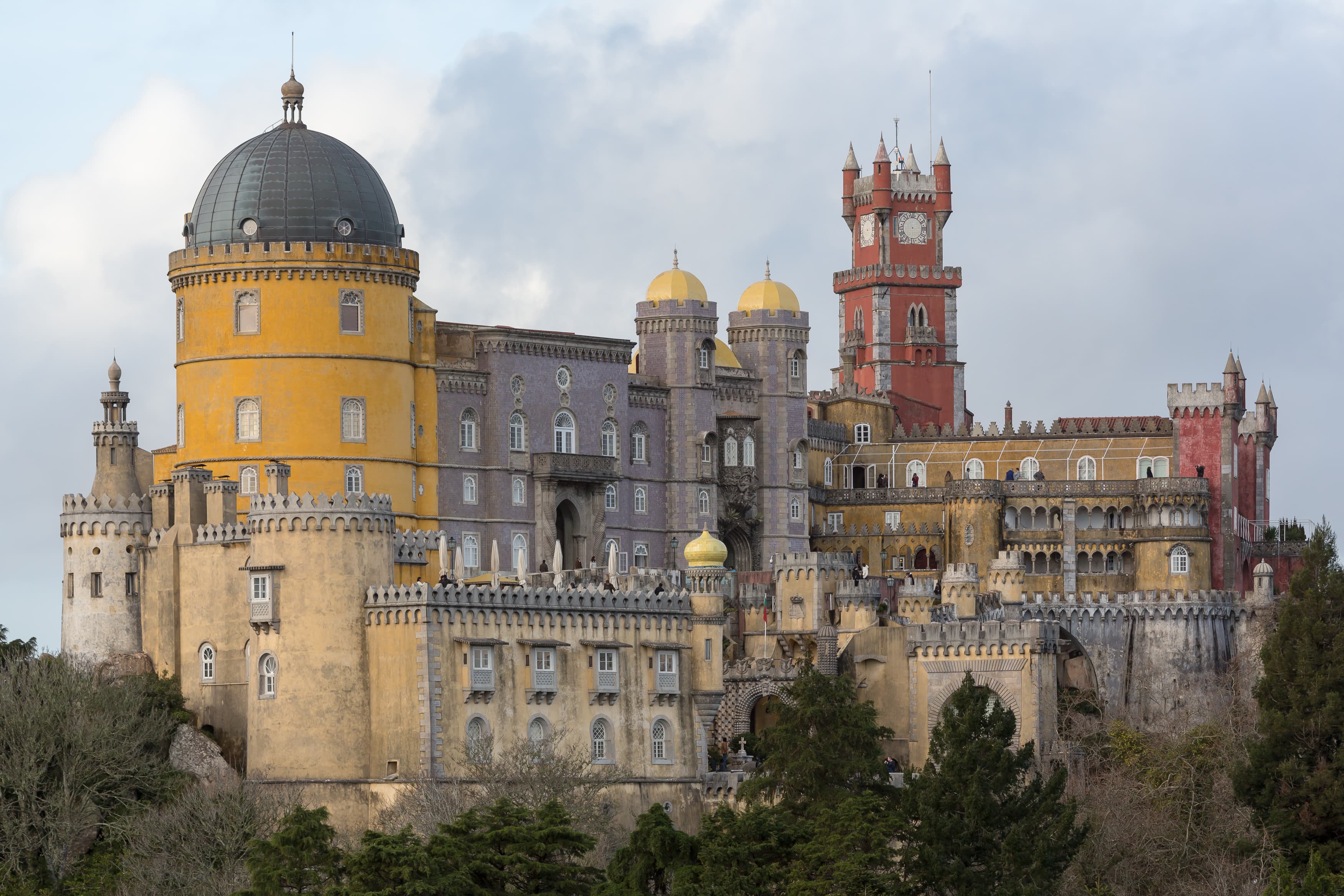
A Romantic palace commissioned by King Fernando II and completed around 1854 on a hilltop in the Serra de Sintra.
From a Hieronymite convent to Fernando II's folly
Where the yellow and red walls gleam today there stood first a twelfth-century hermitage dedicated to Nossa Senhora da Pena and, from the reign of Manuel I, a monastery of the Order of Saint Jerome. The 1755 earthquake left it in ruins. In 1838, the prince consort Fernando II bought the convent, the surrounding Serra and the nearby Castelo dos Mouros with his personal fortune. Between 1842 and 1854 he raised the new palace alongside German architect Wilhelm Ludwig von Eschwege, Baron of Eschwege, incorporating the old monastic structure into a summer residence for the royal family. UNESCO inscribed it as part of the Cultural Landscape of Sintra in 1995.
Battlemented terraces, the triton arch and the Manueline cloister
The route deliberately blends Neo-Gothic, Neo-Manueline, Neo-Moorish and Neo-Renaissance elements — the eclectic, exotic taste that Romanticism craved. You pass under the triton arch set above a shell, walk the battlemented terraces with views over Lisboa and the Atlântico, and enter the Manueline cloister preserved from the old convent. Inside, the royal apartments contain their original furnishings, the copper kitchen and the chapel with its alabaster altarpiece. Around the palace, Fernando II's park brings together sequoias, ferns and camellias gathered from across the globe.
Timed entry, bus 434 and the best time to visit
Entry to the interior is by timed slot with a 30-minute access window, so it is worth buying your ticket the day before. A combined ticket (park and palace) costs around 20 euros and a park-only ticket around 12. Open daily 9:30–18:30, with last entry at around 18:00. From Sintra station, bus 434 (Circuito da Pena) runs every 15 minutes for around 7,60 euros return; going first thing avoids the queues and tour groups. Allow two to three hours to see the palace and park at a relaxed pace.
Frequently asked questions
Do you need to book tickets in advance?
How long does the visit take?
How do you get there without a car, and is it very hilly?
Some links on this page are affiliate links: if you book through them, Andelaria may earn a commission at no extra cost to you. Transparency & affiliate policy
Book tickets and tours: Palácio Nacional da PenaPlan your trip
Book the essentials for your trip to Sintra.
Other places in Sintra
Castelo dos Mouros
castilloA castle built by the Moors between the 8th and 9th centuries, conquered by Afonso Henriques in 1147 following the capture of Lisboa.
Quinta da Regaleira
jardinAn early-twentieth-century estate belonging to Carvalho Monteiro, designed by architect Luigi Manini and famous for its spiral initiatic well some 27 metres deep.
Palácio Nacional de Sintra
palacioA former royal residence, recognisable by its two enormous conical chimneys of around 33 metres that rise above the medieval kitchens.
Palácio de Monserrate
palacioA Romantic palace built between 1858 and 1864 for the wealthy Francis Cook, blending Gothic, Indian and Moorish styles.
Festas de Sao Pedro de Sintra
fiestaThe Festas de São Pedro de Sintra are the town's biggest local celebration, free to attend and held around 28–29 June in honour of São Pedro, patron of the freguesia of São Pedro de Penaferrim. At its heart is the Feira de São Pedro, one of Portugal's oldest traditional fairs, with arraial, sardinha assada and a religious procession.
Festival das Noites de Sintra
fiestaThe Sintra Festival is Portugal's oldest music festival: born in 1957 as the Jornadas Musicais de Sintra, it fills the UNESCO-listed palaces and churches of Sintra with classical music every June. It is a ticketed event, with entries available through Ticketline, plus a handful of free concerts with limited capacity. Check dates and the full programme on the official website.
Feira do Artesanato de Sintra
fiestaThe Feira de Artesanato de Sintra is a free municipal craft fair that the Câmara de Sintra organises in August in the Jardim da Correnteza, next to the Vila Velha. It brings together artisans from the concelho with handmade pieces: ceramics, cork and embroidery. Free entry, open morning to afternoon. Check dates and the programme on the official website.